
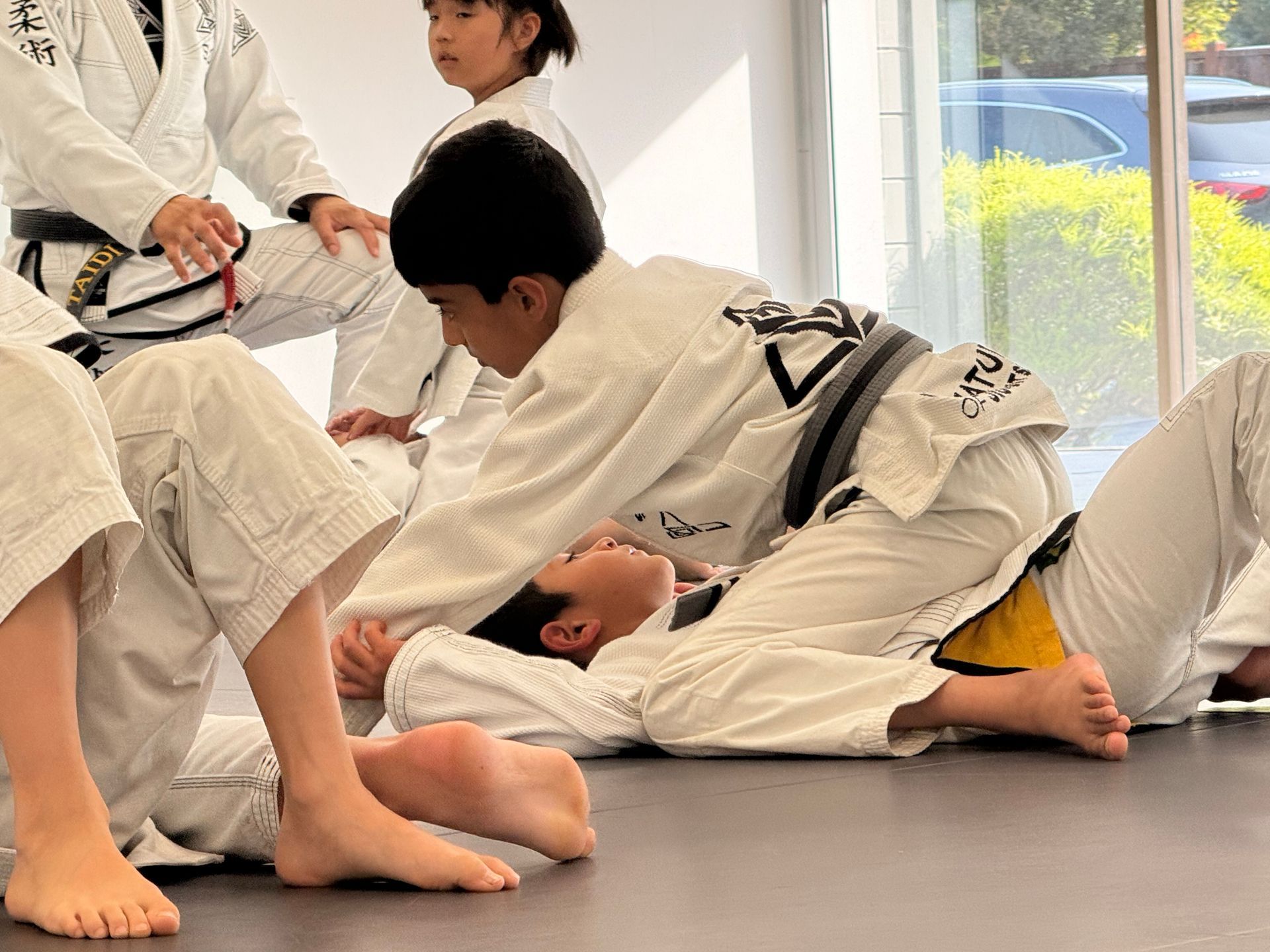
Youth Jiu-Jitsu turns busy energy into calmer focus, stronger bodies, and everyday confidence you can actually see at home.
If you live in Belmont, you already know how much energy kids can carry into a normal weekday. One minute it is bouncing off the couch, the next it is restlessness at homework time, and somehow screen time quietly grows because it feels like the easiest off switch. Youth Jiu-Jitsu gives that energy a better place to go, and we see the difference when kids train consistently.
Youth Jiu-Jitsu is also growing fast for a reason. Around 11 million people practice Brazilian Jiu-Jitsu worldwide, including about 2.3 million in the U.S., and youth tournaments for ages 6 to 17 jumped by 25 percent in 2022. Families are not just looking for a sport. You are looking for structure, safety, and a place where your child can learn to move with control.
In our academy, we treat kids training as skill building, not chaos. We coach in a way that channels intensity into discipline, teamwork, and calm decision making, even when the room gets loud and everyone is excited.
Why Youth Jiu-Jitsu works so well for high energy kids
A big part of the magic is that Brazilian Jiu-Jitsu rewards patience. It is not about being the strongest or the fastest. It is about posture, balance, timing, and problem solving under pressure, which is exactly what many kids need more practice with.
We also love that progress is visible. Your child does not just “show up to play.” In Youth Jiu-Jitsu, kids learn movements that stack over time: breakfalls, hip escapes, controlling distance, safe takedown entries, and positional awareness on the ground. The techniques are specific, but the results spill into daily life.
BJJ is increasingly recognized for mental wellness, too. Statistics report reduced anxiety and depression symptoms in about 70 percent of practitioners. While every child is different, we often notice that training gives kids a reliable outlet for nervous energy. They leave class tired, yes, but also more settled.
Youth Jiu-Jitsu in Belmont: what parents usually want to know first
Is it safe for my child?
Safety is the first question we hear, and you deserve a real answer. Interest in BJJ has doubled over the past decade, and pediatric injuries show a statistically significant increasing trend from 2012 to 2021. The most common injuries reported are sprains and strains at 28.3 percent and fractures at 20.1 percent, with frequent impact on the head, shoulder, and lower arm.
We respond to this reality with a safety first culture. That means controlled rounds, age appropriate pairings, and a strong emphasis on tapping early and often. We coach kids to protect training partners, not “win at all costs.” And we keep a close eye on intensity so skill grows faster than risk.
It also helps to know that, per exposure, BJJ has a lower injury rate than judo, MMA, taekwondo, and wrestling. That does not mean zero risk, but it does mean smart coaching and structure matter a lot.
How often should my child train?
More classes per week can raise injury risk, so we like balance. Consistency is better than spikes. For many families, two days per week is a great start, with an option to add a third day once your child’s coordination and body awareness improve.
If your child plays other sports, we factor that in. Our goal is to support a full, healthy schedule, not overload it.
Will my child actually learn self defense?
Yes. Youth Jiu-Jitsu is built around control, leverage, and escapes. We teach kids how to stay safe in common scenarios, including how to get back to their feet, how to manage distance, and how to stay composed when someone crowds or grabs. You will also hear us talk about awareness and boundaries. Those lessons matter as much as techniques.
What your child learns in a Brazilian Jiu-Jitsu class in Belmont
When you picture a Brazilian Jiu-Jitsu class in Belmont, think guided practice, not a free for all. Class usually includes a warm up with purposeful movement, technique instruction, drilling, and controlled live training tailored to age and experience.
Here are the skill areas we focus on most in Youth Jiu-Jitsu:
• Movement fundamentals like shrimping, bridging, technical stand ups, and safe breakfalls so your child learns how to fall and recover without panic
• Position before submission so kids understand safety and control, including how to hold, escape, and stabilize common positions
• Grip and posture habits that protect shoulders, elbows, and wrists while also building real leverage
• Partner communication skills, including tapping, resetting, and learning to train with respect even when emotions run high
• Game like problem solving where we give a goal and constraints so kids learn decision making instead of memorizing moves
That last point is underrated. A lot of confidence comes from realizing, “I can figure this out,” even if the first attempt is messy.
The belt system: structure that keeps kids motivated and safe
The belt system is not just for tradition. For kids, it creates a clear path and a built in patience lesson. Children start at white belt and progress through 13 colored belts across grey, yellow, orange, and green. Advancement is typically paced at about 8 to 12 months per belt, which helps keep expectations realistic.
Age requirements also matter. Kids must be 10 for orange belt and 13 for green belt. That is not arbitrary. It prevents children from being pushed into ranks that could put them against older, more developed athletes before the body is ready.
In our Youth Jiu-Jitsu program, we award stripes based on how your child is actually showing up: technical progress, consistency, and positive interaction with partners. We want growth that lasts, not quick promotions.
How Youth Jiu-Jitsu transforms energy into positivity at home and school
Parents often tell us the biggest win is not a new technique. It is the shift in attitude. Training gives kids a place to practice effort, patience, and respectful behavior in a setting that still feels fun.
Better physical regulation
Kids learn to breathe under pressure and stay calm when a partner resists. That ability to regulate the body shows up later when a teacher gives a correction, when a sibling pushes buttons, or when homework feels frustrating.
Less anxiety through focused movement
Because BJJ demands attention, the mind gets a break from looping worries. Add the physical activity component, and it becomes a powerful tool for stress management. Again, the broader data suggests anxiety and depression symptoms improve for many practitioners, and we see that focus benefit often in youth classes.
A healthy relationship with challenge
Some kids quit when they are not instantly good at something. In Youth Jiu-Jitsu, everyone struggles, including the confident kids. Learning to get stuck, ask questions, and try again becomes normal. That is a life skill, not just a sports skill.
Trends we are seeing in youth training right now
Youth Jiu-Jitsu is not frozen in time. The sport is evolving, and we keep our coaching aligned with what helps kids succeed safely.
More girls joining, and staying
A powerful wave of female participation is shaping kids classes and high level competition. We love seeing Belmont girls find a sport where strength is not the entry ticket. Technique and timing matter, and a supportive room matters even more. If your daughter is looking for a confidence building activity that is not centered on comparison, BJJ can be a great fit.
More stand up and takedown emphasis
For years, many gyms leaned heavily into ground exchanges. Now there is a noticeable shift toward better stand up skills and takedown awareness. We teach this carefully with age appropriate drills, because standing work changes how kids fall and how they manage space.
No Gi influence and submission only formats
The rise of No Gi events is influencing how young athletes move and grip. Even if your child is not competing, these trends affect modern training. We make sure kids learn adaptable fundamentals, not a single narrow style.
Practical injury prevention for kids: what we coach every week
Since pediatric BJJ injuries have increased over time, prevention needs to be part of training, not an afterthought. We keep it simple, consistent, and kid friendly.
1. Tap early, tap clearly, and never “tough it out” because pain is not progress
2. Build falling skills first, including breakfalls and safe ways to post hands
3. Focus on control over speed, especially in scrambles where elbows and shoulders get stressed
4. Keep a balanced schedule, because fatigue makes technique sloppy and sloppy causes injuries
5. Use positional sparring as a bridge before full rounds, so kids learn solutions without chaos
We also encourage parents to tell us about past injuries or growth related soreness. Kids grow fast, and sometimes coordination lags for a few weeks. Adjusting intensity during those phases is smart coaching.
What to expect in your child’s first Youth Jiu-Jitsu class
Most kids start as white belts and begin with fundamentals. We explain rules clearly, demonstrate the movement, and then coach through practice. Some kids jump in immediately. Some hang back and watch for a minute. Both are normal.
Your child will practice with partners in a controlled way, and we stay close to guide spacing, pace, and safety. We also keep the tone positive. Corrections are specific and calm. The goal is to help your child feel capable, not judged.
If you are wondering about long term commitment, it helps to know the usual timeline. Earning early stripes and the first belt can happen within months, but reaching adult blue belt typically takes 2 to 4 years. Youth Jiu-Jitsu rewards consistency over time, which is honestly a relief for many families. No rush.
Take the Next Step
Building confidence, discipline, and healthy outlets for stress does not require your child to be “a certain type of kid.” It requires a structured place to learn, good coaching, and a steady routine that fits your family. That is exactly what we focus on every day.
When you are ready to see what the experience feels like in person, our Youth Jiu-Jitsu program at Signature of Jiu-Jitsu is built to help Belmont kids train safely, progress with purpose, and carry that positivity into the rest of life.
Continue your Brazilian Jiu-Jitsu journey beyond this article by joining a class at Signature of Jiu-Jitsu.