
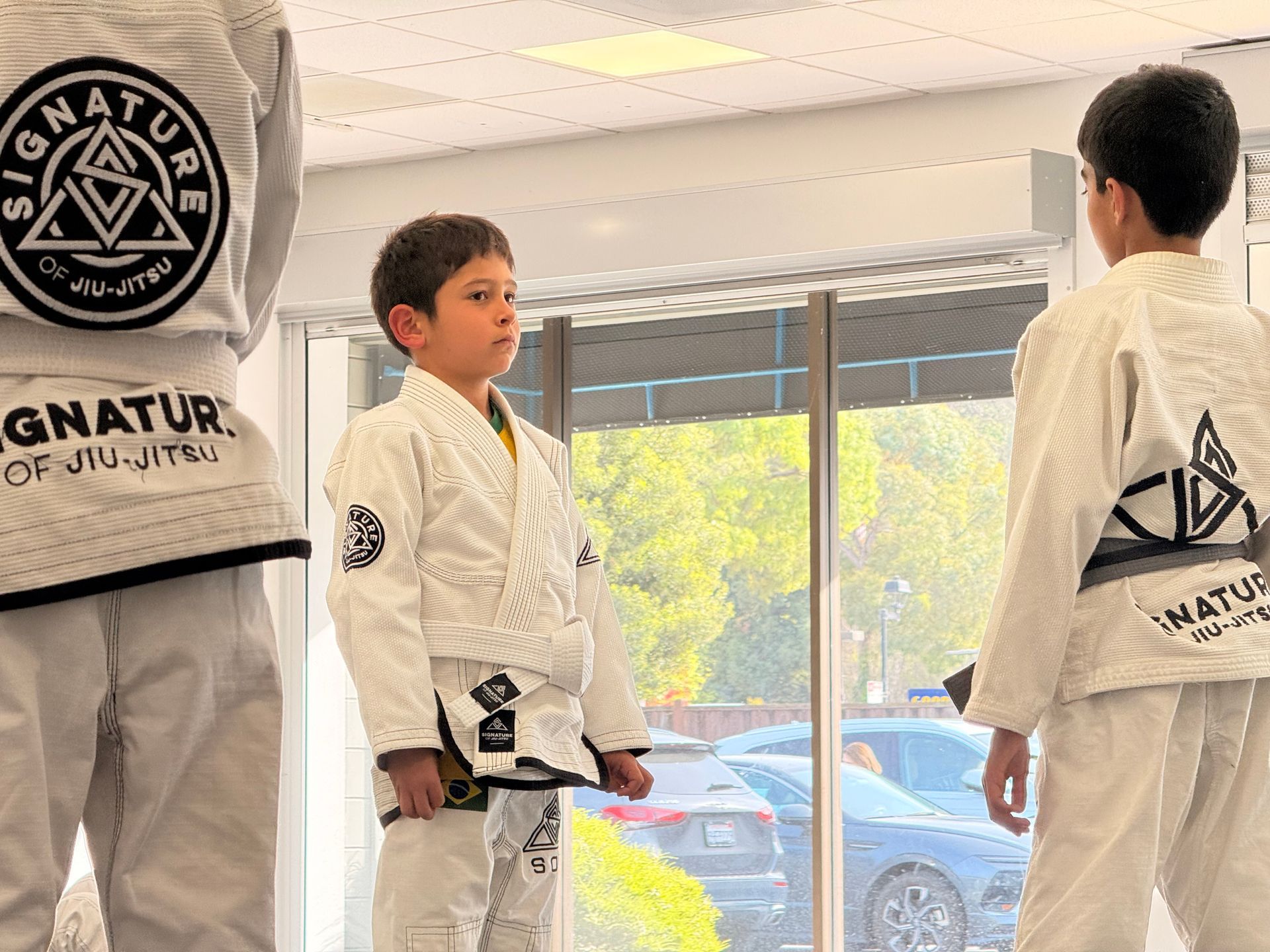
When your child trades scrolling for training, fitness becomes a habit instead of a fight.
If you are like many Belmont families, you have probably watched screen time quietly expand into the after school hours. We get it. Devices are convenient, homework is online, and friends connect through games and group chats. But when movement gets squeezed out, energy, mood, and sleep can take a hit.
Youth Jiu-Jitsu gives kids a place to move with purpose. Instead of passive entertainment, your child gets 60 to 90 minutes of full body training that builds coordination, strength, and confidence. And this is not a tiny niche anymore. Children under 16 now make up about 22 of global Brazilian Jiu-Jitsu academy enrollments, which matches what we see every week: more kids want something real, social, and active.
In Belmont, we see families looking for a structured alternative that is still fun. That is exactly where Youth Jiu-Jitsu fits. It is challenging, but it is also playful in the right ways, with games, drills, and partner work that keeps kids engaged without feeling like another lecture.
Why Youth Jiu-Jitsu is pulling kids away from screens
A big reason screens win is that they are instantly rewarding. Youth Jiu-Jitsu works because it creates a different kind of reward loop: effort, feedback, progress, and belonging. You can feel the difference in a child who finishes class a little sweaty and a lot calmer.
Brazilian Jiu-Jitsu is also one of the fastest growing martial arts in the United States, with search interest rising 104.35 percent from 2004 to 2024. Growth does not automatically mean quality, but it does show that families are finding value in the mix of fitness, self defense, and personal development.
A sport built on leverage, not size
Youth Jiu-Jitsu is often described as the gentle art because it relies on technique and leverage rather than striking. Kids learn how to control positions, escape safely, and stay composed under pressure. That “pressure” is controlled, coached, and age appropriate, but the lessons translate surprisingly well to everyday life, especially for kids who need help staying steady when things feel intense.
Movement that does not feel like exercise
Some kids love traditional sports. Others do not. One advantage of Youth Jiu-Jitsu is that conditioning is baked into the practice. Crawling, bridging, shrimping, standing up with balance, and drilling technique all build athleticism without making the class feel like laps and pushups for an hour.
What your child actually does in class
Parents sometimes picture chaos, like kids rolling around with no structure. Our classes are organized, progressive, and coached closely so kids know what to do and why it matters.
We typically build class around three layers: warmups that teach movement, technique of the day, and controlled partner practice. Over time, kids start linking skills together: an escape leads to a guard, the guard leads to a sweep, the sweep leads to a stable top position.
Here is what most kids experience in a typical session:
• A guided warmup that improves balance, coordination, and safe falling mechanics
• Technique instruction with clear goals, like how to hold a position or escape one
• Partner drilling where we keep intensity appropriate and focus on clean reps
• Supervised live practice when a student is ready, with safety rules reinforced
• A quick wrap up that highlights effort, attention, and respect, not just “winning”
That structure matters because it replaces random screen stimulation with an environment where focus is trained in small, doable steps.
The fitness benefits of Youth Jiu-Jitsu, beyond just “getting tired”
Yes, kids get a workout. But the bigger win is the kind of fitness Youth Jiu-Jitsu builds. It is not only cardio. It is whole body control.
Stronger posture and core stability
Grappling demands a stable base. Kids learn to keep their hips under them, their spine aligned, and their weight balanced. Over months, you often see better posture and fewer “collapsed” positions, even outside the gym.
Coordination, agility, and body awareness
Youth Jiu-Jitsu teaches kids where their body is in space, which sounds simple until you watch a child try to move efficiently. Grappling forces the brain and body to coordinate, especially with footwork, grips, and transitions on the ground.
Confidence that comes from capability
Confidence is a buzzword, but in Jiu-Jitsu it has a concrete source. Your child learns that hard situations can be solved with calm steps. That is a useful lesson for school stress, social stress, and the normal bumps of growing up.
Self defense and conflict skills that fit real life
We train kids to be safe, respectful, and controlled. Youth Jiu-Jitsu is not about picking fights. It is about learning options: how to create space, how to get up, how to protect yourself if someone grabs you, and how to stay aware.
We also emphasize behavior on the mats that supports behavior off the mats. That includes listening, taking turns, and managing frustration. Some kids need more time with that than others, and that is okay. Consistency is where change happens.
Safety first: what Belmont parents should know about injuries
It is smart to ask if Youth Jiu-Jitsu is safe. Any sport can produce injuries, and pediatric BJJ has shown increasing injury counts as participation grows. The most common diagnoses reported in pediatric cases are sprains and strains at 28.3 percent and fractures at 20.1 percent, with the head, shoulder, and lower arm among the most injured areas.
That said, Brazilian Jiu-Jitsu compares favorably to several other combat sports in injury rate per 1,000 athlete exposures, and a large survey found 69.1 percent of practitioners reported no serious injury. Most injuries that do happen are treated without hospital admission, often with an emergency department visit only.
Our job is to take safety seriously, not to pretend risk does not exist. We do that by controlling intensity, teaching tapping early, matching partners thoughtfully, and keeping techniques age appropriate.
How we reduce risk in Youth Jiu-Jitsu
Safety is not one rule. It is a system. We focus on fundamentals that keep kids protected while they learn.
1. We teach kids to tap and to respect the tap immediately, every time
2. We coach controlled movement before adding speed or resistance
3. We reinforce safe falling, posture, and joint awareness from day one
4. We keep supervision tight during partner work and live rounds
5. We set clear behavior expectations so the room stays calm and focused
If you are concerned about your child’s temperament, energy level, or previous injuries, we encourage you to talk with us before class so we can place your child in the right training lane.
How much screen time can Youth Jiu-Jitsu realistically replace?
A common question is, will this actually change habits at home. The most realistic answer is that Youth Jiu-Jitsu creates a dependable block of time that is automatically active. A standard class is 60 to 90 minutes of movement, not counting the drive, getting changed, and the post class water break where kids are suddenly very chatty.
If your child trains two to three times per week, that is several hours that would otherwise often drift toward screens. More importantly, kids start to identify as someone who trains. That identity shift tends to influence what they choose on the days without class too.
Ages, stages, and what we look for in young students
Most academies accept children as young as 4 or 5, and the average pediatric participant age reported in injury research is 11.5 years. In practice, what matters is less about the number and more about readiness: can your child follow directions, stay aware of partners, and handle small challenges without melting down.
We work with the reality that kids mature at different speeds. Some five year olds are focused and steady. Some nine year olds are still bouncing off the walls. Our coaching approach keeps expectations clear while still letting kids be kids.
How often should your child train for real progress?
For most families, the sweet spot is two to three sessions per week. That frequency builds skill fast enough that kids feel progress, which keeps motivation up. Beginners can start with one to two sessions per week and still benefit, especially if your child is adjusting to a new routine.
We recommend you check the class schedule page to pick times that feel sustainable. Consistency beats intensity, especially with kids.
Why Belmont families like a mat based community
Belmont is full of busy, high achieving households. Kids feel that. Youth Jiu-Jitsu gives them a place where effort is visible, progress is earned, and teammates know each other by name.
Jiu-Jitsu worldwide has around 6 million practitioners, with about 750,000 in the United States. A noticeable portion of adult practitioners work in tech fields, which fits our Peninsula reality: families appreciate activities that train both the body and the mind. For kids, that looks like problem solving under pressure, learning to reset after mistakes, and sticking with something that takes time.
First class checklist: what to bring and what to expect
Starting something new is easier when you know the small details. Here is what we suggest for your child’s first Youth Jiu-Jitsu class:
• Arrive a little early so your child can settle in and meet the coach
• Bring water and a simple snack for after class, since training can spike appetite
• Wear comfortable athletic clothes if you do not have a gi yet, unless the program notes specify otherwise
• Make sure fingernails and toenails are trimmed for safety and comfort
• Plan to watch quietly at first, then ask questions after class so kids can stay focused
If your child feels nervous, that is normal. Most kids relax once they see the structure and realize everyone is learning, not performing.
Take the Next Step with Signature of Jiu-Jitsu
Building an active lifestyle does not usually happen with one big decision. It happens through small, repeatable routines that your child actually enjoys. Youth Jiu-Jitsu works because it turns movement into a skill, and skill into confidence, and confidence into momentum.
If you are looking for Jiu-Jitsu in Belmont CA that helps your child trade screen time for real training, we would love to show you how our Youth Jiu-Jitsu in Belmont classes are set up. At Signature of Jiu-Jitsu, we keep the environment structured, welcoming, and focused on long term growth, so your child can feel progress week by week.
Move from reading to rolling to join a Brazilian Jiu-Jitsu program at Signature of Jiu-Jitsu today.