
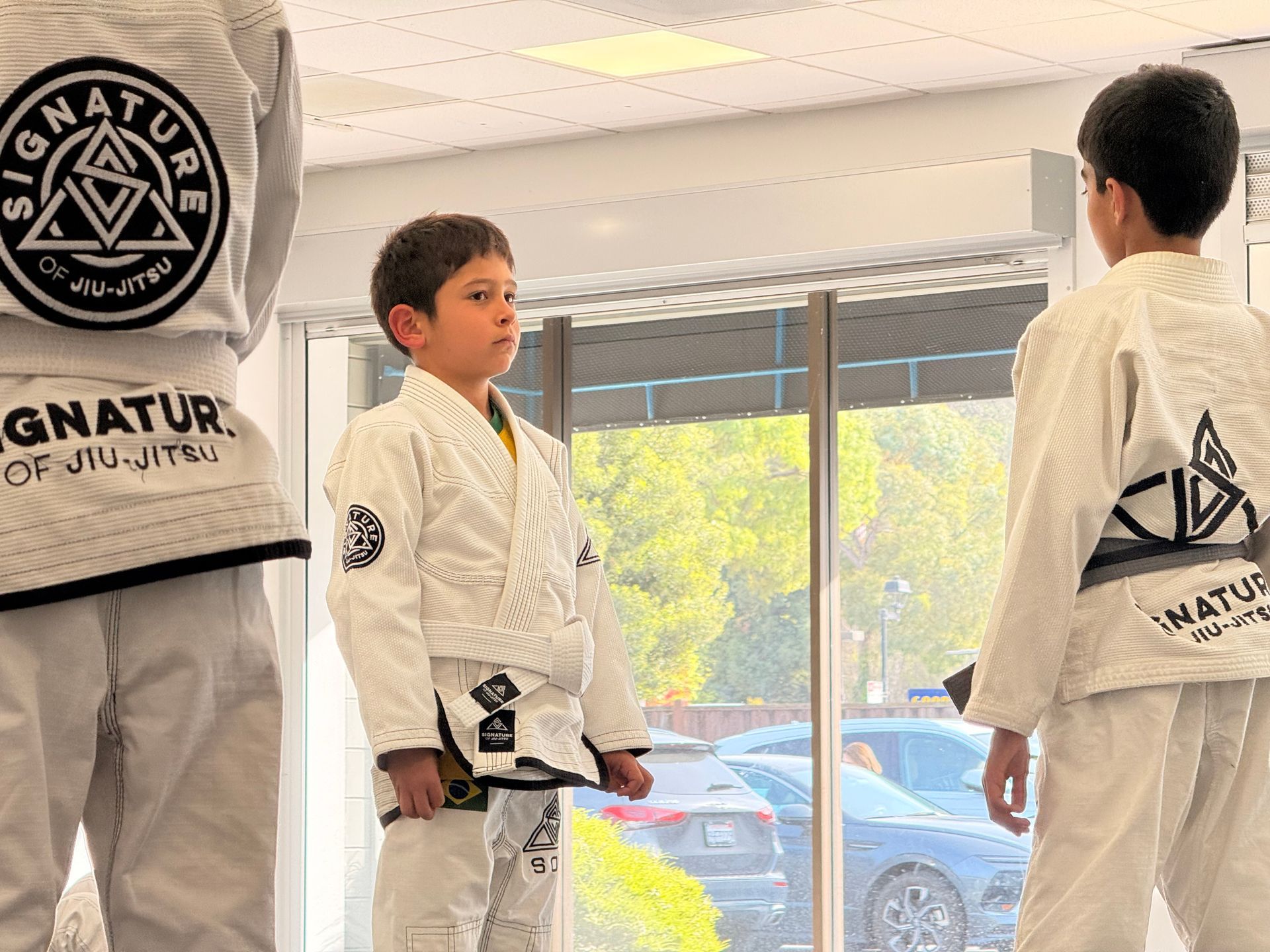
Youth Jiu-Jitsu gives kids a place to move, think, and reset after school while building habits that stick.
Families in Belmont want activities that do more than “burn energy” for an hour. You want something your child can return to week after week, something that supports fitness, confidence, and character without turning every practice into high-pressure performance. That is exactly why Youth Jiu-Jitsu works so well when it is taught as a structured development program.
In our academy, we treat Brazilian Jiu-Jitsu as a long-term skill journey, not a quick self-defense crash course. The value is in the routine: kids show up, warm up, practice a specific movement, get feedback, and try again. That rhythm can support lifelong healthy habits because it teaches consistency, patience, and a healthier relationship with effort.
Research is trending in the same direction. A scoping review found youth martial arts and combat sports can support physical, psychological, social, emotional, cognitive, and academic outcomes in school and out-of-school settings. Another 2024 review reported young martial-arts participants may show better aerobic capacity, strength, flexibility, balance, and body composition than non-athletic peers, while also noting potential benefits related to self-control, mindfulness, and stress reduction. We keep those findings in perspective: results vary, studies are not perfect, and outcomes depend heavily on coaching, environment, and what “training” actually looks like day to day.
Youth Jiu-Jitsu is a youth-development activity, not just a fighting skill
When you hear “Jiu-Jitsu,” it is easy to picture a sport that is only about winning or dominating. A well-designed youth program looks different. Our goal is to give kids a structured place to learn how their bodies move, how to solve physical problems calmly, and how to work with a partner safely.
Brazilian Jiu-Jitsu is especially useful for habit-building because progress is incremental. There is always a next step: a better hip escape, a cleaner technical stand-up, a smoother guard pass, a more controlled pin, a smarter decision in a scramble. Kids learn that improvement comes from repetition and attention, not from being “tough.”
That matters in Belmont, where many families are balancing school schedules, screen time, and multiple activities. Youth Jiu-Jitsu in Belmont can become an anchor in the week: a consistent practice that helps kids feel grounded and capable, even when everything else feels busy.
Physical habits kids build on the mat (that carry into daily life)
A big part of lifelong health is simply learning to enjoy moving your body. Youth Jiu-Jitsu supports that by mixing play, athletic development, and technique into a routine that feels fresh even after months of training.
Strength and endurance without “gym workouts”
Kids build strength in a way that feels natural because grappling uses bodyweight movement and controlled resistance. Pushing, pulling, bridging, squatting, and stabilizing are built into the techniques. Over time, kids also develop muscular endurance and cardiovascular fitness as they learn to keep moving with control, not panic.
A 2024 review linked martial-arts training with improvements in aerobic capacity, muscular endurance, flexibility, balance, strength, and body composition compared with non-athletic peers. We take a practical approach: we keep training age-appropriate, we scale intensity, and we focus on quality movement instead of exhausting kids for the sake of exhaustion.
Mobility, balance, and body awareness
Jiu-Jitsu positions can look unusual, but that is one reason kids develop impressive mobility and coordination. Shrimping, rolling, posting, and changing levels teach children how to move safely in awkward angles. That body awareness can help with sports performance, playground confidence, and basic injury prevention habits like learning how to fall and recover position.
We also want kids to learn how to “listen” to their bodies. Some days a child feels springy and energetic. Some days your child is tired from school, or maybe a little sore from a growth spurt. We coach kids to train with control, communicate, and take smart breaks when needed.
A more positive relationship with exercise
A lifelong habit is not built on willpower alone. It is built on enjoyment and belonging. Many kids stick with Youth Jiu-Jitsu because class feels like a mix of learning and play: there is structure, but there is also curiosity. Kids get to experiment and see what works.
That matters for children who do not naturally connect with team-ball sports or who feel self-conscious in performance-heavy environments. In a Brazilian Jiu-Jitsu class in Belmont, kids can progress at their own pace while still being part of a team-like community.
Mental habits: calm problem-solving under manageable pressure
Youth Jiu-Jitsu is physical, but the brain is always on. Every exchange asks a question: Where is the space? What is my partner trying to do? What is the safest next step? Kids learn to solve problems with their bodies, which is surprisingly transferable to school and daily routines.
Focus, attention, and follow-through
In class, kids practice listening, watching a demonstration, and then trying the movement with intention. That process is not glamorous, but it is powerful. It teaches kids to slow down and follow directions, then make small adjustments based on coaching.
We avoid promising that Jiu-Jitsu “fixes” attention issues or guarantees academic improvements. What we can say honestly is that structured martial-arts environments may support attention and self-regulation when instruction is thoughtful and consistent, which aligns with findings reported in broader youth martial arts research.
Emotional regulation and resilience
Kids will fail at techniques. A lot. That is normal, and it is part of why Youth Jiu-Jitsu can support emotional growth. Children learn how to handle frustration after a sweep does not work, how to reset when a partner escapes, and how to try again without melting down.
The same 2024 review associated martial-arts training with self-control, mindfulness, stress reduction, emotional resilience, and cognitive benefits. We frame this in everyday terms: your child practices being uncomfortable in small, safe doses and learns that uncomfortable does not have to mean unsafe or overwhelming.
Confidence as earned competence (not invincibility)
We care about confidence, but we define it carefully. Healthy confidence is not “my child can beat anyone up.” Healthy confidence is “my child can stay calm, set boundaries, ask for help, and make smart choices.”
In Youth Jiu-Jitsu, confidence tends to show up quietly: better posture walking into class, a willingness to try new things, more patience when learning is hard. It comes from repetition and visible progress, not from hype.
Social habits: respect, communication, cooperation, and boundaries
Grappling requires trust. Kids cannot train well if they cannot cooperate, and they cannot cooperate if they do not learn respect and communication early.
Learning to work with different partners
In class, kids partner up with peers of similar age, size, and experience whenever possible. They learn to match intensity, to be a good partner, and to adjust their approach. That social flexibility is a real-life skill: not every classmate or teammate moves the same way, thinks the same way, or learns at the same speed.
Practicing clear stop signals and boundaries
One of the most practical life skills we teach is how to stop. Kids learn tapping, they learn to release immediately, and they learn that safety rules are not negotiable. This is not just about preventing injury, it is about teaching children that communication matters, that boundaries are real, and that respectful training is the standard.
Prosocial behavior and positive youth development
Research suggests martial arts may contribute to positive youth development through prosocial behavior, resilience, emotional regulation, and reduced antisocial behavior, while also noting the evidence base is uneven and more high-quality studies are needed. We take the balanced view: outcomes depend on the culture you create.
That is why we reinforce simple expectations every class: listen, be respectful, help your partner learn, and train with control. Those are habits kids can bring home, to school, and into future sports and activities.
Why consistency matters more than competition
Competition can be exciting, and some kids love it. But a lifelong healthy habit is usually built on consistency, not trophies. Youth Jiu-Jitsu works best when kids feel successful for showing up, trying hard, and improving over time.
We keep the focus on process goals:
- Train regularly on a schedule your family can actually maintain
- Learn one new detail at a time instead of rushing
- Measure progress by cleaner movement and better decisions
- Celebrate effort, not just outcomes
- Keep training fun enough to continue through the school year
This approach is also more sustainable physically. Excessive training volume, constant high-intensity sparring, or pressure to compete all the time can increase burnout risk. Our priority is helping your child enjoy training for years, not just for a season.
How we keep Youth Jiu-Jitsu age-appropriate in Belmont
Kids are not small adults, and a youth program should not feel like an adult class scaled down. We organize training to match developmental needs, attention spans, and safety readiness.
What a class is designed to include
A Brazilian Jiu-Jitsu class in Belmont should feel structured but not rigid. In our youth classes, we typically include:
1. A warm-up built around basic movement skills like rolls, hip escapes, and balance work
2. Technique instruction with clear coaching cues kids can actually remember
3. Partner drills that emphasize control and cooperation
4. Positional practice that limits chaos while teaching real problem-solving
5. Supervised sparring only when students are ready and only in an appropriate format
That progression matters. Controlled drilling and positional rounds let kids learn safely before anything starts to look like free sparring. It also gives coaches time to spot habits, correct posture, and reinforce safety rules.
Skill milestones that keep kids motivated
Youth Jiu-Jitsu is naturally motivating because progress is visible. Kids collect new skills the way kids collect little wins: an escape that finally works, a sweep that feels smooth, a moment of staying calm under pressure. Clear milestones help kids connect effort to outcome, which is one of the most durable habits you can build.
Safety in Youth Jiu-Jitsu: what parents should know
Parents should be able to ask safety questions comfortably, and we prefer it when you do. Brazilian Jiu-Jitsu involves contact, so safety is not an afterthought.
Injury data from a national emergency-department sample (2012–2021) identified an estimated 8,357 pediatric BJJ injuries, with sprains and strains most common, followed by fractures. The head, shoulder, and lower arm were among frequently affected areas, and injuries increased over time, likely reflecting the sport’s growth. We do not treat that as a reason to avoid training. We treat it as a reason to take supervision, partner matching, and training design seriously.
Here is a parent checklist we encourage you to use before committing to any youth program:
• Are classes divided by age and developmental level, not just belt color
• Are beginners taught tapping, stopping, and releasing clearly from day one
• Is live sparring introduced gradually, with close supervision and rules
• Are partners matched by size, maturity, and experience as much as possible
• Is there a clear policy for injuries, illness, hygiene, and returning to training
• Do coaches reinforce technique and control, not strength and aggression
We also recommend keeping training sustainable. Two classes per week is a great starting point for many kids, especially during the school year. Your child should leave class challenged but not crushed.
What to expect from Youth Jiu-Jitsu in Belmont (before, during, and after class)
Starting something new is easier when you know the rhythm.
Before the first class
Plan to complete registration and basic health information, pack water, and bring clean training clothes. If your child is nervous (which is common), we suggest framing the first class as exploration: show up, learn names, try a few movements, and leave with one thing your child did better at the end than at the beginning.
During class
Expect a clear structure: warm-up, technique, drills, and supervised practice. Coaches should be active on the mat, correcting details, reinforcing safety, and keeping the group focused. Your child will work with partners, but we keep the environment respectful and controlled.
After class
Hydration and hygiene matter. Showering, washing the gi or training gear, and keeping nails trimmed are small routines that reinforce bigger health habits. We also like when you ask your child one simple question on the drive home: “What did you learn today?” It helps kids reflect and notice progress.
Frequently asked questions from parents
What age can my child start Youth Jiu-Jitsu?
It depends on attention span, coordination, and readiness to follow safety rules. Our class structure is designed to keep groups age-appropriate so kids are learning at the right pace.
Does my child need to be athletic first?
No. Many kids build coordination and fitness through training. The early goal is learning fundamentals and feeling comfortable moving on the mat.
Does Jiu-Jitsu make kids aggressive?
Environment matters. Our youth training emphasizes control, respect, cooperation, and de-escalation. We do not treat Jiu-Jitsu as a reason to start fights, and we reinforce the responsibility that comes with learning contact skills.
Do kids have to compete?
No. Competition is optional. Youth Jiu-Jitsu can be a long-term fitness and personal-development activity without tournaments.
Will Youth Jiu-Jitsu help with confidence?
It can help because confidence often comes from earned competence. Kids gain confidence by practicing, struggling a little, and improving over time.
Take the Next Step
If your goal is to help your child build habits that last, Youth Jiu-Jitsu is one of the most practical paths we know: consistent movement, real problem-solving, emotional regulation practice, and social connection, all inside a structured class. When we coach kids with patience and clear standards, the benefits reach beyond the mat into school routines, friendships, and everyday resilience.
We built our youth program at Signature of Jiu-Jitsu to be sustainable for Belmont families: age-appropriate coaching, a focus on technique and safety, and a culture that values long-term growth over short-term intensity. If you are ready to see what that looks like in person, we would love to meet you and your child.
Ready to put your skills into practice? Start training at Signature of Jiu-Jitsu.