
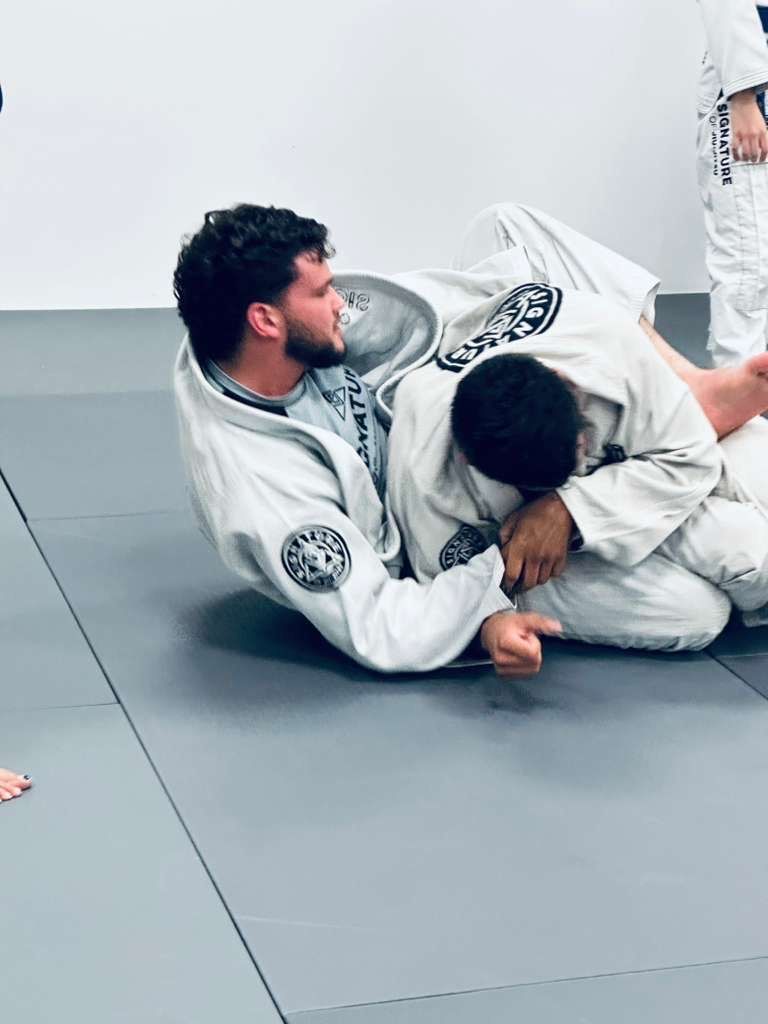
Jiu-Jitsu turns fitness into a skill you can feel improving every week, not just a number on a screen.
Walk into your average gym and you’ll see a lot of people working hard, but not always moving better or feeling better. That’s one reason Jiu-Jitsu has caught on so quickly in Belmont: it’s training that blends strength, mobility, cardio, and stress relief into one practice that stays interesting. You’re not just “getting a workout” in our classes. You’re learning how your body works under pressure, and how to stay calm while you move.
Brazilian Jiu-Jitsu (BJJ) is especially well-suited to full-body wellness because it’s built around leverage, timing, and technique, not raw strength. That makes it accessible whether you’re already athletic, getting back into shape, or simply tired of routines that beat up your joints. And in a high-tempo Bay Area lifestyle, the mental side matters too: the focus you need on the mat has a way of clearing out the mental clutter.
If you’ve been searching for Brazilian Jiu-Jitsu in Belmont that feels supportive and structured, you’re not alone. We meet a lot of people who want a challenging practice, but also want to train safely, progress steadily, and feel better outside the gym as much as inside it.
Why Jiu-Jitsu fits Belmont’s wellness mindset
Belmont is full of people who care about longevity: not just looking fit, but feeling capable. Jiu-Jitsu supports that goal because it trains multiple physical qualities at once. You’ll push and pull, hinge and rotate, balance and breathe, and you’ll do it with purpose because the movements connect to real techniques.
Jiu-Jitsu also matches how many of us actually live. Some weeks are busy, some weeks are calmer, and your training needs to scale. We can keep you progressing whether you’re making it in two times a week or four, because the fundamentals stack. Small improvements in posture, frames, hip movement, and timing add up fast.
And yes, it’s a trend, but it’s not a flimsy one. BJJ has been one of the fastest-growing martial arts in the US, fueled by the popularity of MMA and the demand for functional fitness that doesn’t require heavy equipment. When people realize they can build real strength and conditioning with just a gi, a partner, and a plan, it clicks.
Full-body benefits you can actually notice
A lot of workouts promise “total body.” Jiu-Jitsu delivers it in a way you can feel in daily life, not just during class. You’ll use your legs for base and drive, your core for stability and rotation, your grip for control, and your upper body for frames and pressure. Meanwhile, your heart rate spikes and settles repeatedly, which is a sneaky-effective conditioning builder.
Here are the wellness changes students commonly notice first:
• Better mobility in the hips, shoulders, and spine because you move through varied ranges of motion instead of repeating one pattern
• Practical strength that shows up in carrying, lifting, and posture because you’re resisting and controlling real weight, not just a machine
• Increased cardiovascular endurance from rounds that alternate effort and recovery, similar to interval training
• Less “brain noise” after training because you can’t multitask on the mat, your attention is fully occupied
• A calmer response to stress over time because you practice breathing and decision-making under pressure
When you train Jiu-Jitsu in Belmont CA consistently, the effect tends to feel holistic. You’re not only tired after class. You’re more coordinated, more aware of your body, and, for many people, weirdly more energized the next day.
The technique-first advantage of Brazilian Jiu-Jitsu
One of the best parts of Brazilian Jiu-Jitsu is that it rewards good decisions. Yes, it’s physical, but the “secret sauce” is efficiency. You learn how to use leverage, angle, base, and timing to solve problems that strength alone can’t fix. That’s why smaller people can defend and escape, and why older students can keep training intelligently.
This technique-first approach is also why BJJ is often considered lower-impact than people assume. It’s mostly grappling and ground fighting, with lots of control and incremental pressure rather than explosive collisions. We still take safety seriously, but for wellness-focused students, it’s encouraging to know you can train hard without feeling like you’re sacrificing your knees and shoulders.
It also helps that Jiu-Jitsu keeps you humble in a healthy way. You’ll learn quickly, but you’ll also realize there’s always another layer. That ongoing learning is part of what makes it stick as a lifestyle practice.
Progress that’s real, but not rushed
If you’re the type of person who likes clear milestones, BJJ has them. Belt progression gives structure, but it also sets realistic expectations. Recent survey data from nearly 2,000 practitioners showed average times to earn belts that reflect long-term consistency: around 2.3 years to white belt completion and another 2.3 years to reach blue for many students, with higher belts taking longer. That’s not meant to intimidate you. It’s actually freeing, because it reframes the goal as steady practice rather than quick hacks.
Wellness benefits can show up much sooner than belt milestones. Many students feel changes in strength, cardio, and mobility within the first few weeks. The bigger transformations, like improved movement quality, better recovery habits, and stronger stress tolerance, tend to build over months. That’s the good kind of slow: the kind that lasts.
We also like to remind new students that “progress” in Jiu-Jitsu isn’t linear. Some days you’ll feel sharp. Some days you’ll feel like you forgot everything. That’s normal, and it’s part of learning a complex skill.
A beginner-friendly way to start in Belmont
Starting something new is easier when you know what to expect. In a typical beginner class, we focus on fundamentals and give you a structure you can repeat: warm-up, movement practice, technique instruction, and partner drills. Live sparring is introduced progressively, and you can always pace it based on your goals.
If your main priority is full-body wellness, your early phase should feel more like skill-building than “survival mode.” We want you leaving class thinking, “I learned something and I moved well,” not “I barely made it through.”
A practical starting rhythm for most adults is 2 to 3 classes per week. That’s enough to build momentum, but usually not so much that your recovery falls apart. Once your body adapts, you can scale up if you want.
Training smart: safety, recovery, and injury prevention
It’s honest to say that injury risk exists in grappling, just like it exists in running, soccer, or even lifting. A 2019 study found 59.2 percent of athletes reported at least one injury in the prior six months, and risk increases with higher training frequency. Beginners also tend to get more injuries in training than in competition, largely because everything is new and timing is still developing.
So what do we do with that information? We use it. We coach you to train with control, communicate with partners, and build your “mat awareness” early. We also emphasize that you’re allowed to tap early and often. Tapping is not losing. It’s a safety tool and, honestly, it’s a sign you’re paying attention.
A few habits we encourage for wellness-focused training:
1. Start with technique and controlled drills before pushing hard rounds
2. Prioritize breathing, posture, and frames so you’re not muscling positions
3. Choose training intensity that matches your sleep and stress level that week
4. Ask questions when something feels unclear or uncomfortable
5. Treat mobility and basic strength work as part of your training, not an extra chore
When you train this way, Jiu-Jitsu becomes sustainable. That’s the point. You’re building a practice you can keep for years, not a short sprint that burns you out.
What to wear and bring to your first classes
You don’t need much to get started, and we’ll guide you through the details so you’re not guessing. For gi classes, you’ll want a gi, and for no-gi you’ll want rash guards and athletic shorts without pockets or zippers. Entry-level gis are often around the 100 range, and we can help you pick something that fits correctly, because sizing can be a little weird at first.
Bring water, arrive a little early, and plan to learn a few simple mat etiquette rules. The room has its own rhythm, and once you feel it, it becomes a comfortable place to work hard.
Cost and consistency: what most people budget in California
For many people, cost is part of wellness planning. In California, average monthly BJJ dues were reported around 155.79, which gives you a rough benchmark for what consistent training tends to look like financially. What matters more than the exact number is that your plan supports consistency. Training once in a while is fine, but the real results come when you can show up regularly.
We’re transparent about membership options and schedules because we want your training to fit your life in Belmont. The best program is the one you can actually follow, week after week, without constant friction.
Why this trend keeps growing in the Bay Area
The Bay Area has a strong fitness culture, but it’s also a place where people want efficiency. Jiu-Jitsu is efficient. You get strength, conditioning, mobility, skill development, and community in one place. It also offers a rare kind of “active rest” for your mind, even though your body is working hard.
We also see motivation rise when major events and tournaments happen in California. Big competitions, like The Crown in Long Beach and other high-profile no-gi and gi events, keep the sport visible and inspire students to set goals. Even if you never compete, that energy tends to lift the whole training community.
Ultimately, Jiu-Jitsu in Belmont CA is growing because it solves a real problem: people want a full-body practice that feels meaningful. It’s challenging, but it’s not mindless. It’s social, but it’s not performative. It’s intense, but it can still be tailored to wellness.
Take the Next Step
Building wellness through Jiu-Jitsu comes down to a simple formula: show up, learn fundamentals, and train with a smart pace. When you do that, the benefits stack quickly, and the practice stays interesting long after the “new trend” phase fades.
That’s exactly how we run things at Signature of Jiu-Jitsu. If you’re looking for Brazilian Jiu-Jitsu in Belmont with structure, a welcoming environment, and coaching that supports long-term progress, we’d love to help you start in a way that feels clear and doable.
Take what you learned here to the mat by joining a Jiu-Jitsu class at Signature of Jiu-Jitsu.