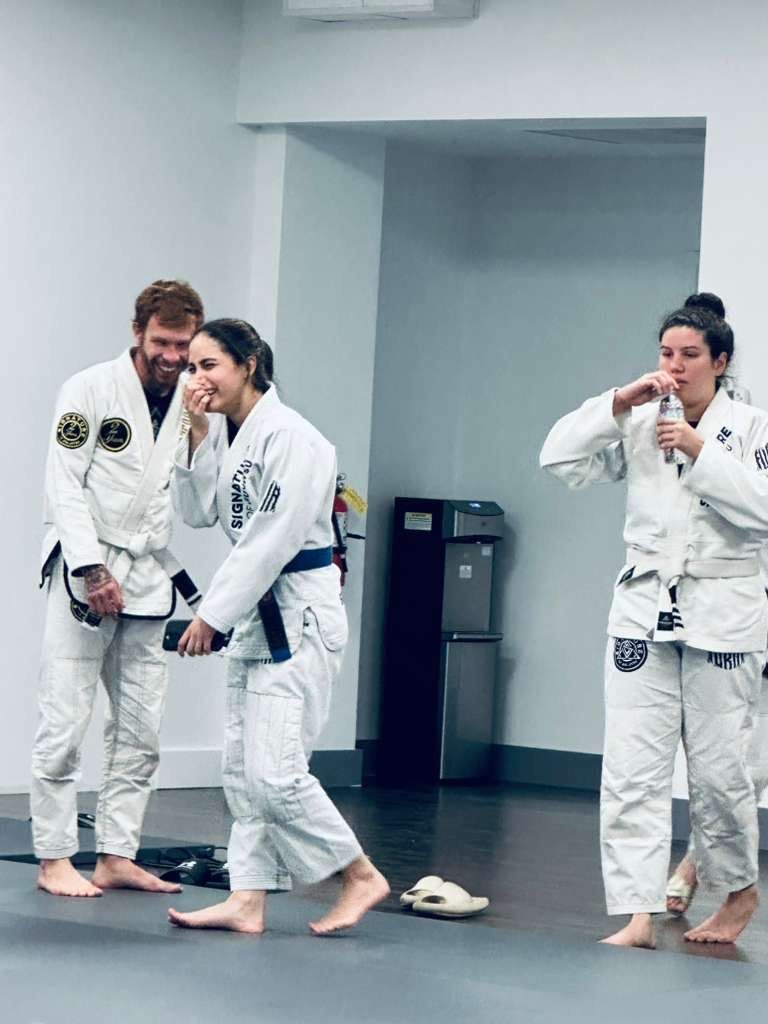
Jiu-Jitsu gives you a place to work hard, think clearly, and leave class feeling more capable than when you walked in.
Brazilian Jiu-Jitsu has grown fast over the last two decades, and the numbers back it up: search interest is up more than 100 percent since 2004, and there are roughly 750,000 practitioners in the U.S. alone. We see the same momentum right here in Belmont, where busy workweeks and packed calendars make structured training feel less like a luxury and more like a reset button.
If you’re looking into Jiu-Jitsu in Belmont CA, you’re probably after more than “learning moves.” Most people who walk into our academy want a dependable routine, better conditioning, and a way to get out of their head for an hour. The good news is that Jiu-Jitsu rewards consistency in a way that’s hard to fake. You show up, you learn something small, and over time that adds up to real change.
In this guide, we’ll break down how our training works, what you can expect as a beginner, and how to train in a way that supports long-term progress. We’ll also address the questions we hear constantly: injury risk, gi vs no-gi, class frequency, and how to fit training into a Belmont lifestyle without burning out.
Why Jiu-Jitsu is booming, and why that matters for your training
Jiu-Jitsu isn’t growing because it’s trendy, it’s growing because it works. It’s a skill-based sport where smaller improvements matter, and you can feel those improvements quickly. When global participation is estimated in the millions and the market is projected to more than double by 2033, it tells us something important: people stick with this when the environment is right and the learning is real.
There’s also a practical reason it fits modern life. Many of us sit all day, stare at screens, and carry a low-grade stress that never fully turns off. Jiu-Jitsu forces you to be present. When you’re solving a grappling problem in real time, you can’t mentally drift. That “focused calm” is a big part of the mental clarity people notice after class.
Belmont is a perfect match for that. We’re close to high-pressure industries, long commutes, and endless obligations. Training becomes a structured hour where you move, breathe, and do something that’s concrete. You leave sweaty, sure, but you also leave clearer.
Discipline you can actually practice (not just talk about)
Discipline sounds abstract until you attach it to a routine. On the mat, discipline becomes simple actions: showing up when you’re tired, drilling the same detail again, tapping early instead of getting stubborn, and asking questions even if you feel awkward for a second.
We build discipline through structure. Classes follow a consistent rhythm so you always know what you’re doing and why. You’re not wandering around guessing. You’re learning positions, escapes, control, and submissions in a progression that makes sense.
Over time, you’ll notice discipline spilling into other areas:
- You manage stress better because you’ve practiced staying calm under pressure
- You get more patient because Jiu-Jitsu rewards timing, not rushing
- You become more coachable because feedback immediately improves outcomes
That’s the kind of discipline that sticks, because it’s earned through repetition, not motivation.
Fitness benefits that don’t feel like “just working out”
A lot of people try Jiu-Jitsu because they’re tired of workouts that feel like punishment. Grappling is hard, but it’s engaging. Instead of counting reps, you’re solving problems with your whole body, using strength, endurance, balance, and coordination.
Jiu-Jitsu also scales. If you’re new, your intensity is naturally moderated by learning. If you’re experienced, you can push the pace with more sparring rounds and sharper transitions. Either way, you get a blend of cardio and strength that feels athletic, not repetitive.
You’ll typically develop:
- Better grip and pulling strength from controlling posture and frames
- Stronger hips and legs from base, guard work, and standing entries
- Improved mobility from moving through tight positions safely
- Conditioning that builds over weeks without needing a treadmill obsession
If your goal is body composition, Jiu-Jitsu supports that too, especially when you train consistently and recover well. The key is sustainable frequency, not trying to “win fitness” in week one.
Mental clarity: why grappling quiets your mind
People describe Jiu-Jitsu as chess with consequences, and that’s not far off. You’re constantly making small decisions: where your head goes, how your hips turn, when you switch grips, when you abandon a plan. That decision-making creates mental engagement, and it tends to override the background noise of the day.
We also think mental clarity comes from constraints. When someone is trying to pass your guard, you have one job: solve that. It’s oddly refreshing. Your phone isn’t in your hand. Your inbox can wait.
If you’re in a high-stress job or managing family responsibilities, this matters. You’re not just exercising, you’re training your nervous system to stay calm and think clearly in uncomfortable situations. That calm shows up outside the academy more than you’d expect.
What to expect in your first few weeks
Beginners often worry about two things: looking lost and getting hurt. We handle both by focusing on fundamentals and controlled training. Your first few weeks are about learning positions and survival skills, not proving toughness.
You’ll learn how to move safely on the mat, how to fall and base, and how to protect yourself in common positions. We also teach tapping early as a skill, not a surrender. It keeps you training tomorrow, which is the real point.
Here’s what most students experience early on:
1. Week 1: Everything feels fast, but you start recognizing positions
2. Weeks 2 to 4: You learn a few reliable escapes and basic control
3. Month 2: You start anticipating what’s coming and breathing better
4. Month 3 and beyond: Your timing improves and sparring feels less chaotic
If you’re training 2 to 3 times per week, you’ll usually feel noticeable changes in fitness and focus within the first month. More classes can accelerate progress, but only if recovery stays solid.
Gi vs no-gi: choosing the right approach for your goals
One of the first decisions people ask about is gi versus no-gi. Both teach Brazilian Jiu-Jitsu in Belmont, but they feel different. The gi adds grips and friction, which slows the action and makes control more technical. No-gi is faster and often more scramble-heavy, with a bigger emphasis on wrestling-style entries and body control.
Competition trends reflect this blend. Wrestling takedowns have surged at elite events, and chokes remain a dominant finishing method. That’s useful for you even if you never compete, because it shapes what modern training emphasizes: solid positioning, safe pressure, and high-percentage finishes.
We coach both in a way that supports your long-term learning:
- Build fundamentals in the gi to sharpen details and control
- Use no-gi to develop movement, balance, and reaction speed
- Keep concepts consistent so you’re not learning two unrelated systems
If you’re unsure where to start, we’ll point you to the best fit based on your schedule, comfort level, and goals.
Training smart in a sport with real injury risk
Let’s be straightforward: injury risk in Brazilian Jiu-Jitsu is real. A commonly cited study found that 59.2 percent of athletes reported at least one injury in the prior six months. That number sounds scary until you add context. Injury rates are influenced by training volume, intensity, experience, and how well people manage ego.
Our job is to make training challenging without making it reckless. We do that through progressive intensity, clear expectations during sparring, and coaching that emphasizes control. We also encourage consistency over extremes. Training hard once a week and then disappearing doesn’t build resilience. Training intelligently, week after week, does.
A few habits we coach from day one:
- Tap early and often, especially while learning joint locks
- Prioritize clean technique over strength-based scrambling
- Choose training rounds that match your energy and experience
- Communicate if something feels off, before it becomes a problem
If you want longevity, treat recovery like part of training. Sleep, hydration, and mobility work are not extras. They’re how you keep showing up.
How our programs and membership options fit real Belmont schedules
Most people in Belmont need training that fits into real life. We keep our class structure consistent so you can drop into the class schedule without feeling like you missed a chapter. Whether you’re training before work, after work, or around school pickups, you should be able to build a routine that holds up month after month.
Our programs are designed to support different goals while keeping the same technical foundation. Beginners get clear fundamentals and guidance. More experienced students get deeper rounds, sharper problem-solving, and a training environment where details matter.
We also keep onboarding simple. You don’t need to “get in shape first.” You build shape by training, and we meet you where you are. If you’ve been searching for Jiu-Jitsu in Belmont CA because you want a structured path, our job is to make that path obvious.
What you’ll actually learn as you progress
A good Jiu-Jitsu program teaches more than submissions. It teaches how to control space, deny grips, manage distance, and escape bad positions calmly. Those skills become your backbone, whether you’re training for self-defense, sport, or just personal development.
As you build experience, we’ll help you connect the major areas:
- Standing entries and takedown awareness, including safe falling mechanics
- Guard fundamentals: how to keep someone from smashing through you
- Passing: how to move around legs with balance and pressure
- Pins and control: side control, mount, back control, and transitions
- Finishing mechanics, especially chokes, with a focus on safety
You’ll also learn something less obvious: how to learn. You’ll get better at asking the right questions and making small adjustments. That learning skill is a big part of why people stay with Brazilian Jiu-Jitsu in Belmont for years.
Ready to Begin
If you want training that strengthens your body and quiets your mind, we’ve built a clear path for you at Signature of Jiu-Jitsu. You’ll get coaching that respects fundamentals, a class structure that supports consistency, and a room where discipline is practiced, not preached.
When you’re ready, start with one class and focus on one goal: show up, learn one detail, and leave a little better than you arrived. That’s how progress works here, and it’s how Signature of Jiu-Jitsu helps Belmont students build fitness and mental clarity through Jiu-Jitsu.
Train with purpose and see steady improvement by joining a Jiu-Jitsu class at Signature of Jiu-Jitsu.