
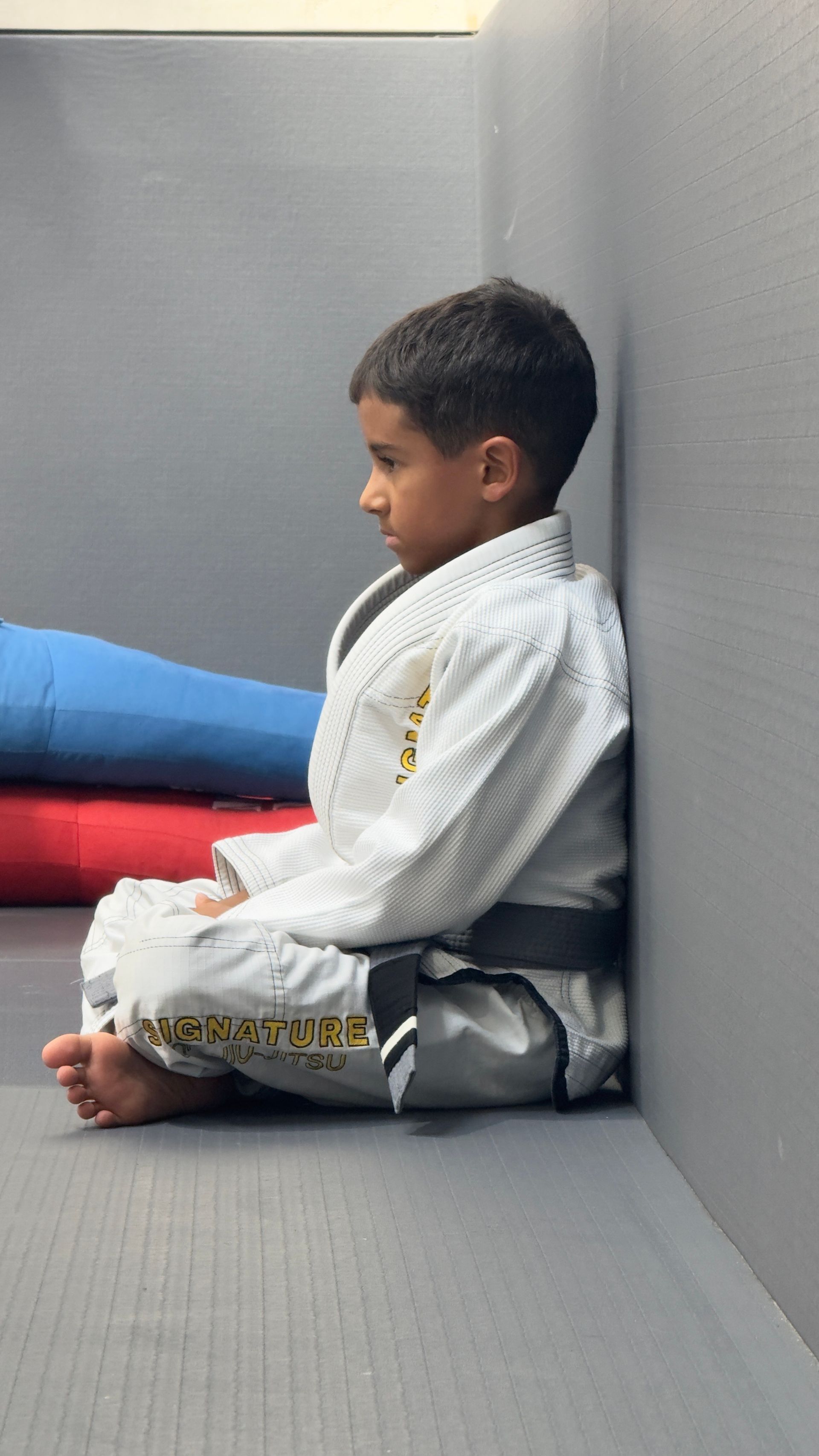
Youth Jiu-Jitsu turns “I don’t know what to do” into “let me try another option” with every round of practice.
When parents ask us what makes Youth Jiu-Jitsu different, we usually answer with something simple: it teaches kids how to solve problems while they’re still in the middle of the problem. Not after the fact. Not in theory. Right there on the mat, with a partner, in a situation that changes every few seconds.
That matters in Belmont, where many kids juggle busy school expectations, packed schedules, and a lot of screen time. Youth Jiu-Jitsu gives your child a real-world way to practice focus, decision-making, and calm persistence. Our goal is not to raise little fighters. Our goal is to help you raise a kid who can think, adapt, and keep going.
Why Youth Jiu-Jitsu feels like a “physical chess match”
In Youth Jiu-Jitsu, kids learn that position comes before power. A smaller, lighter student can succeed by using leverage, timing, and smart choices instead of brute force. That alone is a powerful mindset shift for children who think every challenge is about being “strong enough” or “fast enough.”
On the mat, the “puzzle” is constant. A grip changes. A balance breaks. A path closes. Your child has to notice what’s happening, pick a response, and then adjust if it doesn’t work. That loop is the heart of problem-solving: observe, decide, act, reflect, repeat.
We also keep the training structured. Kids aren’t thrown into chaos. Our classes build understanding step by step, so students learn how to create a plan, not just copy a movement. Over time, that turns into a habit: when something gets tough, your child looks for solutions instead of freezing.
The specific problem-solving skills kids practice in every class
Problem-solving is a big phrase, so we like to make it concrete. Here are the skills we see kids rehearse naturally in Youth Jiu-Jitsu, often without realizing it.
• Pattern recognition: Kids start noticing common setups, like when a partner shifts weight before a sweep or reaches for a grip before a hold.
• Cause and effect thinking: If a student pushes the wrong direction, the partner turns. If the student frames correctly, space appears. The feedback is immediate.
• Decision-making under pressure: Students learn to choose a safe option quickly, especially during controlled sparring rounds.
• Switching strategies: When one escape fails, kids learn to try a second and third option rather than forcing the same move.
• Persistence without panic: The mat teaches that being stuck is not the end. It is a new starting point.
These skills show up outside training in surprising ways: a child reworks a math problem instead of melting down, restarts a writing assignment without tears, or handles a playground disagreement with more patience.
How our drills create real-time thinking, not memorization
A common worry is that martial arts might become “copy what the coach does.” We get it. If that were all it was, the thinking benefits would be limited.
Our Youth Jiu-Jitsu classes are built around partner drills that require active choices. We teach the technique, then we add constraints that force adaptation. Maybe your child has to escape using only certain grips. Maybe the partner changes resistance levels. Maybe the goal is not to win, but to maintain balance for ten seconds while the other student tries to off-balance them.
This kind of training is where problem-solving actually develops. Your child learns the difference between a move that works only in perfect conditions and a move that works when things are messy. And life is usually messy.
Escapes, balance, and resets: the best “thinking skills” curriculum we know
If we had to pick three categories that build young problem-solvers fastest, it would be escapes, balance, and resets.
Escapes teach your child to look for space. Instead of pushing harder, kids learn to create room with frames, hip movement, and timing. That is a mental lesson as much as a physical one: the best answer is often the smartest angle, not the most effort.
Balance drills teach attention. A child who loses posture gets swept. A child who keeps alignment stays stable. That feedback trains body awareness and mental focus at the same time, which is rare in most kid activities.
Resets teach emotional control. In Youth Jiu-Jitsu, something will fail. That is normal. We coach kids to pause, breathe, and restart the sequence without spiraling. Over time, “resetting” becomes part of your child’s identity, which is exactly what you want when homework feels hard or social situations get uncomfortable.
Resilience and the skill of handling “not yet”
Belts in Jiu-Jitsu are earned over time, and kids learn quickly that progress is not instant. That can be a relief in a world where apps provide rewards every few seconds.
In class, your child experiences small failures in a safe setting. A guard pass gets stopped. A sweep doesn’t land. A partner escapes. Instead of treating that as embarrassment, we treat it as information: what did you notice, what did you miss, what will you change next round?
This is one reason Youth Jiu-Jitsu can support mental health in a practical way. The training builds the ability to tolerate frustration. It also teaches delayed gratification, which helps kids stick with school projects, sports seasons, and even friendships when things are not immediately perfect.
Confidence without aggression: what kids actually learn about self-defense
Parents often ask if Jiu-Jitsu in Belmont CA is “too intense” for kids. Our approach is the opposite of chaotic. Youth Jiu-Jitsu emphasizes control, safety, and non-striking grappling skills. Kids learn how to protect themselves, create space, and stay calm.
Confidence comes from competence. When your child learns how to hold posture, escape a pin, or safely get back to their feet, fear shrinks. That confidence tends to look quiet: better eye contact, clearer boundaries, and less reactivity when someone tries to provoke them.
We also talk about responsibility. Skills are paired with respect, partner care, and the idea that walking away is often the best win. Those conversations land better when kids have physical practice to match the words.
Social problem-solving: partners, teamwork, and learning to lead
Youth Jiu-Jitsu is partner-based, which means kids learn how to work with many personalities. Some partners are fast. Some are cautious. Some get discouraged easily. That variety becomes a social classroom.
We coach students to communicate clearly and kindly: “Can we go lighter?” “Can you try that again?” “I’m not sure what happened, can you show me?” These are real leadership skills, and they help kids navigate group projects and peer relationships.
As kids gain experience, our culture encourages them to help newer students. Teaching a basic movement to a beginner forces your child to organize thoughts, simplify instructions, and stay patient. That is problem-solving in a different form, and it often boosts confidence for kids who are quieter at school.
Youth Jiu-Jitsu in Belmont: why this matters in a tech-heavy, high-pressure area
Belmont families often deal with a specific challenge: kids have a lot of mental stimulation but not always enough physical problem-solving. Screens are passive. School can be high stakes. Social media adds noise.
Youth Jiu-Jitsu gives your child a place to practice being present. The mat is immediate. If your child is distracted, posture breaks. If your child rushes, balance disappears. If your child stays calm, options open up. That feedback teaches focus in a way lectures usually cannot.
And because classes are structured, kids know what to expect. That predictable environment can be grounding, especially for students who carry stress from school or feel overwhelmed by social dynamics.
What ages and schedules typically work best
We usually see kids thrive when they start around age 5 and up, because they can follow simple directions and participate safely with a partner. Younger kids focus on basics: listening, movement, balance, and simple escapes. Teens often move faster into strategy, chaining techniques, and using training as a healthy outlet for stress.
For most families, consistency matters more than intensity. Two to three sessions per week is a strong rhythm for Youth Jiu-Jitsu. That schedule gives your child enough repetition to build skill while keeping training fun and sustainable.
Classes typically run 45 to 60 minutes, and we keep the pace moving. Kids learn, drill, play structured games that reinforce concepts, and gradually work into controlled sparring when ready.
What progress looks like in the first 3 to 6 months
Parents like timelines, and we do too, as long as we keep them realistic. Every child is different, but we often see a pattern.
1. Weeks 1 to 4: Your child learns class routines, basic movements, safe falling, and how to work with partners without anxiety.
2. Months 2 to 3: Problem-solving shows up more clearly. Kids start choosing escapes instead of guessing, and frustration decreases.
3. Months 4 to 6: Strategy becomes visible. Your child links steps together, adapts mid-round, and shows more composure in tough spots.
A nice side effect is improved attention span. When kids practice focusing through a full round, homework sessions often feel more manageable, even if school was never “their thing” to begin with.
Safety, supervision, and what “controlled training” really means
Safety is not a slogan. It is built into how we teach. Our Youth Jiu-Jitsu program uses age-appropriate instruction, structured drills, and clear rules around intensity. We match partners thoughtfully, emphasize tapping early, and coach kids to protect each other.
Because Jiu-Jitsu is grappling-based and non-striking in our youth curriculum, the training can be safer than many parents expect. Kids learn to move with control, not recklessness. We also prioritize warm-ups that build coordination and reduce preventable injuries.
If you are looking for youth Jiu-Jitsu in Belmont that balances challenge with care, this structured approach is exactly what you should expect from us.
Take the Next Step
Building problem-solving skills is not about giving kids more pressure. It is about giving them better tools. Youth Jiu-Jitsu trains your child to stay calm, notice details, and make smart adjustments when plans change, which is a life skill that shows up everywhere from schoolwork to friendships.
When you are ready to see how we teach those skills on the mat, we would love to welcome you to Signature of Jiu-Jitsu in Belmont, CA. Our classes are designed to be challenging in the right way: supportive, structured, and focused on real growth you can actually notice at home.
If you’re curious about Jiu-Jitsu training, join a class at Signature of Jiu-Jitsu and learn from the ground up.