
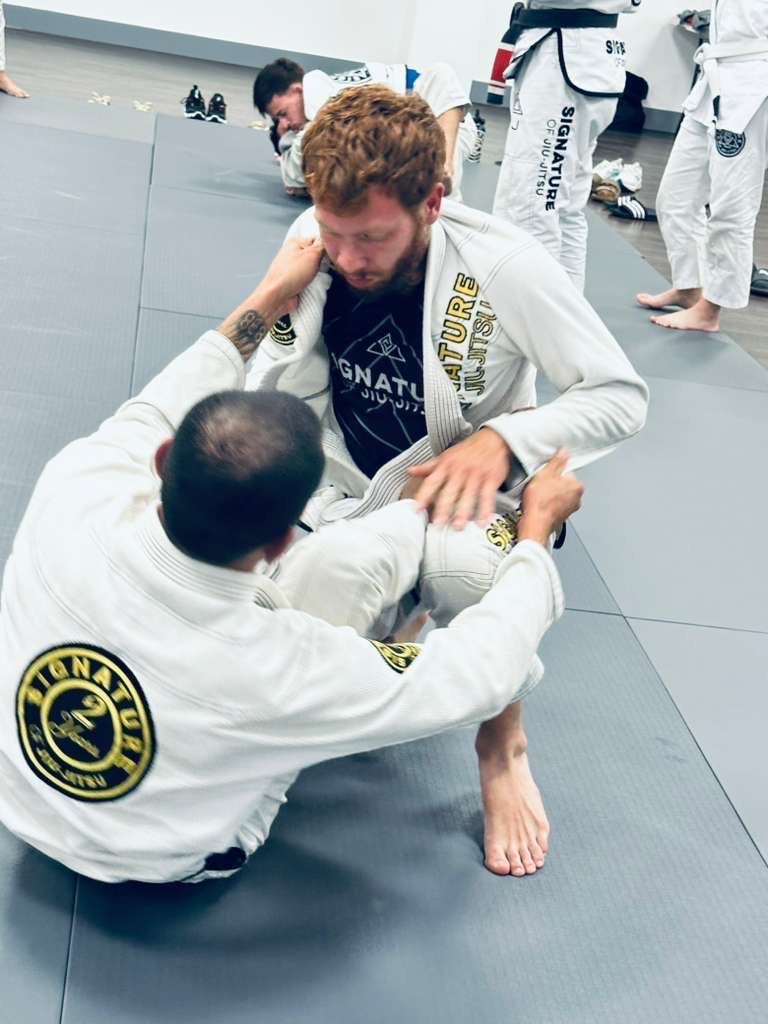
Jiu-Jitsu training turns everyday stress into a skill you can practice, measure, and steadily improve.
In Belmont, life moves fast, and your brain rarely gets a quiet moment. Between demanding work, long commutes, family schedules, and the constant pressure to keep up, it’s easy to feel like you’re always “on.” We built our Jiu-Jitsu program to give you a place where you can switch that noise into something productive: focused effort, clear goals, and steady progress.
Jiu-Jitsu is physical, yes, but it’s also deeply practical for your mind. You learn how to breathe under pressure, how to keep thinking when your body wants to panic, and how to stay calm when a problem doesn’t solve itself right away. Those are training outcomes you feel off the mat, too, whether you’re presenting at work, juggling a busy home, or just trying to be less reactive when the day gets messy.
When people search for Jiu-Jitsu in Belmont CA, they’re often looking for self-defense or fitness. Those are great reasons to start. But what keeps most students training is what happens internally: resilience, focus, and real strength that doesn’t depend on size, ego, or hype.
What “real strength” means in Jiu-Jitsu (and why it feels different)
Real strength is what shows up when you’re tired, uncomfortable, and still willing to think. In Brazilian Jiu-Jitsu in Belmont, we train you to create leverage, manage distance, and use timing and positioning rather than raw force. The techniques reward patience and problem-solving, which is exactly why smaller athletes can control bigger ones when fundamentals are sharp.
There’s also a certain honesty to the mat. You can’t bluff through a position. If your base is off, you get swept. If you hold your breath, you gas out. That feedback loop is immediate, and it’s oddly refreshing. In a world where so much is abstract, Jiu-Jitsu gives you clarity: do the work, improve the detail, repeat.
Physically, you’ll build strength through full-body movement: hips, core, grip, and posture all matter. Mentally, you’ll develop the kind of confidence that comes from evidence. You don’t just “feel” tougher, you watch yourself handle hard rounds and come back the next day anyway.
Resilience: learning to stay calm when things don’t go your way
Resilience in Jiu-Jitsu is not motivational talk. It’s a set of habits you practice. You get put in a tough spot, you feel pressure, and you learn to respond with technique instead of panic. Over time, that becomes normal.
Research and lived experience line up here. Practitioners commonly report that the mental benefits can be even more valuable than the physical ones, including stronger stress tolerance and fortitude in daily life. High-stress professionals, including law enforcement, have also shown reductions in stress, anxiety, depression, and PTSD symptoms with participation, and what’s interesting is that benefits appear even when training frequency is not intense. The act of showing up and engaging matters.
In our classes, we coach resilience in simple, repeatable ways:
- We teach you to pause and breathe when you’re pinned, then work step by step
- We help you recognize “false urgency,” the feeling that you must explode to escape
- We train you to reset after a mistake instead of spiraling into frustration
- We keep training progressive, so hard rounds come after you have tools, not before
That’s how resilience becomes real. You practice it until it’s yours.
Focus: why Jiu-Jitsu pulls your attention into the present
A good Jiu-Jitsu class is one of the few places where multitasking disappears. You can’t scroll and spar. You can’t rehearse tomorrow’s meeting while someone is passing your guard. The body forces the mind to be where it is.
Focus improves because the task is specific and constantly changing. You’re tracking grips, frames, pressure, and timing. You’re listening to coaching cues. You’re noticing patterns in your partner’s movement. That’s attention training, not in a vague way, but in a moment-by-moment way.
Students often notice spillover: better concentration at work, less mental clutter, and improved emotional control. There’s also evidence connecting Brazilian Jiu-Jitsu to emotional intelligence and even improved academic performance for some practitioners, likely because the sport rewards patience, consistency, and structured problem-solving.
If you’ve been feeling scattered, Jiu-Jitsu gives you a simple deal: show up, focus for an hour, and leave with your mind clearer than when you walked in.
The pressure training effect: stress management you can actually practice
Stress is unavoidable. The question is whether you have a method for handling it. Jiu-Jitsu gives you controlled exposure to pressure, with partners, rules, and coaching that keep it safe and productive.
That controlled pressure matters because it changes how your nervous system responds. You learn what it feels like to be uncomfortable without being in danger. You learn to separate sensation from reaction. And eventually you learn that you can stay calm, even when your body is telling you to rush.
We see this most clearly during positional training and sparring:
- Positional rounds teach you to solve one problem repeatedly, which builds confidence fast
- Sparring teaches you to adapt when your first plan fails, which is basically real life
- Cooldowns and post-class reflection help your body return to baseline, not stay “wired”
For people in high-stress roles, that skill can be a big deal. Studies on officers, for example, show measurable mental health improvements after moderate practice hours, along with fewer injuries and use-of-force incidents. The takeaway for you in Belmont is simple: you don’t need to be extreme to benefit. You need consistency.
Why belt progression builds patience, humility, and leadership
One of the most overlooked benefits of Jiu-Jitsu is how the belt system shapes your mindset. It’s a long game. Mastery can take around a decade, and that timeline changes how you think about progress.
Early on, you learn to be a beginner again. That sounds small, but it’s actually powerful. You practice humility without having to talk about it. You tap, you learn, you come back. That process tends to make people more grounded outside the gym as well.
Leadership develops in stages, too. Research and coaching culture often point to leadership emerging as students gain experience, commonly becoming more visible from blue belt onward. In practice, we see leadership in small moments: helping a new student tie a belt, demonstrating a drill, setting a calm tone in training, or being the steady partner who keeps rounds safe and constructive.
If you want a place to build real confidence without feeding an ego, Jiu-Jitsu does that almost automatically.
What to expect in our classes in Belmont
Our goal is to make training challenging but approachable, with a structure that helps you learn rather than just survive. A typical class blends instruction, drilling, and live training so you can understand a technique, practice it, and then pressure-test it.
Here’s what you’ll usually experience:
1. Warm-up with movement that supports Jiu-Jitsu, like hip mobility, core activation, and balance work
2. Technique instruction with clear details on grips, posture, and common mistakes
3. Partner drilling so you can repeat the movement enough times to feel it click
4. Positional training or sparring, scaled to your experience and comfort level
5. Quick wrap-up so you leave with one or two specific takeaways for next time
We keep the room respectful and focused. You’ll work hard, but you won’t be thrown into chaos on day one. And if you’re nervous, that’s normal. Most people are, even the ones who don’t look it.
Getting started as a beginner (without feeling overwhelmed)
Beginning Jiu-Jitsu can feel like learning a new language with your whole body. There are grips, positions, transitions, and a lot of unfamiliar movement. We coach beginners to focus on a few priorities rather than trying to memorize everything.
We recommend starting with:
- Safety first: tapping early, learning how to move with control, and understanding basic boundaries
- Survival basics: posture, frames, and how to stay composed under pressure
- Simple escapes: not flashy, just reliable ways to improve position
- One or two attacks: learning a small “starter toolkit” you can repeat and refine
- Consistent attendance: even one to three sessions a week can create real change over time
The best part is that progress becomes noticeable in everyday ways. You stand taller. You breathe better under stress. You feel less rattled when plans change. That’s not magic, it’s practice.
Training for busy Belmont schedules: consistency beats intensity
A lot of Belmont students are balancing careers, family responsibilities, and packed calendars. We design training to reward consistency, not perfection. You don’t need to train every day to build resilience and focus. You need a schedule you can maintain.
If your week is unpredictable, we encourage you to use the class schedule as a tool: pick realistic days, protect them like appointments, and let training be the anchor. Some weeks you’ll do more, some weeks less. The key is staying connected to the process.
And if you’ve been away for a while, coming back is part of the journey too. Jiu-Jitsu is patient that way. The mat will meet you where you are.
Community and culture: the quiet ingredient that makes progress stick
Technique matters, but environment matters too. People improve faster when the room is supportive, consistent, and serious about learning. Our culture emphasizes respectful training partners, clear coaching, and a shared commitment to getting better without trying to “win” practice.
That community element is also why Jiu-Jitsu has increasingly been viewed through a therapeutic lens in recent years. Peer support, structured challenge, and incremental progress can have a stabilizing effect, especially for people dealing with high mental load. You’re not just exercising. You’re building a skill set alongside people doing the same.
It’s also a space where different backgrounds mix easily. On the mat, what matters is attention, effort, and how you treat your partner.
Take the Next Step
If you want a training routine that builds resilience, focus, and real strength, we’ve designed our Belmont programs to make that growth feel practical and steady, not overwhelming. You’ll learn Brazilian Jiu-Jitsu fundamentals, pressure-tested skills, and the kind of calm confidence that comes from doing difficult things on purpose.
When you’re ready, Signature of Jiu-Jitsu is here to guide you with structured classes, a supportive room, and coaching that respects your goals and your schedule.
Ready to train? Join a Jiu-Jitsu class at Signature of Jiu-Jitsu today.