
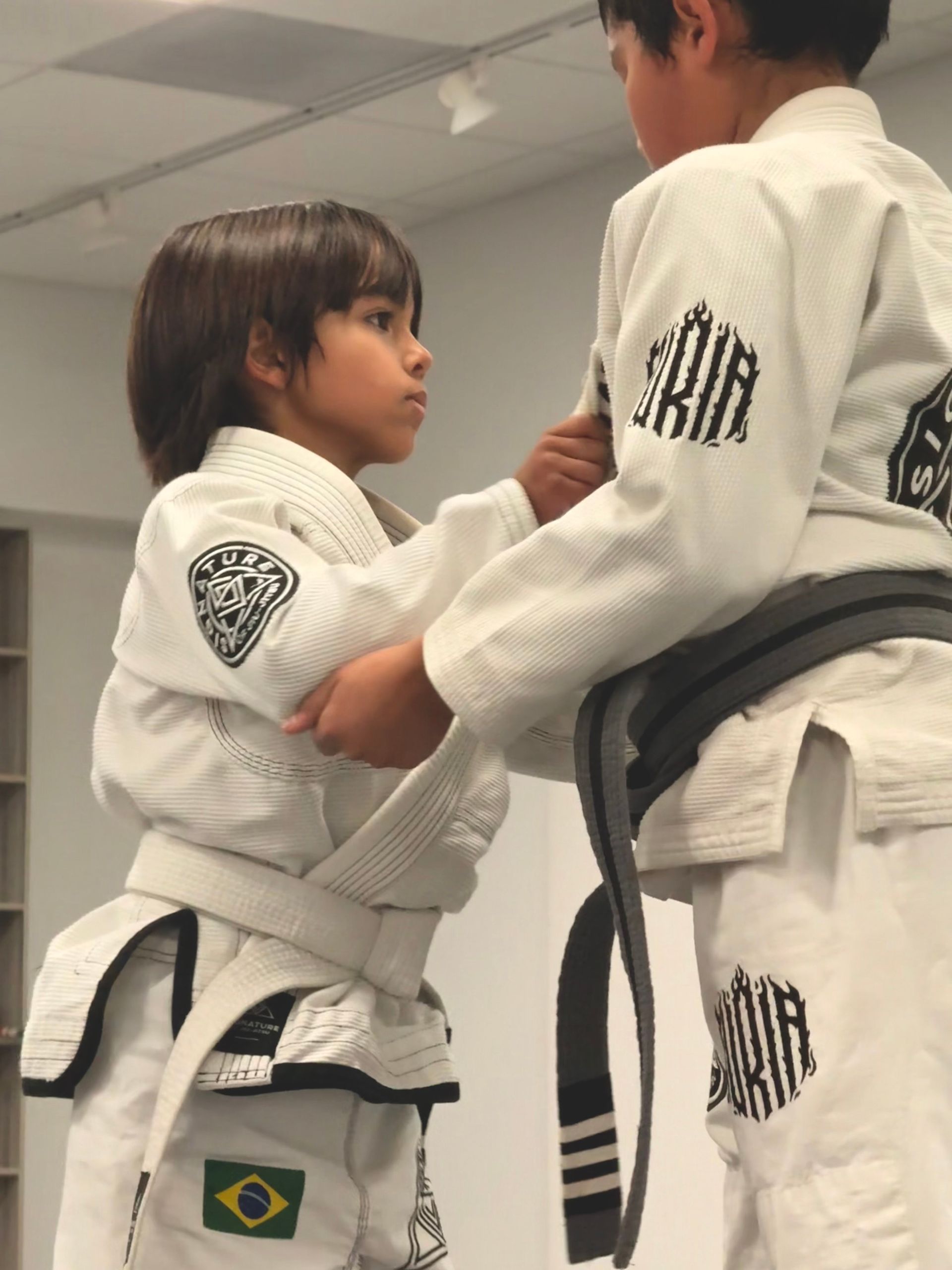
Youth Jiu-Jitsu turns communication into something kids can practice in real time, not just talk about.
If you’ve ever watched a child struggle to speak up, interrupt too much, or shut down when something feels hard, you already know communication is more than “using your words.” It’s listening, timing, confidence, and the ability to stay respectful when emotions show up. That’s exactly why we see Youth Jiu-Jitsu click for so many families in Belmont.
On the mat, communication is built into the activity itself. Kids have to listen closely, read body language, ask questions, switch partners, and solve problems with another person right in front of them. And because our classes are structured by age, we can coach those skills in ways that actually match where your child is developmentally.
In this article, we’ll break down how Youth Jiu-Jitsu in Belmont supports stronger communication habits at different ages, what “communication practice” looks like during class, and what you can realistically expect as your child settles into training.
Why communication improves faster when kids practice it under pressure
Most kids can communicate well when everything is calm. The real challenge is communicating when you feel rushed, embarrassed, frustrated, or unsure. In Youth Jiu-Jitsu, kids learn to stay engaged while their heart rate is up and their brain is working. That’s the environment where real skills form.
Here’s what makes the mat a powerful communication lab:
• Kids get immediate feedback from partners, not just adults telling them what to do.
• The “rules of engagement” are clear, so kids can focus on respect and self-control.
• There’s a natural back-and-forth in drills that requires turn-taking, attention, and timing.
• Small mistakes are normal, so kids get comfortable asking for clarification instead of guessing.
Over time, that repetition becomes a habit. We’re not just hoping a child becomes more confident. We’re giving them dozens of small reps each class where speaking up and listening closely are the practical way to succeed.
How communication happens on the mat, minute by minute
Parents sometimes assume Brazilian Jiu-Jitsu in Belmont is mostly physical, and communication is just a side benefit. In reality, communication shows up constantly, even in a beginner-friendly class.
Listening with intention, not just hearing instructions
In kids classes, we teach in short, clear segments so children can absorb what matters and apply it right away. That trains a very specific kind of listening: paying attention to details, then proving comprehension through action. When your child learns to listen for steps like grip placement, posture, or where to place a knee, that skill transfers to classrooms and sports practices quickly.
We also reinforce respectful listening. That means waiting, staying still, and tracking the coach even when you’re excited or distracted. It’s simple, but it’s not easy for a lot of kids at first.
Asking questions and learning to self-advocate
A quiet child often knows the answer but hesitates to speak. A talkative child may ask questions, but not at the right time. Youth Jiu-Jitsu gives both types of kids a structure for asking questions appropriately. We encourage kids to raise a hand, use a clear voice, and ask for the specific piece of help they need.
That’s self-advocacy, just in kid form. And it builds something parents love to see: a child who can say, “I don’t understand this part,” without melting down or pretending.
Non-verbal communication: posture, eye contact, and personal space
Kids communicate with their bodies long before they can explain what they’re feeling. Jiu-Jitsu makes body language obvious. If a child stiffens, turns away, or panics when pressure is applied, we can coach calming, breathing, and safe responses.
Kids also learn respectful boundaries. They learn what appropriate training contact looks like, how to keep control, and how to reset with a partner. That is communication too, especially for children who are still figuring out personal space.
Confidence, respect, and goal-setting: the communication triangle
We emphasize character, confidence, respect, and goal-setting in our kids program because those traits feed communication. When your child feels capable, it’s easier to speak clearly. When your child practices respect, it’s easier to listen. When your child has goals, it’s easier to handle feedback without taking it personally.
Goal-setting matters more than people think. A child who can say, “This month I want to remember my breakfall and one escape,” is learning to communicate progress. That’s a life skill: naming a goal, tracking it, and describing what helped.
We also use positive reinforcement to make communication feel safe. Kids don’t improve their voices by being shamed into silence. They improve when they feel guided, seen, and challenged in the right dose.
Why age-grouped classes matter for communication growth
Kids don’t communicate the same way at six, nine, and thirteen. That’s one reason we split our youth program into age bands: 5–7, 8–10, and 11–14. This keeps partners closer in size and maturity, but it also lets us coach the “soft skills” at the right level.
Ages 5–7: learning the basics of taking turns and using a calm voice
At this age, kids are still learning how to participate in a group. We focus on foundational habits: lining up, waiting, listening for one instruction at a time, and responding respectfully. Many kids also learn how to handle “no” and “try again” without spiraling.
Communication wins we often see in this group look like:
- Following a two-step direction without repeating it three times
- Raising a hand instead of shouting out
- Saying “I need help” instead of quitting
- Using gentle contact and stopping when asked
These are small moments, but they add up fast when practiced weekly.
Ages 8–10: clearer speech, better listening, and early strategy talk
This is a sweet spot for Youth Jiu-Jitsu in Belmont because kids can start connecting technique to problem-solving. They begin to explain what they’re doing, not just do it. We’ll hear things like, “I’m trying to shrimp out,” or “I lost my grip, can we reset?” That’s functional, respectful communication.
Kids in this band also get more comfortable giving and receiving feedback with partners. Learning to say, “Can you go slower?” or “I think my foot goes here,” is a big deal. It teaches kids that communication can be direct and kind at the same time.
Ages 11–14: self-awareness, composure, and leadership communication
Preteens and early teens deal with social pressure, identity, and sensitivity to embarrassment. Jiu-Jitsu can help because it normalizes learning in public. Everyone is improving, everyone is being coached, and nobody is “perfect.”
In this group, communication becomes more nuanced:
- Staying composed when something doesn’t go your way
- Talking through a sequence with a partner
- Leading by example during drills
- Managing tone when you’re frustrated
As teens mature, we also see stronger boundaries. A teen who can calmly say, “Please stop,” or “Let’s reset,” is practicing self-advocacy that matters well beyond sports.
The Winner’s Methodology and why structure helps kids speak up
We use the Winner’s Methodology for Children’s Jiu-Jitsu, and the big advantage is structure. Kids thrive when they know what to expect: warm-ups, technique, partner drills, and controlled live training appropriate to age and experience.
That structure creates a predictable space for communication:
1. Kids know when to listen and when to move.
2. Kids know how to get help, because the routine is consistent.
3. Kids learn the language of the sport in small pieces, so speaking up feels easier.
4. Kids understand expectations around respect, tapping, and partner safety.
When kids aren’t anxious about what’s coming next, they use more of their brain for learning, and communication improves as a result.
Communication skills kids build without realizing it
Some communication gains are obvious, like speaking louder or making eye contact. Others are quieter but just as valuable. In Youth Jiu-Jitsu, kids practice:
• Repairing mistakes quickly by resetting and trying again
• Reading a partner’s balance and movement, then responding appropriately
• Accepting correction from coaches without taking it as an insult
• Cooperating with different personalities during partner rotations
• Managing emotions when winning and losing in small moments
That last one matters in real life. The ability to lose a position, breathe, and keep going is basically emotional communication. It’s your child showing, “I can handle discomfort and still behave well.”
Gi and No-Gi: two ways to develop communication and adaptability
We train both Gi and No-Gi, and each format brings a slightly different communication challenge. In Gi, grips and fabric create more obvious “handles,” and kids often learn to slow down and think. In No-Gi, movement is faster and reactions matter more, so kids learn quick decision-making and clearer signals with their partners.
Switching between the two helps kids adapt. Adaptable kids tend to communicate better because they’re used to adjusting when circumstances change instead of freezing or forcing one approach.
What you can expect in the first month of Youth Jiu-Jitsu
Parents often ask what changes show up first. In the first few weeks, communication improvements usually appear as better listening and smoother participation, not dramatic personality changes overnight. That’s normal.
A realistic first-month timeline often looks like this:
1. Week 1: Your child learns the routine, basic safety rules, and how to “reset” with a partner.
2. Week 2: Your child starts using class language: tap, position, base, posture, and simple cues.
3. Week 3: Your child asks more specific questions and follows multi-step instructions more consistently.
4. Week 4: Your child shows more composure, even when something feels challenging or unfamiliar.
If your child is shy, you might notice a small but meaningful shift: answering questions without looking down, or volunteering to partner up instead of waiting. If your child is more assertive, you might notice improved patience and better tone. Both outcomes are communication wins.
Parent FAQ: safety, confidence, and social growth
Is Youth Jiu-Jitsu safe for beginners with no athletic background?
Yes, and we treat safety as a skill that kids learn from day one. We coach controlled movement, tapping, partner awareness, and age-appropriate intensity. Your child doesn’t need prior sports experience to start.
Will my child learn teamwork or is it all individual?
Kids develop plenty of teamwork because training requires cooperation. Partners help each other drill, take turns, and problem-solve together. Even when skills are individual, the learning process is shared.
What age is best to start?
Many kids do well starting at five, especially with age-grouped classes. What matters more than “the perfect age” is readiness to participate in a group and willingness to try.
How does this help with bullying, boundaries, or self-advocacy?
We focus on confidence, respect, and calm decision-making. Kids learn to set boundaries, handle pressure, and speak clearly when something feels unsafe or unfair. Those are practical self-advocacy tools.
How often should my child train to see communication benefits?
Consistency matters. Many families start with one or two classes per week and build from there. Communication gains come from repetition: listening, responding, and practicing respectful interaction again and again.
Ready to Begin
If you want your child to communicate with more confidence, more composure, and more respect, Youth Jiu-Jitsu is one of the most practical ways to build those habits while kids stay active. The skills are real, and the progress is measurable: clearer questions, better listening, calmer reactions, and stronger self-advocacy.
We run kids classes in Belmont for ages 5–14 and keep training structured, positive, and developmentally appropriate. When you’re ready, Signature of Jiu-Jitsu is here to help your child build communication skills that carry off the mat and into school, friendships, and family life.
Improve your fitness, confidence, and self-defense skills by joining a Brazilian Jiu-JJitsu class at Signature of Jiu-Jitsu.