
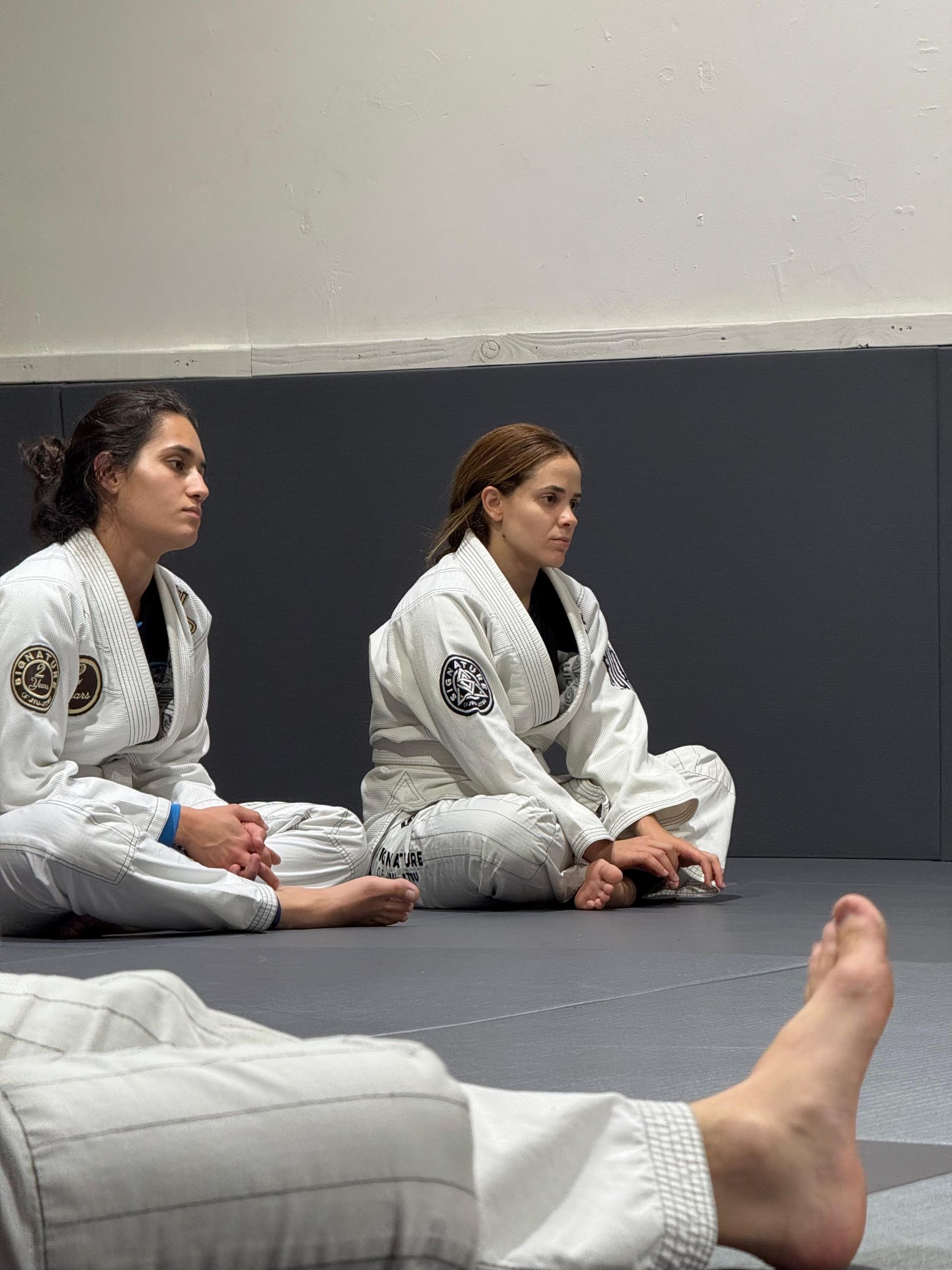
When your brain feels maxed out, training gives you a simple job: solve one problem at a time, calmly.
If you live and work around Belmont, you already know the mental load can be a lot. Screens all day, constant notifications, deadlines that creep into evenings, and that oddly tiring feeling of making decisions nonstop. Adult Jiu-Jitsu can be a practical reset for all of that, not because it distracts you, but because it trains your attention on purpose.
In our Adult Jiu-Jitsu classes, you’re not just learning techniques. You’re learning how to stay present while your heart rate is up, how to think clearly while pressure is real, and how to keep working a problem even when the first plan fails. That combination is exactly what many Belmont adults are missing when “focus tips” and productivity hacks stop working.
This article breaks down how Adult Jiu-Jitsu builds mental clarity and focus in a way that translates to everyday life, including high-stress work, parenting, and simply feeling more settled in your own head.
Why Adult Jiu-Jitsu feels like “human chess” for your brain
People call Brazilian Jiu-Jitsu “human chess” for a reason. Every position has options. Every option has tradeoffs. And the best choice depends on timing, leverage, and reading what’s happening right now (not what you wish was happening).
That’s a big deal for mental clarity. Clarity is not just calmness. It’s the ability to sort signal from noise and commit to the next best action. In Adult Jiu-Jitsu, you practice that skill repeatedly:
You’re pinned, you frame, you make space, you recover guard. You try a sweep, it stalls, you switch to a different angle. Nothing is theoretical, and your brain learns quickly that panicking wastes energy. Clear thinking gets rewarded.
For many people who join our adult Jiu-Jitsu in Belmont community, this is the first time in years their attention has been fully anchored to one task without multitasking. Not because we force it, but because the training environment naturally demands it.
The science behind clearer thinking: focus under pressure changes the brain
Mental clarity and focus are trainable. In Brazilian Jiu-Jitsu, you’re building those traits through a mix of cognitive challenge, emotional regulation, and repeated exposure to manageable stress.
Here’s what’s happening in plain language:
You train the prefrontal cortex to stay online
Your prefrontal cortex supports planning, decision-making, and emotional control. When stress spikes, many people shift into reactive mode. In sparring, we practice staying deliberate. You breathe, you choose, you execute, and you adjust.
That practice matters because the stress in class is real enough to trigger a response, but controlled enough to be safe. Over time, you learn that you can feel pressure without being owned by it.
Neuroplasticity rewards repetition and problem-solving
Jiu-Jitsu is not a single skill. It’s a network of skills: grips, posture, base, timing, transitions, and sensitivity to movement. Every class asks your brain to connect new dots. That repeated learning supports neuroplasticity, meaning your brain gets better at learning, adapting, and retaining.
If you’ve ever felt like your mind is “stuck” in the same loops, Adult Jiu-Jitsu gives you a new pattern: notice, solve, reset, repeat.
Mood and attention chemistry improves with consistent training
Hard training influences dopamine and serotonin regulation, and it also releases endorphins. We’re not presenting Jiu-Jitsu as a medical treatment, but we do see a consistent theme: after class, people feel steadier. The mind quiets down. The mental clutter thins out.
That post-training clarity is one reason adults keep coming back, even when the day was packed and showing up felt like a stretch.
Why Belmont adults in high-stress jobs often feel the change fast
Belmont sits right in the rhythm of Silicon Valley life. That has real upsides, but it also comes with a particular kind of fatigue: constant cognitive output with very little full-body discharge. You can “think” all day and still feel restless at night.
Adult Jiu-Jitsu helps because it creates a clean boundary. When training starts, you can’t answer Slack. You can’t half-listen. You can’t scroll. Your nervous system gets one job: pay attention.
For many adults training Brazilian Jiu-Jitsu in Belmont, the benefit shows up in a few practical ways:
• You switch tasks at work with less friction because you’ve practiced switching strategies mid-round
• You recover from mistakes faster because you’ve been put in bad positions and learned to problem-solve out
• You feel less reactive in meetings or tough conversations because controlled breathing and composure became habits
• You get a clearer sense of what matters today versus what can wait, because your brain practices prioritization constantly
This is why Adult Jiu-Jitsu tends to attract professionals, parents, and people who are tired of “mental wellness” advice that stays theoretical.
The mindfulness effect without sitting still
A lot of people want the benefits of mindfulness, but sitting quietly is not always the easiest entry point. Jiu-Jitsu creates a mindfulness-like state through action. During drilling and sparring, attention narrows to what’s real: posture, balance, pressure, timing, breath.
That’s basically presence, just louder and more physical.
In class, we’ll often cue breathing and pacing. When your breath gets ragged, your decision-making gets sloppy. When you slow your breathing down, you buy yourself time and options. Over time, you start noticing the same pattern in daily life: when stress hits, you can breathe first and respond second.
How a typical class builds focus from start to finish
Our Adult Jiu-Jitsu sessions are structured in a way that naturally trains concentration. You don’t need to be “good at focus” to start. You build it as part of training.
Here’s how the mental side shows up across the class:
• Warm-ups and movement: you connect mind to body and wake up coordination
• Technique instruction: you practice listening, visual learning, and detail retention
• Partner drills: you repeat patterns until they feel automatic, which frees mental bandwidth
• Live sparring: you test decisions under pressure, then learn from outcomes
• Cool down and reset: you leave with that calm, clear feeling that’s hard to fake
This structure is one reason adult Jiu-Jitsu in Belmont is such a strong fit for busy people. The hour does a lot, mentally and physically.
What you learn mentally as a beginner (and why it’s not intimidating)
Beginners sometimes worry they’ll feel lost, or that everyone else will be miles ahead. In reality, the first phase of Adult Jiu-Jitsu is where mental clarity often improves quickly because you’re learning the simplest, most useful habits: how to frame, how to breathe, how to survive, and how to keep thinking.
We coach you to focus on small wins. You don’t need to memorize everything at once. You need a few reliable responses that reduce panic and build confidence.
The beginner mental “upgrade” we see most often
Within the first 4 to 6 weeks, many students notice:
1. Better attention span during a single task because training demands full engagement
2. Less anxiety about being uncomfortable because you practice discomfort safely
3. More patience with learning curves because progress in Jiu-Jitsu is earned, not rushed
4. A calmer baseline mood, especially on training days
5. Stronger self-control under pressure, because sparring is emotional regulation practice
That’s a lot of carryover from something that starts as “I just want to try a class.”
Resilience is a focus skill, and sparring teaches it honestly
Focus is not only about concentration when things go well. It’s about staying engaged when things go wrong. Sparring teaches that in a direct way: you get swept, you reset. You miss a grip, you adjust. You tap, you learn, you go again.
That loop builds resilience, and resilience is what keeps your mind from spiraling during a stressful day. Research on experienced practitioners supports this, with advanced ranks showing higher mental strength, self-efficacy, self-control, and life satisfaction compared to beginners, and more training time correlating with better outcomes.
We keep sparring controlled and progressive so you can build that resilience without feeling thrown into the deep end. The goal is growth, not chaos.
A realistic timeline for mental clarity and focus benefits
Everyone’s different, but we like to set expectations that are motivating and grounded.
• After 1 class: you’ll usually feel immediate stress relief and a quieter mind afterward
• After 3 to 4 weeks: you’ll start noticing better composure and less mental noise on training days
• After 2 to 3 months: your decision-making under pressure improves, and focus carries over into work and life
• After 6 months and beyond: you’re building a durable skill set, including confidence, resilience, and sharper attention
If your schedule is tight, 2 to 3 sessions per week is enough to see meaningful change. Consistency beats intensity almost every time.
Take the Next Step
If you want a training routine that strengthens your body and gives your mind a cleaner, calmer edge, Adult Jiu-Jitsu is one of the most practical ways to do it. The techniques are engaging, the learning never gets stale, and the mental clarity you leave with tends to show up later when you least expect it, like during a hard conversation or a stressful deadline.
We’ve built our adult program at Signature of Jiu-Jitsu around structured learning, safe intensity, and a welcoming culture that makes it easier to start and easier to stick with it, even with a full Belmont schedule.
Train with intention and see real progress by joining a Jiu-Jitsu class at Signature of Jiu-Jitsu.