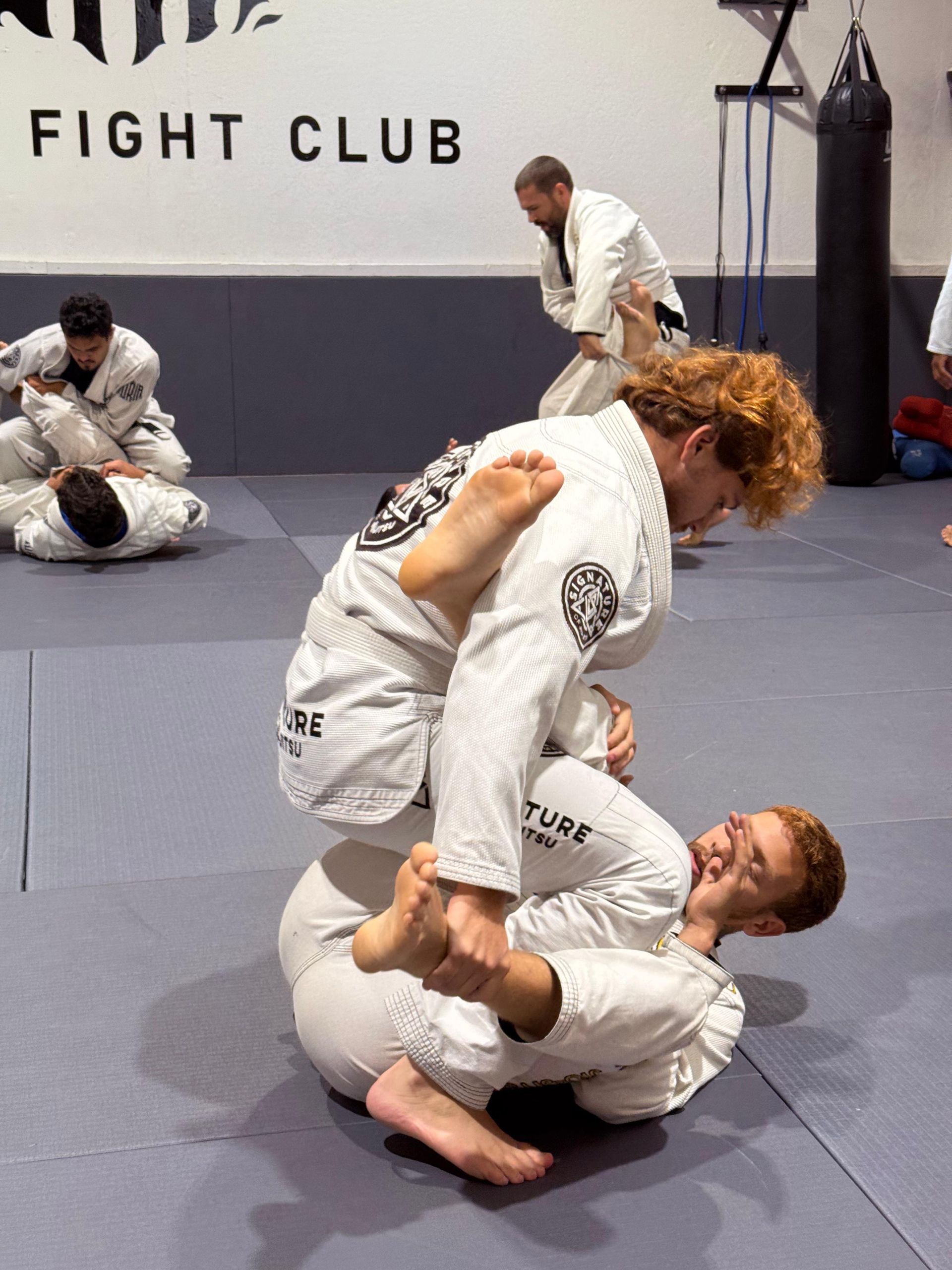
The real win of training is not just what you can do on the mats, but how steady you feel everywhere else.
Adult Jiu-Jitsu tends to surprise people. Many adults walk in thinking it is mainly about self-defense or getting back in shape, and those are real benefits, but what keeps most people coming back is resilience. You start noticing that stressful days feel more manageable, your focus gets sharper, and your confidence becomes quieter and more reliable.
In our Adult Jiu-Jitsu classes, we see the same pattern again and again: consistency builds capability, and capability builds calm. The process is not flashy. It is incremental, a little sweaty, sometimes humbling, and honestly pretty rewarding.
If you have been looking for adult Jiu-Jitsu in Belmont, you are probably balancing a full schedule and a real body, not a hypothetical one. Our job is to help you train hard and train smart, so you can make progress without feeling like you have to rearrange your entire life to do it.
Why Adult Jiu-Jitsu builds resilience faster than you expect
Resilience is a skill, not a personality trait you either have or you do not. Adult Jiu-Jitsu develops it because training puts you in manageable challenges, over and over, with feedback you can actually use. You do not just “get tougher.” You get better at solving problems while your heart rate is up.
Research on Brazilian Jiu-Jitsu shows more experienced practitioners score higher in mental strength, resilience, grit, self-efficacy, and self-control than beginners. That is not magic. It is practice, repetition, and learning how to stay composed when a situation is uncomfortable.
We structure training so you can experience pressure safely. You learn what to do when your first plan fails, how to breathe when you feel stuck, and how to reset instead of spiraling. Those habits carry over into work deadlines, family stress, and the general noise of adult life.
A resilience framework you can feel in real time
Adult Jiu-Jitsu gives you immediate feedback, which adults tend to appreciate. You are not guessing whether you improved. You can feel it. Small wins add up, like escaping a bad position that used to lock you down, or staying relaxed long enough to see an opening.
We also like the belt system for adults because it creates a clear path. In a world where progress can feel vague, the structure matters. Recent survey data suggests average timelines are about 2.3 years to blue belt and around 5.6 years to purple belt, with long-term development continuing well beyond that. That long horizon is part of the point: resilience is built through sustained effort, not shortcuts.
The mental health perks: stress relief, focus, and mental flexibility
Most adults do not come in saying, “I would like to build mental flexibility today.” But it shows up quickly. After training, many people report feeling calmer and mentally clearer, like the mental clutter gets turned down for a while.
Research lines up with that lived experience. A wellbeing study found 92.9 percent of participants reported enhanced mental flexibility, and 92.8 percent reported improved mood. Even more telling, 100 percent reported a sense of community. For adults, community is not a bonus feature. It is a major quality-of-life factor.
Adult Jiu-Jitsu can also complement mental health support in a practical way. Studies have linked BJJ training with decreases in PTSD symptoms and broader emotional difficulties. We are not presenting training as a replacement for professional care, but we do see how movement, challenge, and connection can support better mental health.
Why “thinking under pressure” becomes easier
Jiu-Jitsu is physical problem solving. You learn to make choices under real resistance, not rehearsed resistance. That matters because daily stress works the same way: you rarely get perfect conditions.
Over time, you start recognizing patterns faster and staying less reactive. You get used to discomfort without panicking. Your breathing improves. Your ability to pause improves. Those are resilience skills, and they are trainable.
Physical benefits that translate into real life, not just gym metrics
Adult Jiu-Jitsu is full-body training. It develops cardiovascular health, muscular strength, endurance, balance, and coordination. Because you are moving a person, not a machine, you also build body awareness in a way that tends to stick.
For adults over 30, this is especially useful because training can be scaled. You can train with intensity, but you can also train with control. We pay attention to smart pacing, clean technique, and appropriate resistance so you can keep showing up.
There is also evidence that functional training helps reduce injuries when people develop flexibility, strength, and awareness. In law enforcement populations training in BJJ, comprehensive physical preparation has been linked to measurable reductions in injuries. The underlying lesson is simple: when you know how your body moves, and you strengthen it through realistic patterns, you tend to get hurt less in regular life.
What changes first for most adults
In the first few weeks of Adult Jiu-Jitsu, many people notice:
• Better conditioning than expected, especially in short bursts
• Improved mobility through hips, shoulders, and spine from consistent movement
• Stronger grip and core endurance from controlling positions
• Better sleep after training days, the good tired that feels earned
• A more grounded posture and balance, even when you are not thinking about it
Those changes are not cosmetic. They are functional. You feel more capable getting through a long day.
Community: the underestimated advantage for busy adults
Adult friendships can be oddly hard to build. Everyone is busy, and most social time becomes transactional. Training changes that because you share effort with people. You learn together, you struggle together, and you improve together. That creates connection without forcing it.
Research backs this up strongly. In the same wellbeing survey, every participant reported a sense of community. We see why. The mat is one of the few places adults can show up as beginners again, without needing to pretend they have it all together.
That sense of belonging is also part of resilience. When life gets messy, having a consistent place to go, with familiar faces and a shared goal, can keep you steady.
Adult Jiu-Jitsu in Belmont: how we make training fit real schedules
If you are looking for Jiu-Jitsu in Belmont CA, chances are you are juggling work, commuting, family obligations, and whatever free time you can protect. Our class schedule is built to support consistency, because consistency is what produces results.
We also understand that adults start for different reasons. Some want self-defense. Some want fitness. Some want a challenge that is not another screen. Some simply want a structured practice that makes them feel more resilient and less scattered.
We keep the training environment focused and welcoming, and we coach in a way that helps you understand the “why,” not just memorize steps. Adults learn best when the system makes sense.
Realistic time commitment and what progress looks like
You do not need to train every day to benefit from Adult Jiu-Jitsu. Most adults make strong progress with two to three classes per week, especially in the first year. The key is showing up consistently, even when you feel a little tired or a little busy.
If you train once a week, you can still learn and enjoy it, but progress feels slower. If you train four to five days a week, progress can accelerate, but recovery becomes more important. We will help you find a rhythm you can maintain, because the goal is not a short burst. It is a practice you can keep.
Safety, injuries, and how we help you train with confidence
Let’s be direct: injuries can happen in jiu-jitsu. A 2019 study found 59.2 percent of BJJ athletes reported at least one injury in the previous six months. That statistic sounds intense until you add context: risk changes based on training age, training behavior, and how the room is structured. Beginners are often more likely to get hurt in training than in competition, largely because they are still learning how to move and when to tap.
Our approach is built around longevity. We coach control early, encourage smart tapping, and build intensity progressively. We would rather see you train for years than win a random round on a random Tuesday and disappear for a month.
Here is what we emphasize to reduce risk while still making training real:
1. Tap early and tap consistently while you learn the limits of positions and submissions
2. Choose training intensity intentionally, not emotionally, especially on tired days
3. Focus on clean technique before speed, because speed without control creates chaos
4. Communicate with training partners about injuries or limitations, no awkwardness needed
5. Prioritize recovery habits like sleep, hydration, and light mobility between classes
Those habits are part of resilience too. You learn to respect your body and keep moving forward.
The professional advantage: confidence, composure, and clearer decision-making
One of the most “unexpected perks” adults mention is how training changes the way you show up at work. Adult Jiu-Jitsu teaches you to stay calm in uncomfortable situations and to keep thinking when something does not go to plan.
That can translate into better meetings, clearer boundaries, and less emotional reactivity. You get used to problem solving with limited time and imperfect information, which is basically modern work life in a nutshell.
We also see adults become more comfortable being new at something. That mindset is valuable in any career. You stop attaching your identity to immediate success and start valuing the learning process. That shift alone can make you more resilient in professional environments.
What your first few weeks feel like (and why that matters)
Starting is the hardest part. Most adults feel a mix of curiosity and nerves. You might worry about being out of shape, doing something wrong, or slowing the class down. In reality, beginners are expected to be beginners.
Your first classes typically focus on foundational movements, basic positions, and simple escapes. You will learn how to stay safe, how to move efficiently, and how to train with partners respectfully. You will also probably laugh at least once, usually because you just learned how technical the “simple stuff” really is.
As you settle in, you start to recognize the real benefit: you are doing something challenging on purpose, in a controlled environment, with a clear path forward. That is resilience training, even if you never call it that.
Take the Next Step
Building resilience through Adult Jiu-Jitsu is not about turning you into a different person overnight. It is about giving you a practice that steadily improves your fitness, your confidence, and your ability to stay calm when life gets loud. If you have been searching for adult Jiu-Jitsu in Belmont, we have built our training to be practical, structured, and welcoming for real adults with real schedules.
When you are ready, we would love to help you get started at Signature of Jiu-Jitsu. Come in, train once, and see how it feels in your body and your mind, because that is where the change becomes real.
Develop strong fundamentals and take your training to the next level by joining a Jiu-Jitsu class at Signature of Jiu-Jitsu.