
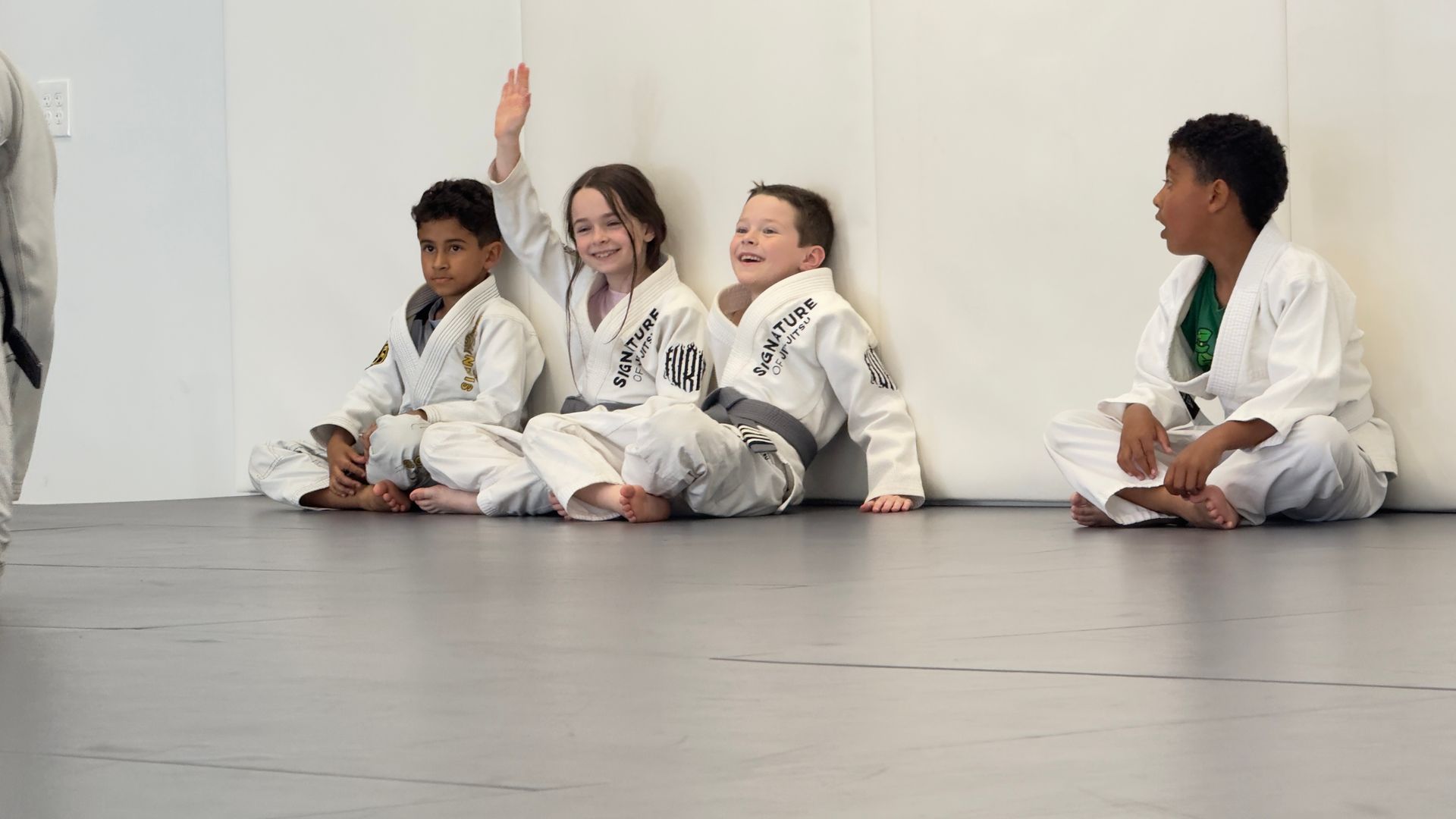
Youth Jiu-Jitsu can turn all that kid energy into calm attention, real confidence, and a room full of supportive teammates.
Parents in Belmont often tell us they want an activity that does more than “just wear kids out.” They want structure, positive coaching, and a place where children can move their bodies while also learning how to listen, try, reset, and keep going. Youth Jiu-Jitsu fits that sweet spot better than most activities because every class blends movement, thinking, and cooperation.
When you watch a kids class up close, the benefits stop feeling abstract. Youth Jiu-Jitsu is hands-on learning: children practice balance, coordination, and body awareness, but also patience and self-control. And because Brazilian Jiu-Jitsu is built around leverage and position rather than size and strength, it gives a wide range of kids a real chance to succeed, including beginners and non-athletes.
In our youth program here in Belmont, we keep the environment upbeat and structured. You will see kids working hard, laughing during games, and learning to treat partners with respect. That mix of focus, friendships, and fun is not an accident. It is how we teach.
What Youth Jiu-Jitsu Actually Teaches (Beyond Moves)
Brazilian Jiu-Jitsu in Belmont is sometimes misunderstood as “just grappling.” In reality, it is a skill system built around problem-solving and safe control. Kids learn how to move their hips, use frames, find balance, escape pressure, and stabilize positions. Those are physical skills, but they are also mental ones because each position asks a question and each technique is an answer.
We teach children to rely on leverage, positioning, and timing instead of trying to overpower someone. That matters for kids because bodies vary so much at the same age. In Youth Jiu-Jitsu, smaller students can still succeed by using angles and good habits, and bigger students learn control and responsibility instead of bulldozing.
Another key point: we teach that training is practice, not a fight. Kids learn to cooperate with partners, follow instructions, and stop immediately when a partner taps. If you are looking for an activity that rewards calm decision-making, this is it.
The Focus Loop: How Kids Practice Attention Without Feeling Lectured
Focus is not a personality trait you either have or do not have. It is a skill, and in Youth Jiu-Jitsu we practice it repeatedly in a way that feels natural.
Here is what “focus” looks like in a typical class moment:
- Your child watches a short demonstration and learns to track details.
- Your child tries the movement and discovers what feels awkward or confusing.
- We give a clear adjustment, sometimes tiny, like “turn your hips” or “move your knee here.”
- Your child tries again, gets a little better, and starts to remember the sequence.
That cycle is simple, but powerful. Kids learn to listen, attempt, accept feedback, and keep working. Some children lock in right away. Others need a few reminders and a reset. Either way, the class structure keeps bringing attention back to the same place: the skill in front of them.
For families searching Youth Jiu-Jitsu in Belmont, the big win is that focus is built into the training. It is not a separate lecture. It is how we make progress.
Friendships and Communication: Why Partner Training Builds Real Connection
A lot of kids activities are social, but Youth Jiu-Jitsu has a unique kind of social connection because partner work is built into nearly every class. Kids drill with each other, take turns, and learn how to be a good training partner. That means communicating, respecting boundaries, and practicing kindness in a very practical way.
We see friendships form because kids share challenges. Everyone struggles with something at first, like remembering steps, staying balanced, or escaping from under pressure. When kids realize their teammates are working through the same stuff, it breaks down walls quickly, even for shy students.
Partner training also teaches kids how to handle small moments of frustration. Maybe a technique does not work the first time. Maybe a partner is stronger. We coach children to breathe, adjust, and try again instead of shutting down. Over time, that creates resilience and a steady confidence that feels earned.
Why It Stays Fun (Even While Kids Are Learning Discipline)
If a program is all structure and no joy, kids quit. We keep training fun without turning it into chaos. Our classes include technical instruction, drills, and age-appropriate games that reinforce movement patterns. Games are not “just games.” They are how kids learn to move well, react quickly, and stay engaged.
We also like measurable progress. Kids enjoy seeing that they can remember a sequence, hold a position longer, or escape more smoothly than last month. Those wins matter, especially for children who do not always feel successful in traditional sports.
Fun also comes from the culture. When kids feel safe, supported, and noticed, they relax. And when they relax, learning happens faster. It sounds almost too simple, but it is true.
Safety in Youth Jiu-Jitsu: What We Do and What You Should Look For
No sport is risk-free, and we do not pretend otherwise. What we do is take safety seriously and keep training age-appropriate. For Brazilian Jiu-Jitsu in Belmont, that means children learn control first, then intensity comes later, and only when it makes sense.
We emphasize:
- Supervised practice with clear rules for partner work
- Warmups that prepare joints and muscles for movement
- Controlled drills that build technique without “wild” scrambling
- Partner matching that makes sense for size, experience, and maturity
- Tapping and immediate release, every time, no exceptions
- Hygiene expectations that help keep the mats and training space clean
We also want you to feel comfortable asking questions. On your first visit, you can watch how we manage the room: whether kids are being guided calmly, whether partners are rotating safely, and whether instruction stays organized. A safe program feels structured, not hectic.
Why Age Groups Matter: A Better Fit for 5 to 14
Kids develop fast, and a five-year-old learns differently than a twelve-year-old. That is why our Youth Jiu-Jitsu program is divided into three groups: ages 5 to 7, 8 to 10, and 11 to 14. Each group gets coaching that matches attention span, coordination, and emotional maturity.
Ages 5 to 7: Foundations, Listening, and Big Movements
At this age, our job is to build comfort on the mats and introduce the basics: how to move safely, how to follow directions, and how to work with a partner. We keep instructions simple and repeat key ideas often. Progress here looks like better balance, better listening, and less hesitation.
Ages 8 to 10: Skill Building and Problem Solving
This is a sweet spot for learning. Kids can remember sequences, handle more detailed coaching, and start connecting concepts. We increase technical detail and build habits that translate across positions, like posture, grips, frames, and controlled transitions.
Ages 11 to 14: Confidence, Composure, and Responsibility
Older kids can train with more intention and self-awareness. We focus on cleaner technique, more situational practice, and respectful intensity. This age group often appreciates that Brazilian Jiu-Jitsu rewards patience and smart decisions, not just speed or strength.
Our Teaching Approach: Supportive Coaching That Meets Kids Where They Are
Our youth classes are structured around an age-appropriate teaching approach called the Winner’s Methodology for Children’s Jiu-Jitsu. The goal is simple: help kids feel supported and capable while they learn real skills. We want children to leave class feeling like they worked hard and improved, not like they got yelled at or embarrassed.
We use positive reinforcement, clear boundaries, and consistent expectations. Kids learn respect because we model it. They learn discipline because class has a rhythm. They learn confidence because they can see progress, even if it happens in small steps.
And we do not expect perfection. Some kids are naturally calm. Some kids are wiggly and loud. Some kids are shy and need a little time. Our coaching keeps everyone moving forward, which is usually what parents are hoping for when they search Youth Jiu-Jitsu.
What to Expect in Your Child’s First Class
Trying something new can feel like a big deal for kids, even when they are excited. We keep first classes friendly and straightforward. You can help by arriving a bit early, so your child is not rushed and you have time to ask questions.
Here is a simple way to plan your first visit:
1. Check the class schedule page and choose the right age group for your child.
2. Confirm current uniform or clothing guidance before you arrive, since gi and no-gi requirements can vary by class.
3. Show up early for a quick orientation, introductions, and an easy transition onto the mats.
4. Let us know about any relevant needs, like prior injuries, allergies, or sensory concerns.
5. After class, ask your child what felt fun, what felt tricky, and what made sense.
Most kids do best with consistency. Starting with a sustainable routine matters more than doing everything at once. And if your child is nervous, that is normal. We will guide them in without forcing a spotlight moment.
Take the Next Step with Signature of Jiu-Jitsu
If you are looking for Youth Jiu-Jitsu in Belmont that balances structure, safety, and genuine fun, we would love to meet you. Our kids program is designed for ages 5 to 14, with coaching that fits each stage and a culture that encourages focus, friendships, and steady confidence.
You can visit us in Belmont at 915 Ralston Avenue and get a feel for the room, the coaching style, and how our students treat each other. When you are ready, we will help your child start with a clear plan, a welcoming first class, and a pace that feels doable at Signature of Jiu-Jitsu.
Continue your Jiu-Jitsu journey beyond this article by joining a class at Signature of Jiu-Jitsu.