
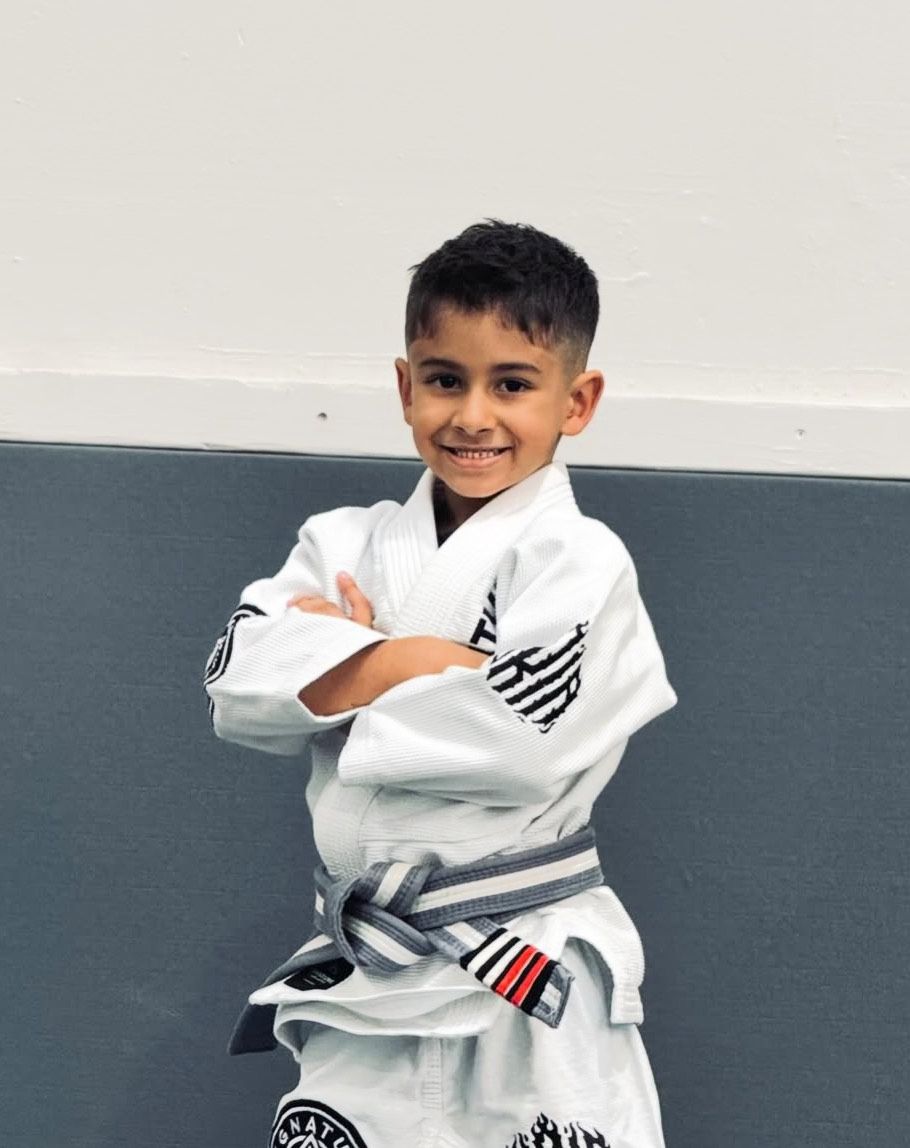
Youth Jiu-Jitsu gives kids a safe place to struggle, reset, and keep going until “hard” turns into “I’ve got this.”
Belmont families juggle a lot: school expectations, busy afternoons, and the constant pull of screens. When parents reach out to us about Youth Jiu-Jitsu, the first question is often about techniques. That makes sense, but it usually changes after the first few weeks. What families really notice is how training shapes a child’s ability to stick with something when it gets frustrating.
Youth Jiu-Jitsu is uniquely suited for that because the practice is built on repetition, problem-solving, and learning to stay calm under pressure. Research on martial arts programs consistently links training with improvements in physical fitness like coordination, balance, flexibility, and strength, and newer reviews highlight gains in self-control and emotional regulation in many kids who train consistently. In other words, the benefits go beyond the mat, and for Belmont parents, that matters.
In our youth program, we treat grit like a skill you can train. We keep classes structured, age-appropriate, and carefully supervised so your child can challenge himself or herself without feeling overwhelmed. The goal is steady progress, not perfection.
Why grit matters for kids in Belmont
Grit is not just toughness. For kids, grit looks like trying again after a mistake, staying respectful when something feels unfair, and continuing to participate even when confidence dips. Those are real-life skills for school, friendships, and sports.
Belmont students often face packed schedules and high expectations, which can be motivating but also stressful. Youth Jiu-Jitsu gives kids a weekly routine where effort is the main requirement. We teach kids to focus on controllables: posture, breathing, listening, and step-by-step problem solving. Over time, that turns into perseverance that shows up in homework habits, classroom behavior, and the ability to handle small setbacks without spiraling.
Martial arts research supports this direction. Reviews and scoping research on youth martial arts interventions frequently point to improvements in self-control, reduced aggression, and better social behavior. Those outcomes do not come from “winning.” They come from guided practice in a structured setting with clear expectations and consistent feedback.
Youth Jiu-Jitsu builds perseverance through safe, structured struggle
One reason Youth Jiu-Jitsu works so well for character development is that it includes “productive discomfort” in tiny doses. Your child tries a movement, it does not work, we adjust it, and your child tries again. That cycle repeats, and it creates emotional recovery. Kids learn that frustration is not an emergency, it is just information.
We keep that process safe by controlling intensity and pairing. We also keep the learning environment predictable. Kids do better when they know what comes next, especially kids who are shy, high-energy, or easily discouraged. A clear class format helps them settle in and stay engaged.
Over time, the mat becomes a practice space for life skills:
- Handling mistakes without melting down
- Listening the first time, even when excited
- Waiting your turn and respecting partners
- Asking questions instead of quitting
- Celebrating small improvements, not just big wins
That is grit, built in a way kids can actually understand.
What kids actually learn in class (beyond techniques)
Yes, we teach real Jiu-Jitsu fundamentals, and we do it in a way that fits the age group. But the deeper curriculum is behavior and mindset, taught through movement.
Self-regulation and focus
Many parents come to us hoping Youth Jiu-Jitsu will help with focus. We cannot promise a personality change in a week, but we can tell you what we train: attention cues, posture, breathing, and following multi-step directions. Martial arts guidance for youth athletes often highlights mindfulness and stress reduction as part of healthy training, and we see the value of that in day-to-day coaching.
Confidence that is earned
Confidence sticks when kids earn it. When a child learns a simple escape after struggling with it for a few classes, the pride is different. It is calm, not performative. That kind of confidence tends to show up in school presentations, social situations, and the willingness to try new things.
Social skills and respectful partner work
Youth Jiu-Jitsu is interactive by design. Kids learn to cooperate with partners, take feedback, and practice with control. Research increasingly connects martial arts participation with improved social skills and reduced conduct issues in some children, and partner-based training is a big reason why. Kids cannot progress without learning how to work well with other people.
Youth Jiu-Jitsu in Belmont: why families choose it as an after-school anchor
After-school hours can either disappear into screens or become a routine that supports health and maturity. Many Belmont parents want an activity that checks multiple boxes: physical fitness, discipline, and a positive peer group. Youth Jiu-Jitsu can do that when it is taught with consistent structure and clear boundaries.
Our classes give kids a place to move, sweat, and reset. They get coaching from adults who expect respectful behavior and follow-through, and they spend time around other kids who are also practicing self-control. That environment matters.
Parents also like that progress in Youth Jiu-Jitsu is visible without being tied to one “big game.” Kids can improve weekly. A better stance, calmer breathing, quicker listening, or a smoother drill counts as progress. For many kids, that steady feedback loop is exactly what helps them stay motivated.
Safety: what you should know before your child starts
“Is jiu-jitsu safe for kids?” is one of the most important questions, and we take it seriously. Youth martial arts guidance from a primary-care perspective often emphasizes the importance of supervision, appropriate intensity, and a culture that prioritizes self-control. That is the framework we use.
Here is what safety looks like in our youth program:
- We keep techniques age-appropriate and focus on control, not force
- We supervise partner work closely and set clear rules for contact and behavior
- We teach how to fall, move, and post safely to reduce awkward strain
- We progress intensity gradually so beginners are not thrown into chaotic training
- We reinforce tapping, stopping, and communicating early and often
We also pay attention to the “hidden safety” issue: emotional safety. Kids learn better when they do not feel embarrassed for making mistakes. We correct, we guide, and we hold standards, but we do it in a way that keeps kids willing to try again.
How Youth Jiu-Jitsu supports athletic development and motor skills
Youth Jiu-Jitsu is physical, but not repetitive in the way some sports can be. Kids crawl, bridge, rotate, balance, and coordinate their hands and feet while paying attention to a partner. That combination is a powerful driver of general athleticism.
Recent reviews of martial arts programs link participation to improvements in cardiorespiratory fitness, strength, flexibility, coordination, and balance. There is also evidence that martial arts interventions can support kids with motor difficulties, showing gains in balance, coordination, and overall motor skill development. We see that play out when kids who used to feel clumsy start moving with more control and confidence.
And since the movements are varied, kids tend to build “whole-body awareness” instead of just one sport-specific pattern. That can support other activities, too, from soccer to swimming to general playground confidence.
Youth Jiu-Jitsu vs team sports: what feels different for kids
Team sports can be great, and many of our students enjoy both. What feels different in Youth Jiu-Jitsu is accountability and feedback. A child cannot hide in the background. At the same time, a child is not judged by a scoreboard every week. Progress is personal, and that can be a relief.
Youth Jiu-Jitsu also trains problem-solving in real time. Kids learn to notice patterns, make decisions, and adjust quickly. That is a mental workout, not just a physical one, and it helps explain why martial arts research often discusses self-regulation and emotional control alongside fitness.
Another difference is that partner work requires cooperation even while “competing” in drills. Kids learn to challenge each other while staying respectful. That is a subtle skill, and it transfers to school group projects and friendships more than most parents expect.
The first 30 days: what you and your child should expect
The first month matters because it sets the tone. Kids usually go through a normal adjustment curve: excitement, then frustration, then a breakthrough moment where things start to click. We plan for that curve and coach through it.
Here is a realistic timeline we often see:
1. Week 1: Getting comfortable with the room, the rules, and the basic movements
2. Week 2: Learning how to partner up, listen under excitement, and repeat drills
3. Week 3: Feeling some frustration as techniques get more detailed, then learning to stay patient
4. Week 4: Noticing progress, better coordination, and a calmer response to mistakes
If your child is shy, we help with gradual participation and simple wins. If your child is high-energy, we channel it into structure and responsibility. If your child gets discouraged easily, we coach the skill of recovery: breathe, reset, try again.
This is also when you can support the process at home. A simple question like “What did you get a little better at today?” does more for grit than “Did you win?”
Practical FAQs for Belmont families
What age can my child start?
It depends on readiness more than a specific number. If your child can follow simple directions, participate safely with others, and handle brief frustration without shutting down, we can usually work with that. Our class schedule page helps you find the right age group.
What should my child wear to the first class?
Comfortable athletic clothing is usually fine for a trial. If your child continues, we will guide you on uniform basics, what fits properly, and what makes training safer and more comfortable.
How often should kids train to see progress?
Consistency beats intensity. Many families start with 2 classes per week and build from there depending on school workload and energy. Progress in Youth Jiu-Jitsu is easiest to see when attendance is steady.
Gi or no-gi for beginners?
Both can be beginner-friendly. The key is learning fundamentals, movement, and control. We coach beginners carefully regardless of uniform style, and we focus on skills that transfer across training.
Will jiu-jitsu help with confidence or bullying?
Youth Jiu-Jitsu can support confidence by teaching posture, boundaries, and calm decision-making. For bullying concerns, we emphasize awareness, self-control, and how to get help from trusted adults. The biggest shift many parents notice is that kids carry themselves differently when they feel capable and composed.
How do I know our program is a good fit?
Look for a class that is structured, supervised, and age-appropriate, with clear behavior expectations and a culture of respect. You should also feel comfortable with how we communicate progress, safety, and goals.
A family pathway: from kids’ classes to Adult Jiu-Jitsu in Belmont
Many Belmont parents like the idea of training alongside their kids, even if it starts later. Youth Jiu-Jitsu creates a foundation that can grow with your child for years, and it also opens a path for family training routines as schedules allow.
If you have ever been curious about Adult Jiu-Jitsu in Belmont, watching your child train can be the nudge you need. We make it approachable for beginners, and the long-term value is real: shared goals, healthy stress relief, and a family culture built around effort and learning.
Take the Next Step
Building grit is not a speech you give kids, it is a practice you give them. Youth Jiu-Jitsu works best when the environment is safe, structured, and consistent, and when kids are coached to recover after mistakes instead of fearing them. That is how perseverance becomes normal.
If you want a program in Belmont that treats character development and skill development as the same goal, we would love to show you how we run classes at Signature of Jiu-Jitsu and help your child get started with a clear, supportive plan.
Take what you learned here to the mats by joining a Brazilian Jiu-Jitsu class at Signature of Jiu-Jitsu.