Belmont desk life can dull your movement and attention, and Jiu-Jitsu is one of the most efficient ways to sharpen both.
Belmont has a familiar rhythm: long workdays, lots of sitting, and the kind of mental load that follows you home. Over time, that routine quietly steals two things most of us miss only after they fade: agility and focus. The good news is you can train both at once, and you can do it in a way that feels genuinely engaging, not like another chore on your calendar.
That is why we put so much emphasis on Jiu-Jitsu as a complete workout, not just a martial art. It is physical problem-solving under real resistance, where you learn to move well, breathe under pressure, and make smart decisions in real time. If you have ever left a typical gym session feeling like your body worked but your mind stayed scattered, this style of training often feels like the missing piece.
Brazilian Jiu-Jitsu in Belmont is also having a moment for a reason. Participation has surged in recent years, with martial arts enrollment rising about 15 to 20 percent annually in the U.S., and global practitioner estimates topping 5 million. People are choosing training that blends cardio, strength, and mental resilience, and our experience matches that trend: once you feel what focused grappling does for your energy and attention, it is hard to unsee the benefit.
Why Belmont techies need BJJ for agility
If your work keeps you at a desk, your body adapts. Hips tighten. Ankles stiffen. Shoulders round forward. Even if you lift or run, it is common to notice a gap in side-to-side movement, balance, and the ability to change direction quickly. Jiu-Jitsu fills that gap because it demands multi-directional movement, constant posture adjustment, and coordinated whole-body effort.
Agility in grappling is not just quick feet. It is the ability to shift your base, recover from awkward angles, and transition smoothly without panic. We train those skills in a controlled environment, step by step, so you build confidence in your movement rather than just powering through.
There is also a Belmont-specific reality we see all the time: talented, high-performing professionals dealing with a low-grade, always-on stress response. Jiu-Jitsu gives your nervous system a different kind of challenge. You cannot multitask. You cannot doomscroll. You have to be present, because another human is right there, reacting to your choices.
Jiu-Jitsu as the workout that trains your brain, too
We love strength training and conditioning, but grappling adds a layer most workouts cannot replicate: decision-making under pressure. You are constantly processing frames, grips, angles, distance, timing, and balance. That active learning is part of why people often report feeling mentally clearer after class.
There is also emerging evidence that intense, skill-based training can support cognitive sharpness. Studies suggest that as little as 30 minutes of grappling can increase BDNF, a brain-derived neurotrophic factor linked to learning and memory. No one needs to treat class like a neuroscience experiment, but it is encouraging to know that the mental snap you feel after training has a biological basis.
In practical terms, Jiu-Jitsu becomes a form of moving meditation with feedback. If you rush, you get off-balance. If you hold your breath, you fatigue. If you tune out, you get caught. Over time, you build a calmer attention that carries into meetings, parenting, and everything else that demands patience.
What makes Brazilian Jiu-Jitsu different from “just working out”
A treadmill is predictable. A weight is predictable. A training partner is not, and that is the point. Brazilian Jiu-Jitsu is a grappling-based martial art built on leverage and positioning, originally influenced by judo and later popularized in the U.S. through the Gracie family. The central idea is simple and powerful: technique can allow a smaller person to control a larger one.
That is why this training feels so functional. You are not rehearsing movement in the air. You are learning how to manage real pressure, real weight shifts, and real resistance. The conditioning you build comes from solving problems with your whole body, not from repeating a machine pattern.
We also keep safety and longevity at the center of training. Jiu-Jitsu can be intense, but it does not need to be reckless. When instruction is progressive and the room culture is respectful, you can train hard without feeling like you are sacrificing your joints for a short-term sweat.
How we structure classes so beginners feel comfortable fast
Most adults are not worried about working hard. They are worried about feeling lost. We get it. The first few classes can feel like learning a new language, especially if you have never grappled before. So we teach fundamentals in a way that keeps you oriented and lets you collect small wins quickly.
A typical beginner-friendly class includes technique instruction, drilling with a partner, and controlled rounds where you can apply what you learned. We scale intensity based on your experience and goals. If you are here for fitness and skill-building, you can train in a way that supports that. If you want deeper performance training, we can guide you there, too.
Here is what you can expect our beginner pathway to emphasize:
• Posture and base so you feel stable, not wobbly, even when someone is pushing or pulling you
• Escapes and defensive movement so you learn how to stay calm in tough positions
• Positional control basics like how to hold side control or mount without relying on strength
• Submissions taught with safety and precision, focusing on timing and leverage over force
• Live training rules and etiquette so you know how to roll responsibly from day one
Those details matter because comfort drives consistency, and consistency is what changes your body and your confidence.
Gi vs No-Gi: which one should you start with?
We teach both Gi and No-Gi because each format builds useful attributes. The Gi adds grips and friction, which slows the pace a bit and makes it easier to feel certain mechanics. No-Gi reduces grips and increases scrambles, so it often feels faster and more athletic.
If you are not sure where to begin, we usually recommend trying both and noticing what clicks. Some students love the technical puzzle of the Gi. Some love the movement of No-Gi. Most end up appreciating the balance, because the skills transfer in valuable ways.
In either format, our focus stays the same: smart positioning, efficient movement, and training habits you can sustain for years.
Adult training in Belmont: realistic goals and real progress
Adult Jiu-Jitsu in Belmont should fit into your life, not take it over. Many of our students train two to four times per week, and that is enough to see meaningful change in conditioning, mobility, and stress tolerance. If you can train more, great. If you can train less for a season, we help you stay connected and keep your momentum.
We also see a lot of “quiet progress” that people do not expect. You might notice you are sleeping better. Your shoulders feel less tight. Your patience improves. You walk into a hard conversation at work and do not spike as quickly. Those are not flashy outcomes, but they are real, and they add up.
And yes, you can start later than you think. Beginners over 40 do well when training is scalable and technique-focused. You do not need to be a former athlete. You need a willingness to learn and a commitment to show up consistently.
Why women and families stick with this kind of training
Participation trends show women’s involvement in BJJ rising sharply, with some reports estimating growth around 40 percent in recent years. That tracks with what we see: women want training that builds real capability, not just a fitness routine. In grappling, you develop control, boundary-setting, and the ability to stay composed under pressure. It is empowering in a grounded, practical way.
Our environment is family-friendly, and we take that seriously. When kids train, they build coordination, discipline, and confidence in a way that usually shows up at school and at home. When adults train, they model consistency and courage, and kids notice that, too.
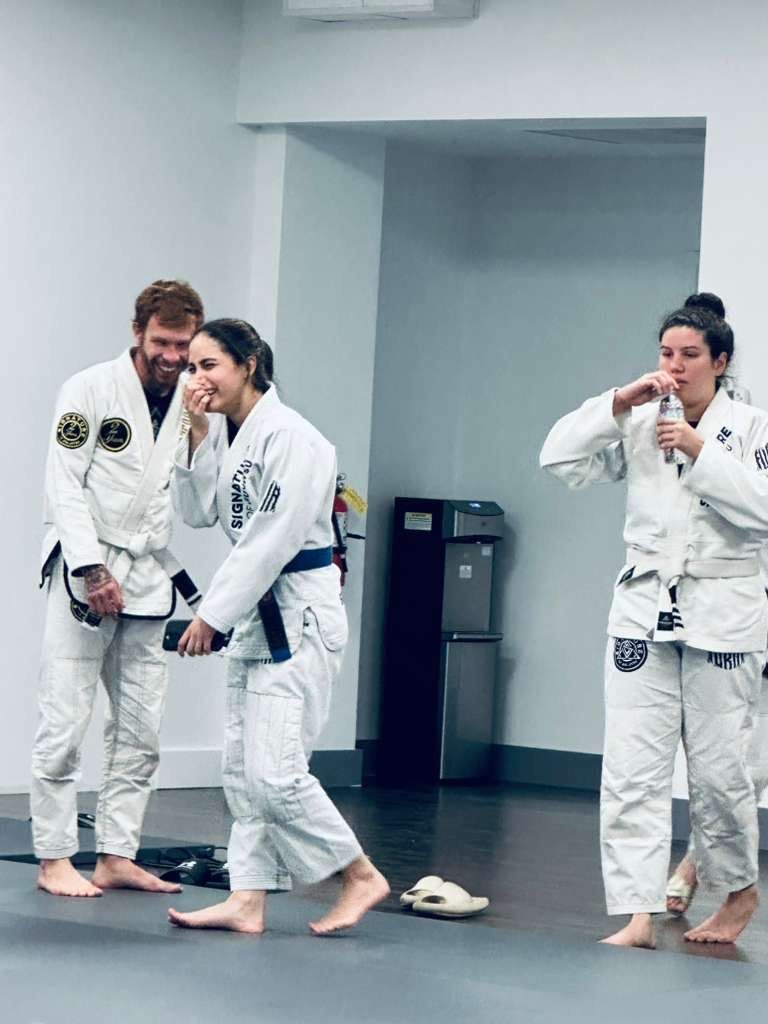
We also like how Jiu-Jitsu creates community without forcing it. You partner up, you help each other improve, and over time familiar faces become part of your week. For many Belmont residents, that social anchor is a big deal, especially when work is demanding and time is limited.
A day-by-day schedule that matches Belmont life
One of the biggest barriers to getting fit is friction: if the workout time does not match your actual schedule, you will skip it. We run classes throughout the day, seven days a week, so you can train before work, after work, or on weekends without feeling like you have to rearrange your whole life.
If you are a parent, flexible times make it easier to stay consistent. If you work hybrid, midday training can break up the day and reset your focus. If you travel, a fuller schedule gives you more chances to make up sessions when you are back.
To plan your week, we recommend a simple approach:
1. Pick two “non-negotiable” class days you can protect most weeks
2. Add a third optional day for when your schedule cooperates
3. Choose Gi or No-Gi based on what you enjoy that week, then stay consistent for a month
4. Track one measurable improvement, like fewer pauses while rolling or smoother escapes
5. Reassess after four weeks and adjust your training frequency realistically
That structure keeps the training sustainable, and sustainable training is what delivers long-term results.
What you gain that a gym routine rarely teaches
Traditional fitness can build muscles and endurance, but it often misses movement intelligence. Jiu-Jitsu forces you to coordinate breathing, balance, timing, and decision-making while tired. It also teaches you to stay composed in uncomfortable positions, which turns out to be useful far beyond the mat.
Here are a few outcomes we hear about most often:
• Functional strength that shows up in daily life, like carrying, lifting, and moving without feeling fragile
• Better mobility through hips, spine, and shoulders from varied movement patterns
• Improved cardio that comes from bursts of effort and active recovery, similar to real-world demands
• A calmer stress response because you practice staying relaxed while solving hard problems
• Sharper focus because live training requires immediate attention and clear priorities
Those benefits are why so many people in Belmont treat training like a cornerstone habit, not a short-term fitness phase.
Take the Next Step with Signature of Jiu-Jitsu
If your goal is to feel more athletic, more focused, and more capable in your own body, Jiu-Jitsu gives you a direct path to all three. We keep training practical, progressive, and welcoming, so you can start where you are and build from there without guessing what to do next.
When you are ready to try Brazilian Jiu-Jitsu in Belmont with a team that values technique, safety, and consistency, we would love to have you join us at Signature of Jiu-Jitsu for a free trial class and a clear plan forward.
Experience how Jiu-Jitsu builds resilience and focus by joining a class at Signature of Jiu-Jitsu.