Jiu-Jitsu gives you a practical way to practice calm under pressure, then carry that calmer focus back into real life in Belmont.
Stress is not just a feeling in your head. It shows up in your shoulders, your sleep, your breathing, and the way your mind keeps replaying tomorrow’s deadlines. Around Belmont, that pressure often comes from work intensity, long commutes, and the constant sense that you should be doing one more thing. We built our adult Jiu-Jitsu in Belmont program around a simple idea: if you can learn to stay relaxed while solving physical problems, you can get better at staying relaxed when life feels crowded.
Jiu-Jitsu is a rare kind of training because it asks your whole system to cooperate. You have to breathe, think, and move with control while someone gives you realistic resistance. That combination is exactly why so many adults use training as a stress reset, and why research keeps pointing to measurable mental health improvements, including reduced anxiety and stronger emotional regulation.
In this guide, we will show you beginner friendly Jiu-Jitsu moves and mini drills that directly support stress relief. You will also learn how we structure classes so you build confidence and resilience without getting crushed on day one. If you are looking for Jiu-Jitsu in Belmont CA as a healthier outlet for pressure, you are in the right place.
Why Jiu-Jitsu Works for Stress Relief (Not Just Fitness)
Most stress management advice is passive: sit, breathe, try to clear your mind. That can help, but it does not always translate to the moment you feel rushed, challenged, or mentally overloaded. Jiu-Jitsu trains your nervous system in a different way. You learn to function while your heart rate rises and your body feels pressure, then you learn how to downshift and recover.
There are a few mechanisms we see again and again in adults who train with us. First, you get the endorphin and mood lift from real exercise, plus the satisfaction of solving a problem with technique. Second, the “pressure simulation” is controlled and safe, which teaches your mind that discomfort does not have to become panic. Third, you get community, which is a bigger deal than most people expect when stress has been isolating.
Studies on Brazilian Jiu-Jitsu show striking mental health outcomes. In adult participants, large majorities report improvements in anxiety, confidence, and mood, with mood benefits reported at roughly 96.9 percent in one dataset and anxiety improvement around 87.5 percent. We cannot promise a number for any single person, but we can say this: the pattern is real, and you can feel it in how your breathing changes after a few weeks of consistent practice.
The Belmont Factor: High Output Lives Need High Quality Recovery
Belmont sits in the middle of Silicon Valley energy. That can be exciting, but it can also be relentless. We train with adults who spend all day making decisions, managing teams, shipping products, or caring for family, and the brain does not always switch off when the laptop closes. Stress stacks up quietly until it spills into sleep, digestion, or short patience.
Our goal is to make training a structured reset, not another chaotic demand. Adult Jiu-Jitsu in Belmont should feel like a clear hour where you know what to do, what to focus on, and how to measure progress. You will sweat, you will think, and you will leave feeling more organized inside your own body. That matters when your day to day life pulls you in ten directions.
A Simple Rule: Breathe First, Move Second
Before we get into specific techniques, we want to share the skill that changes everything: breathing under pressure. In Jiu-Jitsu, it is common for new students to hold their breath without realizing it. That triggers more tension, faster fatigue, and the familiar “I’m overwhelmed” feeling.
We coach a steady rhythm: inhale through the nose when possible, exhale long and controlled when you bridge, shrimp, or frame. Even if you forget the details of a move, remembering to exhale on effort keeps your body from spiraling into panic mode. Over time, that habit tends to show up outside the gym too, like when a meeting gets tense or traffic gets irritating.
Three Beginner Moves That Double as Stress Relief Tools
The best “stress relief” techniques in Jiu-Jitsu are not fancy. They are foundational movements that give you options when pressure shows up. Options create calm. When you know you have a way out, your body stops treating the moment like an emergency.
Bridge and Roll Escape (Upa) for the Panic Reset
This is one of the first escapes we teach because it turns a stuck position into a structured sequence. If you have ever felt trapped under a heavy pin, you know how quickly the mind can race. The bridge and roll gives you a simple checklist, which is calming by itself.
What it trains mentally is important: you learn to pause, align your body, and then use timing instead of frantic pushing. That translates well to stressful moments off the mat, where “do the next right step” beats “try everything at once.”
Key points we coach:
- Plant your feet close to your hips so your bridge is strong without straining your back
- Secure an arm so your partner cannot post and stop the roll
- Bridge up, not just sideways, so you create real lift
- Exhale as you bridge, then stay compact as you turn
When students start using the bridge and roll confidently, we see shoulders drop and breathing smooth out. It is not magic. It is a practiced response to pressure.
Shrimp Escape (Hip Escape) for Mobility and Mental Flexibility
Shrimping looks simple, but it is one of the most useful movements in all of Jiu-Jitsu. It teaches you how to make space even when someone is close, and it builds hip mobility that many adults lose after years of desk posture.
For stress relief, shrimping works because it is rhythmic. You can repeat it across the mat like a moving meditation, but with a practical outcome. We often use it in warmups, and you can feel the spine and hips wake up in a way that makes your whole body feel less “stuck.”
We emphasize:
- Turning to your side rather than trying to scoot flat on your back
- Using your feet to push and your hips to slide, not your neck
- Keeping your elbows in so your shoulders stay safe
- Moving in clean repetitions instead of rushing
This is also where mental flexibility comes in. If your first shrimp does not create enough space, you do another one. That lesson, repeat the correct action calmly, is a stress skill.
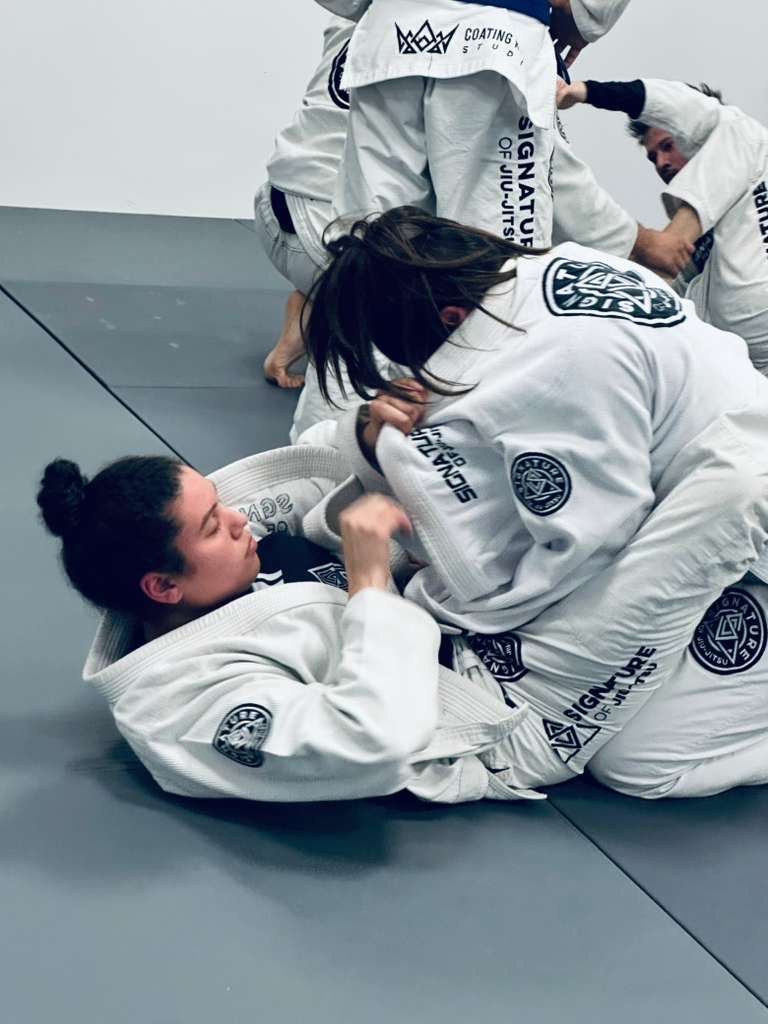
Closed Guard Posture Break to Sweep Setup for Focus Under Resistance
Being in someone’s guard can feel like mental noise: hands grabbing, legs controlling, balance changing. We teach posture and base as a way to quiet that noise. When you can stabilize your spine and keep your head and hips aligned, you think more clearly.
From the bottom, learning to break posture and set up a sweep teaches you patient problem solving. You are not forcing. You are building a sequence: control, angle, off balance, then action. That is the same structure we want you to use when life feels messy.
A basic flow we teach:
1. Establish safe grips and keep your elbows close so you are not overreaching
2. Pull to break posture while you keep your hips active
3. Create an angle with a hip shift so your sweep has leverage
4. Off balance your partner, then commit to the sweep with a steady exhale
5. Settle on top and stabilize before you chase the next move
This kind of training is why Jiu-Jitsu helps adults build confidence. You learn that you can be calm and effective at the same time.
How We Keep Adult Training Safe, Structured, and Beginner Friendly
A common worry is safety, especially for adults with old injuries, tight hips, or stress already in the body. We take that seriously. Our classes are built to scale intensity so you can learn without feeling thrown into the deep end.
We start with fundamentals and position awareness, because technique protects you better than raw effort. When you rely on strength, you tense up, and tension is where tweaks happen. When you rely on mechanics, you can stay relaxed and move with control. That is better for your joints and your nervous system.
We also treat tapping as a skill, not a failure. Tapping early and consistently lets you train longer, recover better, and keep your stress relief habit sustainable. If your main goal is to handle pressure better, training smart is part of the plan.
What “Calm in the Storm” Looks Like on the Mat
In the beginning, most adults feel the same three sensations during live practice: breathlessness, decision overload, and tight muscles. The shift happens when you start recognizing patterns. You learn that certain positions repeat, certain escapes work, and you do not need to react to every movement.
We coach you to narrow your focus. Instead of thinking about ten techniques, you might focus on one priority, like framing to protect space, or recovering guard, or improving posture. That is a mental skill you can take to work: prioritize one controllable action, then build from there.
If you train at least twice per week, you give your brain enough repetition to adapt. Recent trends in martial arts research suggest that consistent practice at that frequency is strongly associated with improved resilience and focus. Again, results vary, but consistency tends to beat intensity.
Stress Relief Benefits You Can Expect Over Time
Some benefits show up quickly, like improved mood after class and better sleep that night. Others build slowly, like confidence under pressure and the ability to recover emotionally after a tough day. The long term outcomes are why adults stick with Jiu-Jitsu, even when schedules get busy.
Here is what many students report as training becomes a routine:
- Better emotional regulation because you practice thinking while your heart rate is elevated
- Reduced baseline tension in the neck, shoulders, and jaw as breathing improves
- More confidence from small wins, like escaping a pin or completing a sweep
- Improved mobility and core stability that makes daily movement feel easier
- A stronger sense of community, which can be a quiet antidote to stress
These are not abstract ideas. You can measure them in real life: fewer stress headaches, more patience with family, better posture at your desk, and a clearer mind when something unexpected happens.
How to Train for Stress Relief Without Burning Out
Stress relief training should leave you energized, not wrecked. We recommend a simple approach: show up consistently, stay technical, and gradually increase intensity as your comfort grows. If you arrive already exhausted, you can still train, but we may guide you toward lighter rounds or positional work so your body gets what it needs.
Hydration, sleep, and nutrition matter too, not in a perfectionist way, but in a practical way. Jiu-Jitsu in Belmont CA should support your life, not compete with it. When you treat training as part of your recovery system, it becomes easier to stay consistent, and that is when the mental benefits really compound.
Take the Next Step
Building stress resilience does not require you to be fearless or naturally athletic. It requires a place where you can practice composure, learn smart movement, and feel supported as you improve. That is exactly what we aim to provide every day at Signature of Jiu-Jitsu in Belmont.
If you are curious about adult Jiu-Jitsu in Belmont, we invite you to experience a class and see how the techniques in this article feel in your own body. The small details, like breathing under pressure and moving with leverage, are where the real stress relief starts to take root.
Put these techniques into practice by joining a Jiu-Jitsu class at Signature of Jiu-Jitsu.