The fastest way to feel calmer under pressure is to practice staying calm while you are under pressure.
Most people come to Jiu-Jitsu for practical reasons: a better workout, real self-defense, a new challenge, or a way to shake off stress after work. What surprises many beginners is how quickly training starts changing the way you think, not just the way you move. You learn to breathe when you want to tense up, to problem-solve when you want to quit, and to keep showing up even on the days you feel a step behind.
In Belmont, life moves at a steady pace, but it is still full of pressure: long workdays, family responsibilities, and the constant sense that your brain is always on. Our goal is to give you a place where you can train hard, learn smart, and leave feeling more capable than when you walked in. Jiu-Jitsu gives you that kind of progress you can actually feel in your body.
Mental toughness is not a personality trait you either have or you do not. It is a skill set, built through consistent training and a supportive room where you can fail safely, learn, and try again. And strength, the kind that matters in everyday life, comes from moving with control, balance, and intent, not just lifting heavier and heavier weights.
Why Jiu-Jitsu Builds Mental Toughness So Reliably
Jiu-Jitsu puts you in problems on purpose, in a controlled way. You start in a position where you are uncomfortable, then you work methodically to improve it. That is the whole game. Over time, you stop panicking in bad spots because you have been there before, you know you can survive, and you know there is a way out.
A big part of mental toughness is learning to separate discomfort from danger. When you are brand new, any pressure can feel like an emergency. With practice, your nervous system calms down. You notice details. You make better choices. That ability carries into real life: difficult conversations, stressful deadlines, and those moments where your heart rate jumps for no good reason.
We also train you to be realistic about progress. Some weeks you feel sharp and strong. Other weeks you feel like everyone suddenly got better overnight. That is normal. The toughness comes from continuing anyway, paying attention, and trusting that the work adds up.
Composure Under Pressure Is a Trainable Skill
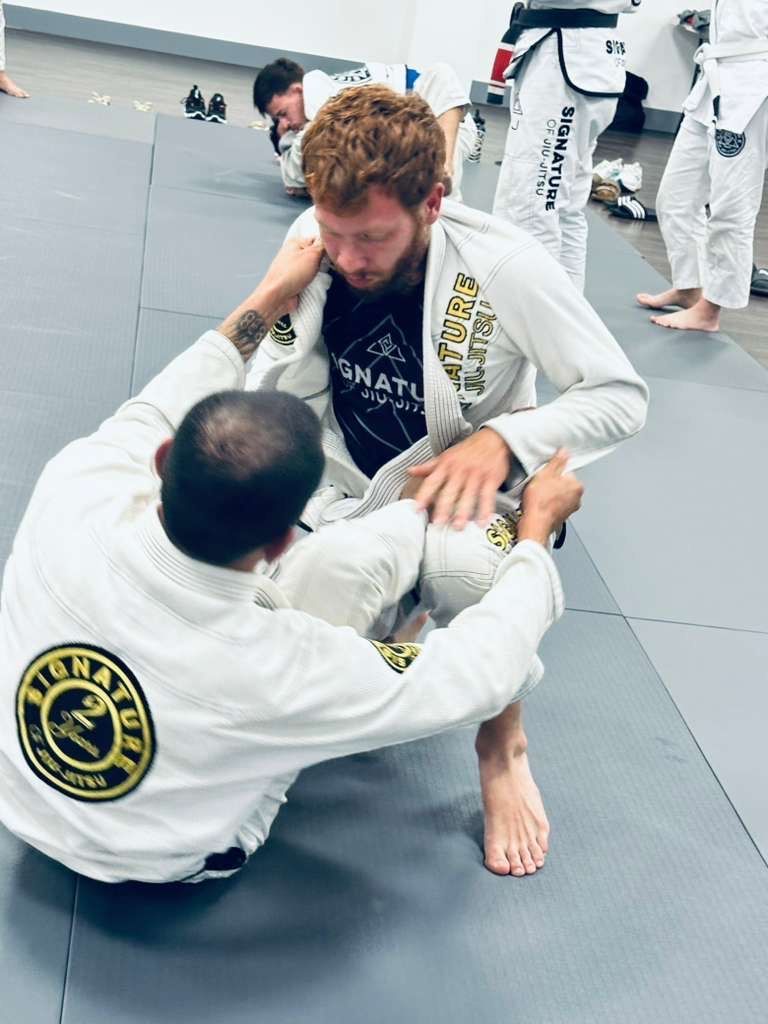
In Jiu-Jitsu, you cannot fake calm. If your breathing gets shallow, your muscles burn faster. If your mind goes blank, you give up positions you could have defended. So we teach you to slow down and stay present, especially when you feel crowded, pinned, or out of options.
One of the simplest habits we reinforce is breathing with intention. When you get stuck, you exhale, you frame, you make space, and you rebuild position. It sounds small, but it is the difference between reacting and responding. That is composure.
Problem-Solving Beats Brute Force
A lot of adults worry that they need to be strong to start. Strength helps, sure, but technique decides most exchanges. When you learn how leverage works, you stop trying to win every moment with effort alone. You start asking better questions: Where is the weight? Where is the space? What is the safest next step?
That mental shift is one reason Brazilian Jiu-Jitsu in Belmont attracts busy professionals and parents. You get a workout, but you also get an hour where your brain is fully engaged in one task. No multitasking. No doom scrolling. Just solving the puzzle in front of you.
Building Strength the Way Jiu-Jitsu Demands
Strength in Jiu-Jitsu is not only about max power. It is about using your whole body together: hips, core, grip, posture, and timing. You build strength by moving through resistance, repeatedly, with control.
When you train consistently, you develop what we call usable strength. Your base gets stronger. Your posture improves. Your core becomes more responsive. You learn to generate force from the ground up, and you learn when not to waste it.
If your goal is to feel athletic again, Jiu-Jitsu is a practical path. You are pushing, pulling, bridging, rotating, and stabilizing, often all in the same round. You also get plenty of mobility work without it feeling like a separate chore.
What Gets Stronger First
Many students notice changes in a predictable pattern. Your cardio improves because you are learning how to pace. Your grip endurance improves because you are controlling positions. Your core improves because you are constantly resisting twists and collapses.
Here are a few strength qualities we see develop quickly with steady training:
• Positional strength, the ability to hold posture and structure when someone is trying to break it
• Hip strength, especially in bridges, shrimping, and standing up safely from the ground
• Grip and forearm endurance, from controlling sleeves, collars, wrists, or ties
• Core stability, from framing, rotating, and keeping alignment under pressure
• Movement efficiency, because you stop doing extra work and start choosing better angles
This is one reason Adult Jiu-Jitsu in Belmont works so well for people who do not love traditional gyms. The strength comes as a side effect of learning the art.
Gi vs No-Gi: Choosing the Format That Fits You
We offer both Gi and No-Gi classes because each format teaches you something valuable. If you are unsure where to start, you are not alone. The good news is that you can try both and feel the difference pretty quickly.
The Gi adds grips and friction. That slows the pace a bit and rewards patience, control, and precision. No-Gi removes those grips and tends to move faster, with more emphasis on body positioning, clinching, and connection.
Neither is better. Each is a tool. If your goal is self-defense and overall skill, cross-training both styles gives you a wider base.
Quick Differences You Will Feel Right Away
Gi tends to feel like a chess match with more handles. No-Gi tends to feel slippery and scrambly at first. In both, we coach you to prioritize safety, posture, and clean technique. If you are brand new, we will help you choose a class that matches your comfort level and your learning style.
A Beginner-Friendly Approach That Still Challenges You
Starting something new as an adult takes humility. You may be successful in your career, responsible in your life, and still feel clumsy during your first week on the mats. That is normal, and honestly, it is part of the value.
We structure training so you can learn fundamentals without getting overwhelmed. You will drill techniques with a partner, ask questions, and build up your understanding step by step. Live training is introduced in a way that respects your safety and lets you apply what you are learning.
We welcome first-time beginners and experienced practitioners, so the room has a healthy mix of skill levels. That matters because it creates a ladder you can climb. You can train with someone more experienced when you want guidance, and you can train with someone closer to your level when you want to test yourself.
What to Expect in Your First Class
Your first class should feel welcoming, organized, and clear. You will warm up, learn a small set of techniques, drill them, and then finish with positional rounds or controlled sparring depending on the class. You do not need to be in shape before you start. Training is how you get in shape.
If you are wondering what to wear, you can keep it simple. For No-Gi, athletic clothing that fits and does not have pockets is a good start. For Gi, we can point you toward the right uniform options. Bring water. Show up a little early so we can get you oriented without rushing.
Training for Confidence and Real-World Self-Defense
Confidence is not about feeling invincible. It is about feeling prepared. In Jiu-Jitsu, you learn how to manage distance, control positions, and escape when you are underneath someone bigger. You learn how to stay calm and how to protect yourself intelligently.
Our training emphasizes real mechanics: posture, base, leverage, and awareness. You will practice getting off the ground, defending common holds, and controlling a situation without relying on strength alone. For many adults, that is the point. You want skill you can trust, not theory.
We also build a habit of accountability. When you train, you show up for yourself. That routine alone can be a quiet kind of confidence builder, especially when everything else in life feels noisy.
Women’s Training: Strength, Boundaries, and Practical Skill
We offer classes that welcome women who want a supportive place to train. Some women come in focused on self-defense. Others come for fitness, stress relief, or a new challenge that feels meaningful. Often it becomes all of the above.
Jiu-Jitsu is uniquely suited for smaller practitioners because it is built around leverage and control. You learn how to frame, create space, and escape, then how to improve position and stay safe. You also gain something that is hard to explain until you feel it: comfort in close contact and pressure, without freezing. That is a real skill.
Training also strengthens boundaries. You learn what controlled intensity feels like. You practice saying yes or no in a structured way, like choosing how hard to spar or when to reset. That carries over into everyday life more than people expect.
Family-Friendly Training in Belmont
We teach kids, adults, and women, and that mix creates a strong community feel. For families in Belmont, it is helpful to have one place where everyone can train, improve, and share the same values: discipline, respect, and consistent effort.
Kids gain coordination, confidence, and focus. Adults gain stress relief, conditioning, and practical skill. When families train in the same environment, it becomes easier to keep a routine. And routines are where progress lives.
We keep the culture supportive and structured. You should feel like you can ask questions, learn at your pace, and still be challenged. That balance matters.
How Often Should You Train to Build Toughness and Strength?
Consistency beats intensity. If you train once in a while, you will learn techniques, but they will not stick the same way. If you train regularly, your body adapts, your timing improves, and your confidence grows.
We usually recommend starting with two to three classes per week if your schedule allows. That frequency gives you enough repetition to remember what you learn, without feeling like training takes over your life. If you can only do one class per week, start there and build. The key is to keep it sustainable.
Here is a simple progression many adults follow:
1. Weeks 1 to 2: Learn basic positions, tapping, and how to move safely on the ground
2. Weeks 3 to 6: Build a small set of escapes and controls you can repeat with confidence
3. Months 2 to 3: Start connecting techniques, improving cardio, and understanding timing
4. Months 4 and beyond: Refine your game, train with more intention, and feel real momentum
If you stay patient, the results show up in a steady, honest way. Your body changes, your mind settles, and hard days become easier to handle.
Ready to Begin
Building mental toughness and strength is not about chasing perfection. It is about putting yourself in a place where you can practice discipline, learn real skills, and walk out a little stronger each week. That is exactly what we aim to deliver, with Gi and No-Gi options, beginner-friendly coaching, and a community that takes progress seriously.
When you are ready to train Brazilian Jiu-Jitsu in Belmont with experienced instruction, we would love to welcome you to the mats at Signature of Jiu-Jitsu, where our programs are designed for kids, adults, and women, including complete beginners.
Move from reading to rolling to join a Jiu-Jitsu class at Signature of Jiu-Jitsu today.