Jiu-Jitsu is one of the fastest-growing martial arts in the U.S., and beginners in Belmont can start safely with the right plan.
Starting something new is exciting, but it can also feel oddly specific in the questions it creates: What do I wear, where do I stand, what if I mess up the warm-up, and how do I know what to practice first? If you are searching for Jiu-Jitsu in Belmont CA, you are usually not looking for hype. You are looking for a clear, beginner-friendly path that actually works.
We teach Jiu-Jitsu as a practical skill set you build one class at a time. It is also a surprisingly effective way to get in shape without staring at a treadmill timer. Nationally, interest in Brazilian Jiu-Jitsu has climbed steadily for years, and the community keeps growing because the training stays engaging and real.
In this guide, we will walk you through what to expect, how to start, what fundamentals matter most, and how to train in a way that keeps you progressing while staying healthy. If you have been curious about Brazilian Jiu-Jitsu in Belmont, this is your roadmap.
What Jiu-Jitsu Actually Is (And Why Beginners Love It)
Jiu-Jitsu is a grappling-based martial art centered on control, leverage, and submissions. Instead of relying on strikes, you learn to manage distance, off-balance an opponent, and use positioning to stay safe. For many beginners, that makes training feel approachable because technique matters more than raw athleticism.
A useful way to think about it is problem solving with your body. Someone closes space, you frame and recover guard. Someone pins you, you escape to a better angle. Each round teaches you something, even when you are tired and your brain is trying to remember the name of that one position.
This style also scales well. You can train hard when you want, or train more technical and controlled on days you need it. That flexibility is one reason Brazilian Jiu-Jitsu has expanded so quickly in the U.S., with hundreds of thousands of practitioners and a market that continues to grow with fitness adoption and tournament visibility.
Why Training in Belmont Fits Real Life in the Bay Area
Belmont is close enough to the energy of San Francisco and Silicon Valley, but day-to-day life here still runs on schedules, commutes, and family logistics. We build our programs with that reality in mind because consistency matters more than intensity when you are starting.
Most beginners do best with a simple rhythm: show up, learn one or two concepts, repeat them often, and slowly add layers. If you train two to three times per week, your progress tends to feel steady without your body feeling beat up. More is not always better at the beginning, especially when your muscles are adapting to new movement patterns and grips.
California also has a strong grappling culture, and that helps newcomers. You will be surrounded by people who understand that everyone starts somewhere, and that the first win is simply walking through the door and getting on the mat.
Gi vs No-Gi: What You Should Start With
Beginners often ask whether they should start with a gi or no-gi. We like beginners to understand both, but starting with the gi is a straightforward way to learn fundamentals because grips slow the action down and make control more visible.
In the gi, you wear a traditional uniform that gives you handles, so posture and spacing matter immediately. In no-gi, you wear shorts and a rash guard and rely more on body locks, head position, and movement. Both are valuable, and both teach timing, balance, and pressure.
If your goal is self-defense, fitness, or just becoming more capable, either style will support you. The important part is training in an organized, progressive way so you are not guessing what to work on.
What You Will Learn First: The Real Beginner Fundamentals
Early training should focus less on flashy submissions and more on positions and escapes. When you can control where the fight happens, everything else becomes easier.
We structure our beginner progression around a few core building blocks:
• Base and posture: staying balanced so you do not get tipped over easily
• Frames: using forearms and structure to create space without muscling
• Guard and guard retention: keeping your legs between you and pressure
• Escapes from bad positions: mount, side control, and back control basics
• Top control: learning how to pin safely and move with pressure
Submissions are part of the system, but they make more sense after you can reliably hold position. Modern competition data reflects this too, with chokes making up the majority of finishes at high levels. That does not mean beginners should chase chokes right away, but it does show how positioning and control lead to the most consistent results.
What a First Class Usually Feels Like
Your first class is rarely dramatic. It is more like, “Oh, this is technical,” followed by, “Why do my forearms feel like that?” We start you with a clear orientation so you know where to line up, how to move safely, and what the plan is for the day.
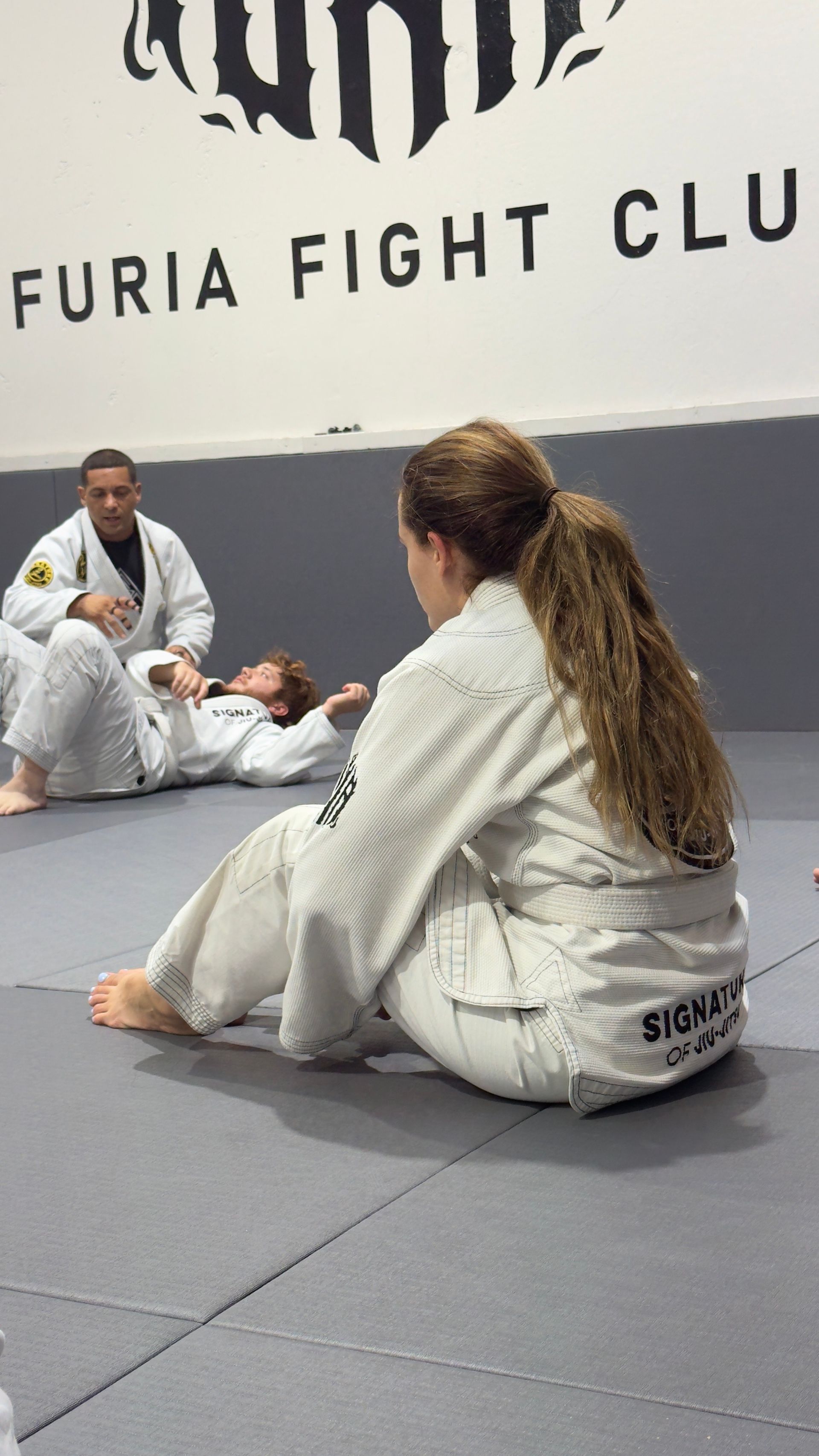
A typical beginner class includes a warm-up designed for grappling movement, a technique section where we repeat key details, and partner drilling so you can build comfort. Depending on the class, you may also do light, supervised sparring. Sparring is where you learn timing, but we treat it as a skill, not a brawl.
Most importantly, you do not need to be in shape to start. Training is what gets you there. We would rather you show up consistently than try to “prepare” for months and never begin.
How to Start Safely: Injury Prevention That Actually Matters
Brazilian Jiu-Jitsu is a contact sport, and injuries can happen, especially when new students train too hard too fast. Data from athlete surveys shows a meaningful percentage report injuries within a six-month window, with novice injury risk often tied to training habits and unfamiliar movement. The good news is that beginners can dramatically lower risk with smart pacing and communication.
Here is what we coach from day one:
1. Tap early, tap often, and tap without hesitation when something feels wrong
2. Prioritize escapes and defense before hunting submissions
3. Use controlled intensity, especially during early sparring rounds
4. Ask questions about grips and posture instead of forcing strength
5. Rest when you are sore in joints, not just muscles
We also match training partners thoughtfully because size and experience differences matter. The best training environment is one where you feel challenged and safe at the same time.
Your First Month Plan: Simple, Consistent, Effective
Beginners do best when the plan is clear. The first month should feel like building a base layer, not cramming for a test.
A simple approach that works for most people:
• Train 2 to 3 times per week so your body adapts without overload
• Repeat the same techniques enough times to feel them, not just remember them
• Track one focus per week, like guard recovery or side control escapes
• Add light strength and mobility work on off days if you feel good
• Sleep and hydration matter more than most people expect
If your schedule is intense, even two classes a week can produce solid progress. The key is showing up, then letting time and repetition do their thing.
Gear and Costs: What You Actually Need to Begin
You do not need a closet full of equipment to start Jiu-Jitsu. You need the basics and a willingness to learn. Most beginners start with one gi, a rash guard, and a belt that comes with the gi set.
As a rough starting budget, many students spend around 100 to 200 dollars on initial gear depending on brand and how many items they buy upfront. If you train regularly, you will eventually want a second gi so laundry is not a daily puzzle.
We also recommend basic hygiene essentials: flip-flops for off the mat, nail trimming, and a habit of washing gear right after training. It sounds small, but it is part of being a good training partner.
Progress and Belt Timeline: What to Expect Without Overthinking It
Belt progression in Brazilian Jiu-Jitsu takes time, and that is a feature, not a flaw. Most students can expect roughly one to two years to reach blue belt with consistent training, though timelines vary based on attendance, focus, and how quickly fundamentals click.
We encourage you to measure progress in practical ways. Can you escape mount more often than last month? Can you maintain posture in someone’s guard? Can you stay calm when you get stuck? Those are real wins.
The best part is that improvement is not linear. You will have weeks where you feel sharp, and weeks where everything feels hard. That is normal. You are learning a complex skill under pressure, and your brain needs repetition to make it automatic.
How Jiu-Jitsu Compares to Wrestling and Judo for Beginners
People often ask how Jiu-Jitsu compares to wrestling or Judo. We respect all grappling arts, and there is plenty of cross-over. Wrestling tends to emphasize takedowns, scrambles, and top pressure, while Judo emphasizes throws and gripping sequences. Jiu-Jitsu spends more time on ground control, guard work, and submissions, which is why it appeals to people who want a complete grappling system.
Competition trends also show more wrestling-style takedowns influencing modern matches, which is useful context for beginners. Even if you start on the knees in some rounds for safety and learning, understanding how to stand, grip, and off-balance is part of becoming well-rounded.
If you are starting fresh, you do not need to pick a “perfect” background. You just need a consistent practice environment and a curriculum that builds you up step by step.
Start Your Journey with Signature of Jiu-Jitsu
When you are ready to begin, we make it straightforward at Signature of Jiu-Jitsu: show up, learn the fundamentals, and build real skill through structured practice in Belmont. Our goal is to help you train Jiu-Jitsu with confidence, whether you want better fitness, practical self-defense, or a long-term martial arts journey that keeps you growing.
If you have been searching for Brazilian Jiu-Jitsu in Belmont and wondering where to start, the next step is simply getting on the mat. We will guide you through the early learning curve, help you train safely, and keep your progress simple enough to stay consistent.
Ready to train? Join a Jiu-Jitsu class at Signature of Jiu-Jitsu today.