Jiu-Jitsu changes the way you move, think, and handle pressure long after class ends.
Jiu-Jitsu has a reputation for being highly technical, but what surprises most new students is how quickly it starts shaping everyday life. The physical part is obvious: you sweat, you learn to move better, and you get stronger in ways that feel practical. The less obvious part is what happens to your focus, your patience, and your ability to stay calm when something gets uncomfortable.
Here in Belmont, we train with real people who have real schedules, real stress, and real goals. Some students want a challenging fitness routine that doesn’t get boring. Some want self-defense skills that make sense for an adult body and adult responsibilities. Others want a place to learn, reset, and feel part of something consistent each week.
Brazilian Jiu-Jitsu in Belmont fits that need because it’s not based on being the fastest or the most athletic in the room. It’s based on leverage, timing, and decision-making under pressure. That’s why so many adults stick with it, and why the growth is so strong globally, with millions of practitioners worldwide and a steady expansion in studios and participation.
Why Jiu-Jitsu hits different for adults in Belmont
Adult life on the Peninsula can feel like a constant sprint: commutes, meetings, family logistics, and a brain that rarely powers down. Adult Jiu-Jitsu in Belmont gives you something rare: an hour where you can’t multitask. If you try, you’ll get swept, pinned, or submitted by someone using clean technique. It’s oddly refreshing.
The mat also gives you immediate feedback. When something works, you feel it. When it doesn’t, you learn why. That loop of effort, correction, and progress is one reason many practitioners report stronger confidence within a year, along with better problem-solving off the mat. The benefits don’t stay trapped inside the gym.
And since Belmont is full of busy professionals, we structure training so you can build consistency without needing to rearrange your whole life. You’ll see students training a few times a week and still progressing steadily, because quality reps and smart pacing beat burnout every time.
Transformation beyond the mat starts with small, repeatable wins
Most people expect transformation to feel dramatic. In reality, it’s usually quiet. It’s showing up even when you’re tired. It’s learning to breathe while someone is putting real pressure on you. It’s noticing that you’re calmer in traffic or more patient during a tense conversation because you’ve practiced staying composed when things get physical.
On the mat, you learn how to lose without spiraling. You tap, you reset, you try again. That’s not just a martial arts lesson, it’s a life skill. Over time, many students notice they take feedback better at work, handle mistakes with less ego, and recover faster when the day goes sideways.
Jiu-Jitsu rewards consistency more than intensity. You don’t need to “win” every round. You need to learn one detail, one angle, one decision at a time. That approach is exactly what makes it sustainable for adults who want progress, not punishment.
What you actually learn in Brazilian Jiu-Jitsu in Belmont
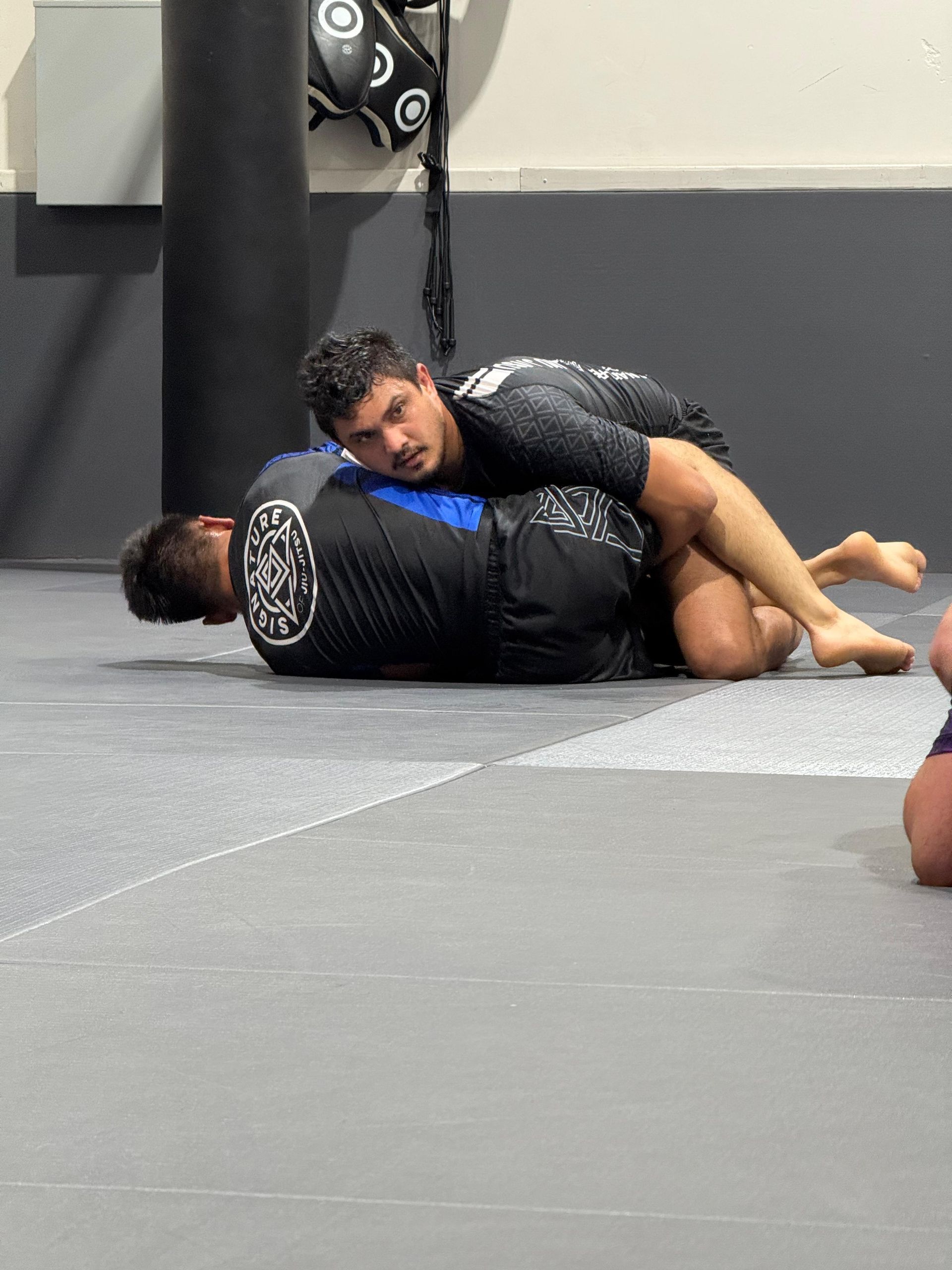
If you’re new, it’s normal to wonder what training looks like week to week. Our classes focus on fundamentals, positional control, escapes, submissions, and the transitions that connect everything. You’ll spend time learning technique and then pressure-testing it through controlled drilling and sparring that matches your experience level.
A good way to understand the learning path is to think in positions, not moves. Positions give you a map. Moves are what you do inside the map. Once that clicks, training starts to feel less random and more like building a skill set that stacks logically.
Here are a few core areas we build over time:
• Escapes that help you stay calm and get out from under pressure, starting with simple mechanics and reliable frames
• Guard fundamentals that teach you how to control distance, off-balance an opponent, and set up sweeps or submissions
• Top control concepts that emphasize stability first, then progress, so you’re not relying on strength to hold position
• Submission mechanics that focus on safety and precision, so you learn to finish with control rather than force
• Live sparring habits like pacing, breathing, and decision-making, which is where confidence starts turning into real capability
Belt progression, patience, and what “progress” really means
People ask about belts early, which makes sense. You want a roadmap. Across the sport, the average time from white to blue belt is often cited around 2.3 years, with cumulative timelines stretching longer as you move up. That’s not a promise or a requirement, but it’s a helpful reminder: Jiu-Jitsu is built for long-term growth.
In adult training, progress shows up in practical ways long before a belt changes. You might notice you can survive longer in bad positions. You might finally escape side control without panicking. You might hit the same sweep twice in one week and feel like you just cracked a code.
We keep expectations realistic, because adult bodies and adult schedules vary. Some weeks you’ll feel sharp. Some weeks you’ll feel clumsy. Both are normal. The win is staying consistent enough that the “clumsy weeks” don’t knock you off track.
The confidence shift: why it’s more than just self-defense
Confidence in Jiu-Jitsu isn’t bravado. It’s quiet. It’s knowing you can handle pressure without freezing. It’s learning that you can be uncomfortable and still make good decisions. That carries over everywhere: presentations, hard conversations, parenting, even how you walk into a room.
Many practitioners report increased confidence after a year of training, and it makes sense. You’ve practiced a challenging thing in a controlled environment and watched yourself adapt. You’ve felt what it’s like to be tired and still think clearly. That’s not theoretical confidence, it’s earned.
Self-defense is part of the picture, but “beyond the mat” confidence is often what changes daily life the most. You start trusting your ability to learn, adjust, and stay steady when the moment demands it.
Fitness that feels practical, not performative
A lot of fitness routines feel repetitive. Jiu-Jitsu doesn’t. You’ll build strength, conditioning, and mobility, but the effort is attached to a skill. You’re not just grinding through a workout, you’re learning how to move your body efficiently under resistance.
That matters for adults because the goal isn’t to feel wrecked after class. The goal is to improve while staying healthy enough to train next week. Over time, most students notice better core strength, grip endurance, and cardio, along with improved body awareness. Even small changes like learning how to base properly or how to fall safely can make a difference in everyday movement.
If you’ve ever tried to “get in shape” and quit because it felt boring, Brazilian Jiu-Jitsu in Belmont offers something more engaging. You’re solving problems with your whole body, and the workout sneaks up on you.
Stress management and mental clarity you can actually feel
Belmont life can be intense in a quiet way. You might not feel dramatic stress, but it accumulates. Training gives your brain a single task: deal with what’s happening right now. That kind of focus can be a relief.
You also learn to breathe when you’re under pressure. That sounds simple until you’re pinned and your instincts want to panic. Practicing calm responses in physical situations often makes it easier to stay calm in social and professional situations. Many practitioners also report improved problem-solving, which tracks with what we see: you get used to making decisions with imperfect information and adjusting quickly.
It’s not magic. It’s practice. But it works, especially when you train consistently and recover well.
Safety, injuries, and how we train for longevity
Let’s be honest: Jiu-Jitsu is a contact sport, and injuries can happen. Research often reports notable injury rates over a six-month window, and risk tends to rise with intensity and experience level. The good news is that most preventable issues come down to pacing, communication, and smart training habits.
We coach safety from day one. That includes tapping early, choosing appropriate partners, and learning positional control before chasing flashy submissions. Our goal is to help you train for years, not just for a few intense months.
A few practical ways you can reduce risk right away:
1. Start with a sustainable frequency, like two to three classes per week, and build up as your body adapts
2. Focus on clean technique first, because forced movements under resistance are where strains often happen
3. Communicate with training partners about intensity, especially when you’re new or returning from time off
4. Prioritize recovery basics like sleep, hydration, and light mobility work between classes
5. Ask questions early, because confusion often leads to tense, awkward movement that increases risk
Community in Belmont: why the room matters as much as the technique
People stay with Jiu-Jitsu for the skill, but many stay because of the room. A supportive training environment changes everything. It helps beginners relax. It helps experienced students train with purpose instead of ego. And it helps adults feel like they have a place where progress is shared and encouraged.
We’ve seen retention trends across the industry hover around the idea that consistency improves when people feel connected, and that matches what we aim to build here. When you know names, when you have partners who want you to improve, it’s easier to show up even on days when motivation is low.
You don’t need to be loud or extroverted to belong in Jiu-Jitsu. You just need to train, be respectful, and stay curious. The rest tends to take care of itself.
Training options that fit a real adult schedule
Adult Jiu-Jitsu in Belmont has to fit around work and family, or it simply won’t last. We organize our program so you can find a rhythm that works, whether you’re training a couple times a week for wellness or training more often because you love the technical side and want to level up.
If you’re wondering about costs, California averages around the mid-150s per month in many places, and we keep membership options competitive for the area while focusing on coaching quality and a training culture that supports long-term progress. You can always confirm current details and times on the website, especially because schedules can shift with seasons and demand.
For people who like structure, checking the class schedule helps you plan your week in advance. For people who prefer flexibility, consistency matters more than perfection. Two steady sessions a week beats one random burst of training followed by a month off.
Take the Next Step
Building skill in Jiu-Jitsu is one of the most reliable ways we know to create real change you can feel: better fitness, clearer thinking under pressure, and confidence that shows up in regular life. When you train consistently, the benefits stack fast, even if it looks subtle from the outside.
If you’re ready to experience that kind of growth in Belmont, we’d love to welcome you in. At Signature of Jiu-Jitsu, we keep training practical, structured, and supportive so you can progress at a pace that fits your life and keeps you healthy.
Put these techniques into practice by joining a Jiu-Jitsu class at Signature of Jiu-Jitsu.