
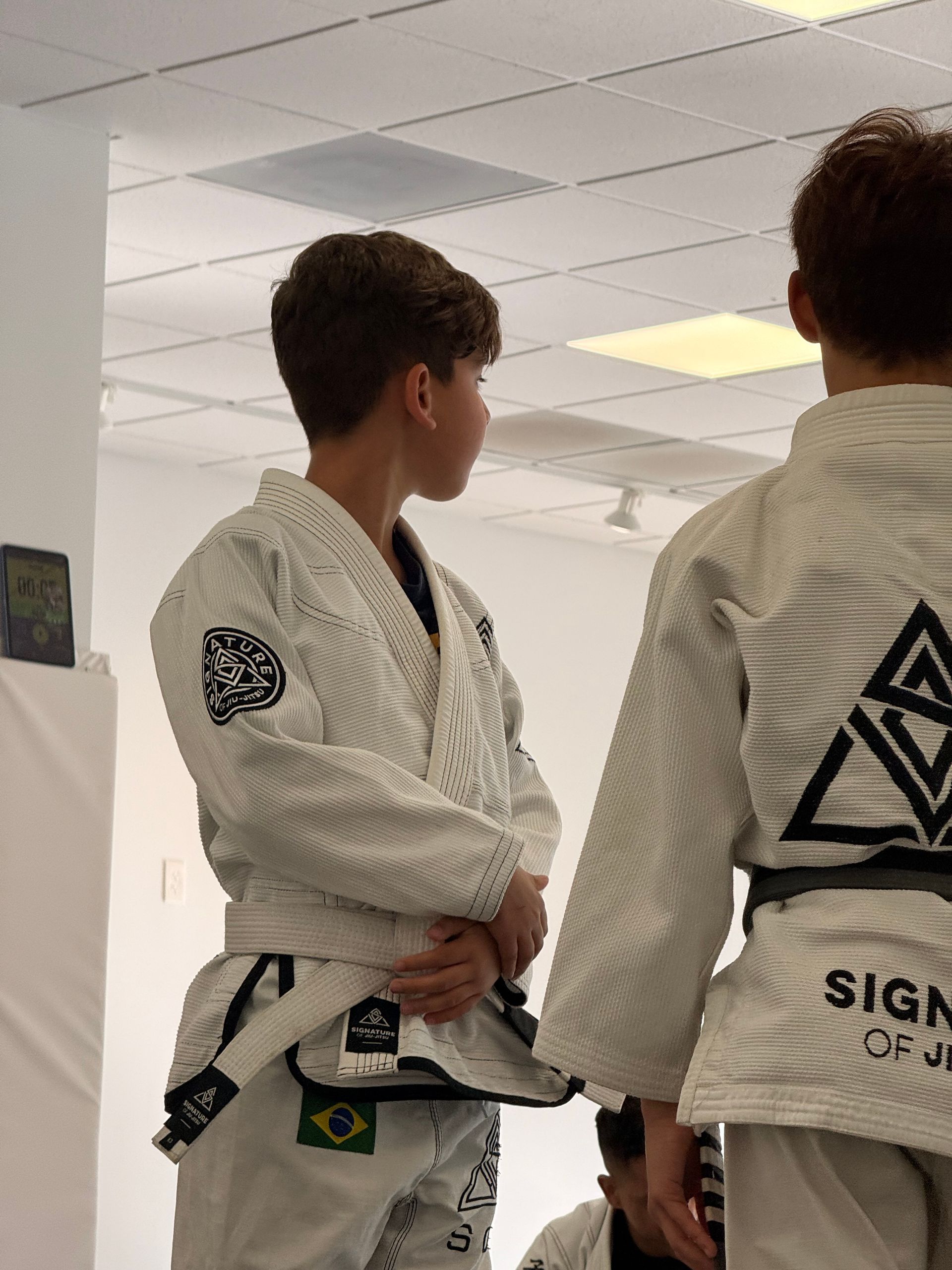
Youth Jiu-Jitsu gives kids a calm, controlled way to handle real-life problems without relying on punches or panic.
If you are looking at Youth Jiu-Jitsu for your child, your first question is probably the same one we hear all the time in Belmont: Is this actually safe, and will it teach real self-defense? We take that question seriously, because kids do not need more chaos in their week. They need structure, clear boundaries, and skills that work when emotions run high.
What makes Youth Jiu-Jitsu different is the goal. We are not teaching kids to trade hits. We are teaching kids to create safety through control, leverage, and smart decision-making. That is why Brazilian Jiu-Jitsu has become one of the fastest-growing martial arts in the country, with interest doubling over the last decade and millions of practitioners worldwide.
In our Youth Jiu-Jitsu in Belmont programs, the center of everything is situation management: how to stay balanced, how to protect yourself, how to escape safely, and how to choose the least risky option. The techniques look physical, but the lesson is often quiet: stay calm, breathe, and make good choices.
Why Youth Jiu-Jitsu is built for safe self-defense
A lot of self-defense systems start with striking. Youth Jiu-Jitsu starts with control. That difference matters for kids because control can scale. It works for different sizes, different personalities, and different comfort levels. A child does not need to be aggressive to be effective.
Brazilian Jiu-Jitsu uses leverage and body mechanics, so smaller students can learn to defend themselves without trying to overpower someone. We focus on positions, balance, and grips that help a child stop a situation from getting worse, and that is a major reason many parents see it as a safer pathway for learning self-defense.
When you look at injury rates across combat sports, Brazilian Jiu-Jitsu is often reported as having one of the lowest injury rates per 1,000 exposures compared with activities like judo, MMA, taekwondo, and wrestling. That does not mean risk is zero. It means the training method encourages controlled contact, tapping, and supervision, and those things reduce unnecessary intensity.
What we mean by safe self-defense for kids
Self-defense for a child is not the same as self-defense for an adult. Kids are dealing with school environments, social conflicts, and the occasional rough moment on a playground. Our definition of safe self-defense includes:
• Creating space and getting away when possible
• Protecting the head and neck during contact
• Using positioning and grips to stop being pulled, pushed, or pinned
• Escaping holds without escalating into a bigger fight
• Knowing when to get an adult immediately
We also teach that self-defense starts before anything physical happens. Awareness, posture, and voice can change the entire outcome. Youth Jiu-Jitsu gives kids a framework for that, and we keep it age-appropriate so it feels practical instead of scary.
How our classes keep training controlled and age-appropriate
Parents sometimes imagine a room full of kids going wild. Real training is the opposite. A well-run Youth Jiu-Jitsu class is organized, progressive, and very clear about rules. We build skills step by step, and we protect kids from being pushed into intensity before they are ready.
Most youth classes run about 45 to 60 minutes. We blend movement skills, technical instruction, and partner drills in a way that keeps kids engaged without turning the room into a free-for-all. We also keep partner work structured so students learn control first, not “winning.”
A helpful detail many families do not know about is the kids belt system. Children progress through 13 belt colors, starting at white and moving through grey, yellow, orange, and green, with age requirements attached to certain ranks. For example, orange belt is tied to age 10 and green belt to age 13. That structure supports safety because it keeps expectations realistic and competition fair for growing bodies.
The real skill kids learn first: control
Control sounds simple, but it is a skill that takes practice. In Youth Jiu-Jitsu, a child learns how to hold position without squeezing too hard, how to move without crashing into a partner, and how to stop immediately when someone taps. That last part is huge. Tapping is a built-in safety language, and we treat it as non-negotiable.
This focus on control is also what keeps the training from becoming aggression training. When kids learn they can solve problems with positioning and calm movement, the need to “prove something” fades. Over time we often see the same pattern: the students who started out a little nervous become steady and confident, and the students who started out a little intense learn patience and restraint.
What kids practice in a Brazilian Jiu-Jitsu class in Belmont
We keep the curriculum grounded in fundamentals that show up in real situations. A child does not need a hundred flashy techniques. A child needs a handful of reliable answers, repeated enough times that the body remembers them under stress.
Here is the kind of skill set we build through our Youth Jiu-Jitsu in Belmont training:
• Base and balance drills that prevent falls and help kids stay steady when pushed
• Escapes from common pins and grabs, taught with clear safety checkpoints
• Positional control so a student can stabilize without striking
• Guard and mount basics taught as problem-solving positions, not domination games
• Safe partner rounds where the goal is applying technique calmly, not going hard
We also coach kids on how to use their voice, when to disengage, and why getting help is the best option when it is available. Self-defense is not one move. It is a series of choices.
Safety rules we coach every class
Our safety culture is not just “be careful.” It is specific. Kids do better when expectations are clear, so we repeat these points often and we correct them right away when needed.
1. Tap early and tap clearly, and stop immediately when your partner taps
2. Protect the head and neck, and avoid any risky twisting or cranking
3. Match speed to the drill, not to your emotions in the moment
4. Keep hands open and controlled in scrambles so fingers do not get caught
5. Ask questions when something feels confusing or uncomfortable
These habits matter because youth injuries, while usually manageable, can happen. Research on pediatric Brazilian Jiu-Jitsu injuries shows that sprains and strains are common, fractures can occur, and the head, shoulder, and lower arm are frequent injury sites. We use that reality as a reason to coach smarter, not as a reason to avoid training altogether.
Why the belt system matters more than most parents realize
Belts are not just rewards. In kids programs, belts are a safety system. The 13-belt youth pathway sets expectations for skill, maturity, and age. It prevents a student from being pushed into the wrong competitive bracket or being asked to perform techniques that are not appropriate for a developing body.
Most kids progress through a belt roughly every 8 to 12 months, but promotions are not automatic. We look at consistency, behavior, control with partners, and understanding of fundamentals. A child who can do the moves but cannot follow rules is not ready for the next step yet, and that is actually a good thing. Youth Jiu-Jitsu is supposed to build responsibility alongside skill.
What about sparring and competition?
Sparring, often called rolling, is where kids learn timing and composure. It is also where many parents worry the most. We introduce sparring progressively, with tight supervision, and with clear goals. Early rounds are not about “winning.” They are about learning to stay safe and apply one simple objective at a time.
Competition is optional. Some kids love the idea of a tournament. Some kids would rather progress quietly and never step on a mat in front of a crowd. Both paths are valid. If your child does compete, it helps to know that matches are typically about 8 to 10 minutes, sometimes with overtime. That length encourages strategy, pacing, and control instead of a quick burst of chaos.
We also prepare kids with practical tools: how to warm up, how to manage nerves, how to tap without embarrassment, and how to respect an opponent. Those are life skills, even if your child never competes again.
Youth Jiu-Jitsu works for small kids and non-athletes
One of the best things about Youth Jiu-Jitsu is that it does not require a certain “type” of kid. Athletic kids usually enjoy the movement, but quieter kids often thrive because the art rewards focus and detail. Kids who are smaller for their age can succeed because leverage and angles matter more than brute force.
We coach to the student in front of us. If your child needs more structure, we provide it. If your child needs encouragement to try, we create safe reps that build confidence. If your child is already confident, we teach humility and responsibility, because skill without control is not the goal.
Confidence, boundaries, and the Belmont parent perspective
Belmont families often tell us the same priorities: you want your child to be safe, you want your child to be respectful, and you want an activity that builds confidence without feeding aggression. Youth Jiu-Jitsu fits that value set because the techniques reward calm thinking and precise movement.
There is also a community piece that matters. Training regularly puts kids in a room where effort is normal. Everyone struggles with a new skill at first. Everyone learns to keep trying. Over time, students stop fearing mistakes, which is a pretty big deal for school and sports and, honestly, life.
The popularity of Brazilian Jiu-Jitsu has surged nationally, with search interest rising more than 100 percent over two decades and youth tournaments growing as more families look for practical self-defense training. We see that same trend locally, and we treat it as a responsibility: if more kids are showing up, the coaching and safety standards have to rise with it.
Getting ready for a first Youth Jiu-Jitsu class
If you are planning your child’s first class, the practical side is simple. Kids can start without fancy gear. Bring a comfortable shirt and shorts, no shoes on the mat, and a water bottle. We handle the rest, including basic orientation so your child knows what to expect.
What we recommend most is arriving a few minutes early so your child can settle in. The room has a certain rhythm: warm-ups, technique, partner drills. Once kids feel that structure, nerves usually drop quickly.
We also encourage parent observation. When you watch a class, you can see how we correct behavior, how we pair kids, and how we keep the room calm. If you have questions about the program, membership options, or how the class schedule fits around school, the website is the fastest place to get clear answers.
Take the Next Step
A safe, effective self-defense program for kids should build skills and character at the same time, and that is exactly what we aim for every day on the mat. Youth Jiu-Jitsu is not about teaching kids to look for fights; it is about teaching them how to stay calm, create safety, and make smart choices when a situation gets physical.
If you want a place where your child can learn real self-defense in a structured environment, we would love to help you explore our approach at Signature of Jiu-Jitsu. You can review the program details, check the class schedule, and choose a starting point that feels comfortable for your family.
Put these techniques into practice by joining a Brazilian Jiu-Jitsu program at Signature of Jiu-Jitsu.