Jiu-Jitsu rewards smart technique, steady practice, and the kind of confidence you can actually feel in daily life.
Starting something new as an adult can feel like a leap, especially when it comes to martial arts. Most beginners walk in with the same questions: Will I be the only new person, will I get hurt, and do I need to already be “in shape” to keep up? We get it, and we built our beginner experience so you can learn Jiu-Jitsu step by step without feeling thrown into the deep end.
One reason Jiu-Jitsu works so well for beginners is that it is designed around leverage, timing, and position, not brute force. That means you can start building real skills from day one, even if you have zero background in sports, lifting, or combat training. In Belmont, we see plenty of students who sit at a desk all day, juggle family schedules, or just want a fitness routine that stays interesting.
If you are looking for Jiu-Jitsu in Belmont CA because you want practical self-defense, better fitness, or a mental reset that is more effective than scrolling on a phone, you are in the right place. Our job is to give you structure, coaching, and training partners who make progress feel realistic and measurable.
Why Jiu-Jitsu is a beginner-friendly martial art
Jiu-Jitsu is often called “the gentle art,” and that is not just a catchy phrase. It is a grappling system that focuses heavily on control, escapes, and finishing holds that can be applied safely in training. When we teach fundamentals, we prioritize positions and pressure awareness so you can stay calm and make good decisions under stress.
Because the goal is to improve technique, you do not need to be explosive or naturally athletic to start. You will absolutely get stronger over time, but the early wins usually come from learning where to put your hands, how to align your hips, and how to conserve energy. Those details add up quickly.
For many beginners, the biggest surprise is how mentally engaging it is. You are solving problems with your body in real time. That focus tends to quiet the noise from work and the rest of life, which is a big reason adult enrollment has continued to grow nationwide in the last few years.
What beginners actually learn first (and why it matters)
We teach beginners in a way that builds confidence without skipping the essentials. Before submissions, we focus on the “why” behind each position, because understanding the purpose of a movement helps you remember it under pressure.
The foundational positions that create control
Positions are the backbone of Jiu-Jitsu. If you can recognize where you are and what your job is in that spot, you stop feeling lost. Early training usually revolves around:
• Guard, where you learn to protect yourself and set up sweeps or submissions
• Side control, where you learn to stabilize and apply pressure without muscling
• Mount and back control, where you learn control that leads to safe finishes
• Standing and takedown awareness, so you can manage distance and balance
This is also where safety improves. When you know positions, you stop moving randomly, and your training becomes smoother for you and your partner.
Submissions, introduced the right way
Yes, you will learn submissions, but we treat them as the final step of a sequence. You earn a submission through position, timing, and control. That approach keeps training respectful and reduces the “spaz factor” that many beginners worry about.
Common early submissions include armbars and chokes, taught with clear tap etiquette and partner awareness. Tapping is normal here, and learning to tap early is a skill, not a weakness.
How Jiu-Jitsu builds strength, fitness, and confidence (without wrecking your joints)
A lot of adults come to us wanting fitness, but not the kind that leaves you limping for three days. Jiu-Jitsu can be intense, but it is also scalable, which is why it is popular with beginners, professionals, and adults over 40.
Strength that shows up in real life
Jiu-Jitsu develops “useful strength,” the kind that comes from repeated, controlled effort. You will notice it in:
Grip endurance from holding sleeves, wrists, or frames
Core strength from staying connected while you move your hips
Leg and glute strength from bridges, stand-ups, and guard retention
Postural strength from learning alignment and pressure
Many students also notice better posture at work. It is not magic. It is just that you start paying attention to how your spine and hips work together.
Conditioning that does not feel like a treadmill
Live training rounds, even light ones, build cardio quickly. The difference is you are focused on a task, so the work feels purposeful. You will still sweat, but it usually feels like a satisfying kind of tired, not a drained, bored tired.
Confidence that comes from competence
Confidence in Jiu-Jitsu is not motivational talk. It is earned through repetition. You learn an escape, you drill it, you try it in a controlled round, and then it works. That progression teaches you that calm problem-solving beats panic, which tends to carry into everyday situations.
A “day one” walkthrough: what your first class feels like
Beginners tend to imagine a chaotic room where everyone is already advanced. In reality, your first class is structured. We want you to leave knowing what you worked on and why it matters.
Here is what you can expect:
1. You arrive a little early so we can help you get oriented and answer questions.
2. We start with a warm-up focused on movement skills you will actually use, like hip escapes and bridges.
3. We teach a small set of techniques with clear goals, usually tied to one position.
4. You practice with a partner in a controlled way, with coaching and corrections.
5. Depending on the class, you may do light positional rounds, which are guided and beginner-appropriate.
You do not need to “win” anything on day one. The win is showing up, learning the safety rules, and getting your first rep of the fundamentals.
Gi vs No-Gi: which one should you start with?
We offer both Gi and No-Gi formats because each teaches useful skills. Beginners often ask which one is better for self-defense, fitness, or faster progress, and the honest answer is that both support your growth.
Training in the Gi
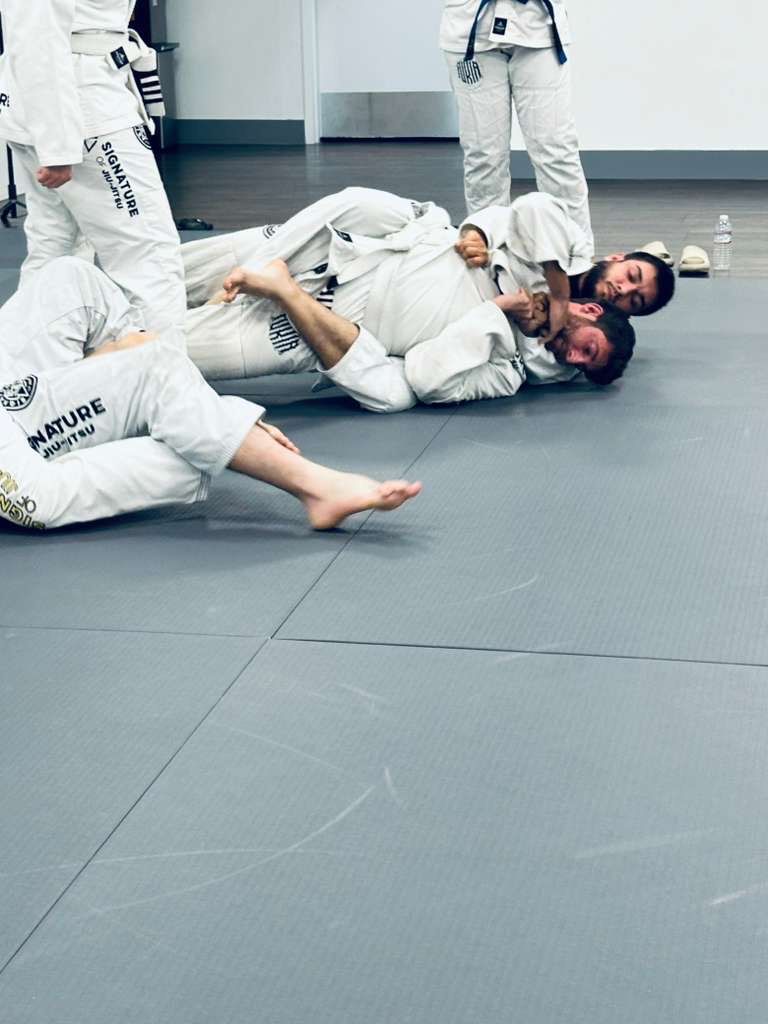
The Gi slows things down in a helpful way. You get grips, friction, and clearer control points, which makes it easier to understand leverage. The Gi also reinforces patience and precision, since small mistakes become obvious quickly.
Training No-Gi
No-Gi tends to be faster and sweatier. Because there are fewer grips, you learn movement, balance, and body positioning in a different way. For modern self-defense situations, No-Gi skills translate naturally to everyday clothing and real-world clinches.
If you are not sure where to start, we will guide you based on your goals and what feels comfortable.
Staying safe and progressing steadily as a beginner
Safety is not an afterthought in our adult program. Beginners improve fastest when they feel safe enough to try, fail, and try again.
How we keep training low-risk and beginner-friendly
We coach pacing and control early, because intensity without structure is when people get hurt. We also help with partner matching so you are not tossed into rounds that feel overwhelming.
A few habits make a big difference:
Tap early and tap clearly, especially while you are learning
Focus on frames and posture before trying to “go hard”
Ask questions when something feels confusing or physically awkward
Prioritize consistency over intensity, especially in your first month
Jiu-Jitsu is challenging, but it should not feel like survival. The goal is steady progress.
Milestones that help you measure progress
Beginners often worry that they are “behind” because they do not know what progress looks like. We like simple milestones that keep you motivated and grounded:
• Weeks 1 to 4: You recognize basic positions like guard and mount, and you learn a couple reliable escapes.
• Months 1 to 3: You start connecting techniques, and you may hit your first clean submission in training.
• Months 3 to 6: You feel calmer during rounds and can recover from bad positions without panicking.
• Months 4 to 6: Many students earn a stripe on their white belt as skills become more consistent.
Progress is not perfectly linear. Some weeks you feel unstoppable, and some weeks you feel like you forgot everything. That is normal, and it usually means your brain is upgrading.
Adult Jiu-Jitsu in Belmont: fitting training into a real schedule
Most people who search for adult Jiu-Jitsu in Belmont are balancing work, family, and a body that does not bounce back like it did at 22. We structure our class schedule so you can train consistently without needing to rearrange your whole life.
A realistic starting point for beginners is 1 to 3 classes per week. If you train once a week, you will learn, but it will feel slower. Twice a week is where many adults hit a sweet spot. Three times a week builds momentum quickly, especially in the first few months.
We also encourage simple “between class” habits. A few minutes of hip mobility or light stretching can keep you feeling good and make your next session smoother. Nothing fancy, just consistent.
The mindset shift: why beginners stick with it (and why some don’t)
Beginners who stick with Jiu-Jitsu usually do one thing well: they focus on learning, not proving. The room is full of people working on something, and that shared effort matters.
We also set expectations early. You will tap. You will get stuck. You will feel awkward learning new movements. And then, one day, you will realize you handled a position calmly that used to spike your heart rate. That is the moment many people realize this training is different, and worth it.
If you want the benefits without burning out, choose consistency, listen to your body, and let us coach you through the rough patches. That is what we are here for.
Take the Next Step
If you are ready to start Jiu-Jitsu in Belmont CA in a way that feels structured, supportive, and genuinely skill-focused, we would love to meet you at Signature of Jiu-Jitsu. Our classes are built to help beginners develop real fundamentals, improve fitness, and gain confidence through practical training that scales to your level.
You do not need to “get in shape first” or show up already knowing what to do. Bring a willingness to learn, and we will guide you from your first warm-up to your first reliable escapes, sweeps, and controlled rounds at Signature of Jiu-Jitsu.
New to Jiu-Jitsu? Start your journey by joining a Jiu-Jitsu class at Signature of Jiu-Jitsu.