
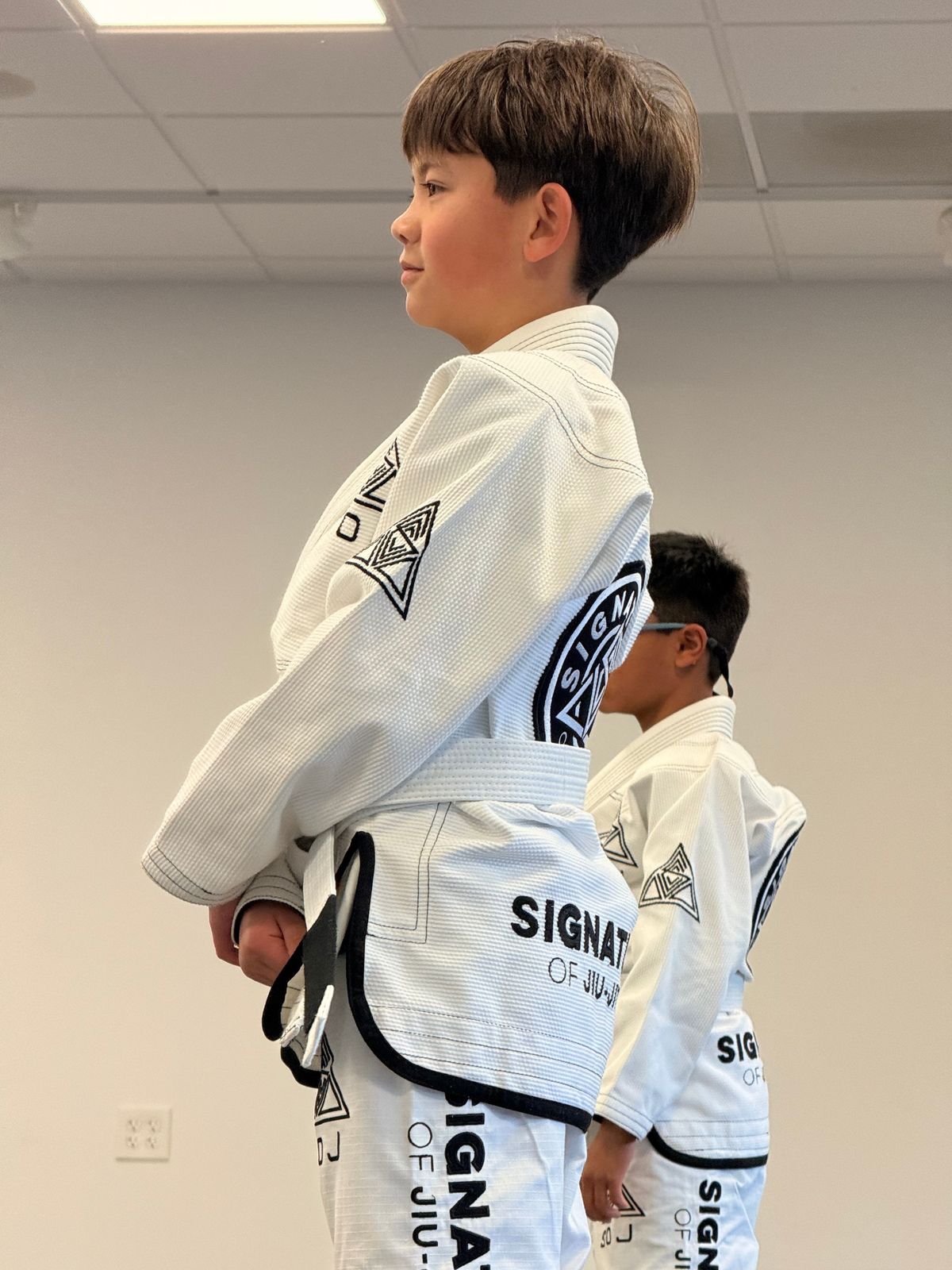
Youth Jiu-Jitsu gives quiet kids a structured way to feel brave without being put on the spot.
If your child hangs back in groups, speaks softly around new adults, or freezes when it is “their turn,” you are not alone. We meet plenty of Belmont families who want an activity that supports confidence and social comfort without demanding instant extroversion. That is exactly where Youth Jiu-Jitsu can be a surprisingly good fit.
Youth Jiu-Jitsu works because kids do not have to become loud to succeed. Instead, your child can start by learning simple movements, practicing with a partner in a controlled way, and stacking small wins. Over time, those wins add up to something bigger: a kid who walks onto the mat with less hesitation and carries that steadiness into school, sports, and everyday life.
In our Belmont academy, we focus on skill-building, positive coaching, and age-appropriate structure for kids ages 5–14. We keep the environment welcoming, the expectations clear, and the progress visible, so shy kids can settle in, feel safe, and grow at a pace that makes sense.
Why shy kids often thrive in a structured martial arts setting
Shyness is not a flaw. For many kids, it is simply a “slow to warm up” temperament, especially in unfamiliar spaces. The tricky part is that many activities reward quick social confidence: joining a group instantly, shouting to be heard, or performing in front of everyone. If that is not your child’s style, the activity can feel exhausting before it even becomes fun.
Youth Jiu-Jitsu tends to be different because the structure does some of the social heavy lifting. Class has a predictable rhythm, clear rules, and specific roles. Your child does not have to invent conversation or fight for attention. We guide the interactions with simple prompts: partner up, take turns, listen, switch, reset. That “script” is calming for reserved kids.
Another quiet advantage is that progress in Jiu-Jitsu is not based on being the fastest runner or the loudest teammate. Brazilian Jiu-Jitsu is built around leverage, positioning, timing, and problem-solving. When a child realizes, “I can figure this out,” confidence starts forming in a realistic way.
How Youth Jiu-Jitsu builds confidence through a simple loop
We never want to promise that a sport will cure shyness or erase anxiety. What we can say, honestly, is that Youth Jiu-Jitsu creates repeated chances for kids to practice courage in small, manageable doses. Confidence usually grows from experience, not pep talks.
Here is the confidence loop we see again and again:
1. Your child tries a new skill that feels slightly challenging
2. Our coaches break it down, step by step, and your child practices it safely
3. Your child struggles a little, then gets one detail right
4. That small success becomes repeatable with drilling and patient feedback
5. The skill works with light resistance, then a bit more
6. Your child starts trusting their ability to learn and adapt
This matters for shy kids because the first “wins” can be private and quiet. A child does not have to speak up in front of the room to feel proud. Sometimes the first sign of growth is subtle: better posture, eye contact, a calmer face when it is time to partner up.
Why Jiu-Jitsu is a good match for kids who do not feel “athletic”
Some kids avoid sports because they already believe they are behind. Maybe they are not coordinated yet. Maybe they had a rough experience on a team. Maybe they are smaller, or they dislike the chaos of a crowded field.
Youth Jiu-Jitsu gives kids a different entry point. Because technique and leverage matter so much, we can help beginners succeed quickly with the right foundation. We teach posture, base, balance, and movement patterns that make kids feel more capable in their own bodies. That physical competence is not just “fitness,” it is a kind of quiet confidence: I can move well, I can handle contact appropriately, and I can stay calm when something unexpected happens.
We also coach kids to treat mistakes as normal. On the mat, everyone taps, resets, and tries again. That is a healthy lesson for a shy child who fears being wrong in front of others.
What a beginner class looks like in our Belmont Youth Program
A first day can feel big to a shy kid, so we keep the experience straightforward and welcoming. You can expect clear instruction, consistent routines, and lots of coaching. We want your child to understand what to do and why it matters, without feeling singled out.
Most youth classes include a mix of:
• Warm-ups that build coordination and body awareness
• Technique instruction with a few key details to focus on
• Partner drills where kids take turns practicing safely
• Games that reinforce movement and teamwork without awkward small talk
• Optional, closely supervised sparring as kids are ready
If you are wondering about intensity, think “progressive.” We begin with basics and build from there. For shy kids, that gradual approach helps a lot. They get time to learn the room, learn the routine, and learn that partners are here to help, not to judge.
Age-specific classes: why we separate kids 5–14 into three groups
Kids develop quickly, and an 11-year-old learns differently than a 5-year-old. That is why we divide our youth program (ages 5–14) into three groups:
Ages 5–7: comfort, coordination, and listening skills
In this range, we keep instructions simple and upbeat. Games and short drills help kids practice following directions, taking turns, and staying engaged. A shy child often starts by observing, then joins in once the routine feels familiar.
Ages 8–10: skill building and “I can do hard things”
Kids here can handle more detail and more structured partner work. We focus on fundamental positions and escapes while reinforcing respect and self-control. This is also a sweet spot for confidence because progress shows up quickly when kids practice consistently.
Ages 11–14: responsibility, resilience, and healthy challenge
Preteens and early teens benefit from more problem-solving and more situational training. Social dynamics can be intense at this age, so we keep the mat culture respectful and supportive. Youth Jiu-Jitsu in Belmont is often a steady anchor for kids who feel self-conscious elsewhere.
Partner drills, games, and coaching that help shy kids open up
Shy kids do not need to be pushed into the spotlight. They need repeated, positive interactions that feel safe. That is where partner drills shine. The interaction is built in: one person practices, the other cooperates, then you switch. It is predictable. It is fair. It is not a popularity contest.
We also use games on purpose, not as filler. Games let kids connect while moving, which is easier for many reserved children than standing around and talking. Over time, that “side-by-side” teamwork turns into real friendships.
Our coaching style matters, too. We use positive reinforcement, but we keep it specific. Instead of vague praise, we point out concrete behaviors that build confidence and character:
• Showing up and stepping on the mat even when nervous
• Trying the drill again after a mistake
• Using a calm voice with a partner
• Listening and following the sequence
• Tapping early and respecting taps immediately
• Encouraging a teammate without making a big scene
Those details might sound small, but for shy kids, they are everything.
Confidence milestones you can actually look for (beyond belts)
Belts and stripes can be motivating, but confidence is usually easier to spot in everyday behaviors. If your child is in Youth Jiu-Jitsu, here are realistic changes you might notice over the first few months:
• Your child enters class with less hesitation and starts warm-ups sooner
• Your child greets the coach or answers questions more clearly
• Your child can work with a new partner without shutting down
• Your child recovers faster after getting stuck or losing a position
• Your child asks one question instead of staying silent through confusion
• Your child stands taller, makes more eye contact, and looks more “at home”
• Your child uses calmer problem-solving instead of panicking during pressure
If you see even one or two of these shifts, it is meaningful. Quiet growth counts.
Safety, sparring, and first-day nerves: what parents should know
A common concern is whether a shy child will be overwhelmed by contact. We get it. Youth Jiu-Jitsu is a contact sport, but it should be taught with clear rules, careful supervision, and gradual progression.
Will your child have to spar right away?
Not necessarily. Our approach builds from instruction and drilling into more live practice as kids demonstrate readiness. When we introduce sparring, we keep it age-appropriate and controlled, with coaching and boundaries. Your child is never supposed to feel thrown into chaos.
Is Jiu-Jitsu safe for kids?
No sport is risk-free, but good coaching and good habits reduce risks. We emphasize tapping, control, and respect for partners. We also care about cleanliness and mat hygiene, because a healthy training space matters just as much as technique.
What if your child is nervous on day one?
Nerves are normal. If your child needs a moment to watch, breathe, or ease in, we can work with that. Many shy kids do best when they know the routine and can predict what happens next. After a couple of classes, the room usually feels familiar, and participation becomes easier.
Can parents watch?
Yes, parents being nearby can make a big difference for a child who is slow to warm up. We want you to feel comfortable, informed, and confident in what your child is learning.
Frequently asked questions about Youth Jiu-Jitsu in Belmont
Does my child need experience to start?
No. We teach fundamentals from the ground up, and beginners are welcome.
What should my child wear?
We offer both Gi and No-Gi training, and what your child wears depends on the class format. If you are coming for a trial, check the website or reach out so we can point you to the right gear for that day.
Is Youth Jiu-Jitsu just self-defense?
Self-defense awareness is part of training, but the day-to-day experience is broader: learning focus, discipline, resilience, and how to solve problems under pressure without losing control.
Will this make my child aggressive?
Our culture emphasizes respect, cooperation, and control. The goal is calm confidence, not picking fights. Kids learn rules, boundaries, and responsibility along with technique.
How do you match partners?
We pay attention to size, age, experience, and temperament. For a shy child, a patient partner can change the entire experience, so we are thoughtful about pairings.
Take the Next Step
Building confidence usually starts with something simple: showing up, learning one movement, and realizing, “I can do this.” That is the heart of Youth Jiu-Jitsu, and it is why so many quiet kids begin to shine once training becomes part of their routine.
When you are ready, we would love to welcome your family at Signature of Jiu-Jitsu in Belmont. Our youth program is designed for ages 5–14 with age-specific classes, positive coaching, and a supportive community that helps kids grow stronger in body and steadier in mindset.
If you want to get started, we offer trial classes so your child can experience the environment, meet our coaches, and take the first step without pressure.
Challenge yourself physically and mentally through consistent Jiu-Jitsu training at Signature of Jiu-Jitsu.