Adult Jiu-Jitsu turns everyday stress into practical resilience you can feel in your body and carry into your week.
If you live and work in the Bay Area, you already know how easy it is to run on adrenaline and coffee, then call it “normal.” We meet plenty of adults who can handle a packed calendar, but still feel oddly worn down by the constant pace. Adult Jiu-Jitsu gives you a different kind of outlet: physical problem-solving that forces your mind to settle, even when your day has been loud.
What surprises many beginners is how quickly the training becomes less about “fighting” and more about building grit through small, repeatable wins. You learn a skill, pressure-test it safely, adjust, and try again. Over time, that loop changes how you handle discomfort, frustration, and fatigue, on the mats and off.
In our adult Jiu-Jitsu in Belmont community, we see the same theme: people come in looking for fitness or stress relief, and stay because the training makes them feel sturdier. Not invincible. Just steadier, more capable, and more present.
What “true grit” actually looks like on the mats
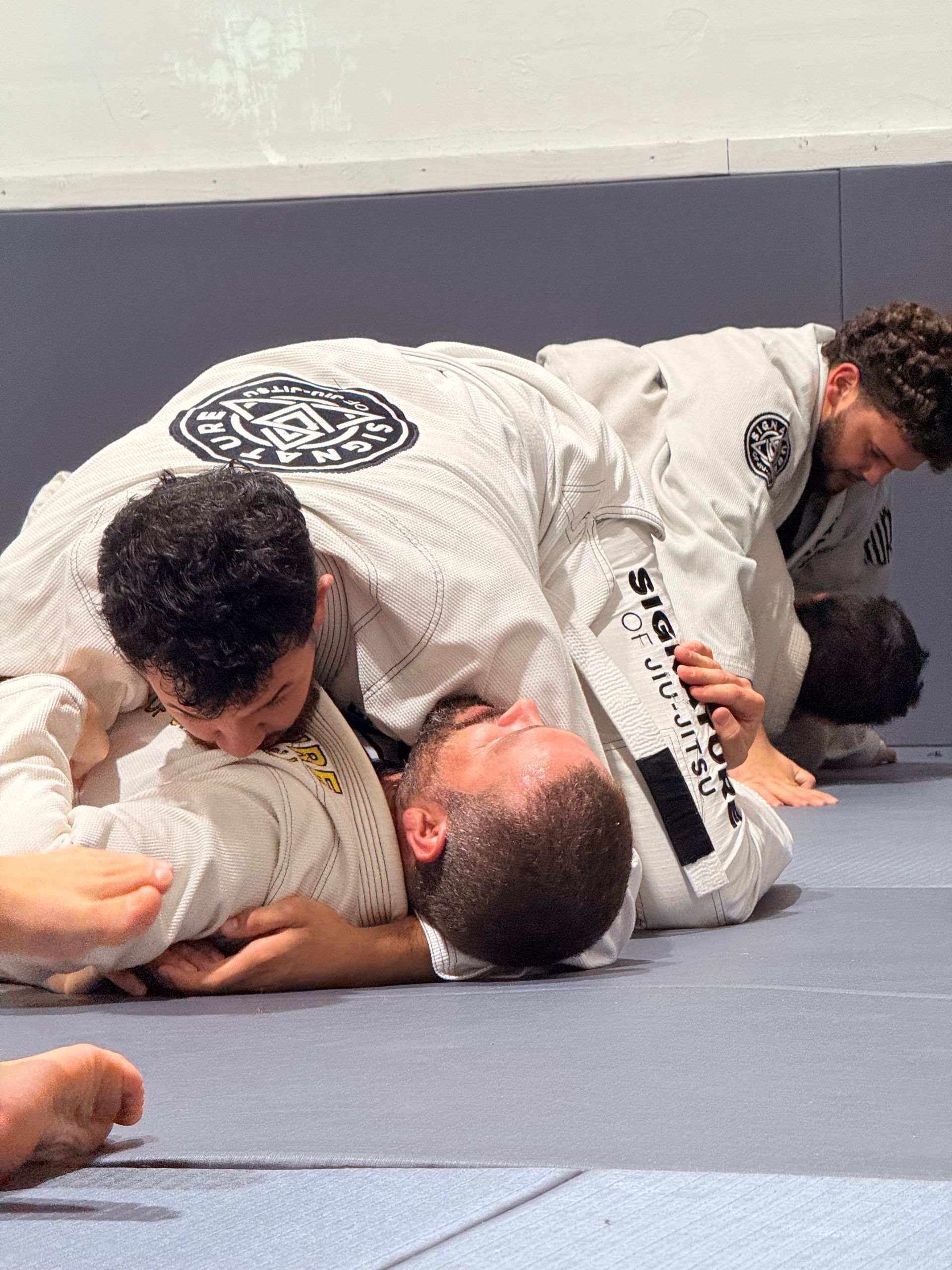
Grit is not hype. It is the ability to keep working when you do not instantly succeed. In Adult Jiu-Jitsu, you cannot fake that, because the mat gives immediate feedback. A technique either creates leverage or it does not. Your timing either holds up under pressure or it breaks. That honesty is part of why Brazilian Jiu-Jitsu builds resilience so reliably.
Research lines up with what we experience in class. As practitioners progress, measures of mental strength like resilience, self-efficacy, and self-control tend to rise, with advanced belts showing significantly higher levels of grit and life satisfaction than beginners. The point is not the belt itself. The point is what the long process requires: patience, consistency, and the willingness to be a beginner long enough to become skilled.
In practical terms, grit in Jiu-Jitsu in Belmont CA often shows up as:
- Returning after a hard class, not because it was fun, but because you learned something real
- Staying calm when you are pinned and your brain wants to panic
- Accepting correction without taking it personally
- Choosing technical improvement over “winning” a round
That kind of composure tends to bleed into the rest of your life. Meetings feel less intense. Conflict feels more workable. Even your posture changes a bit, like your nervous system remembers you can handle pressure.
Why Adult Jiu-Jitsu is a mental reset for Belmont professionals
Belmont is full of people who think for a living: engineers, product leaders, healthcare workers, educators, parents juggling everything. The irony is that many high performers spend all day in their heads, then try to unwind with something that still keeps them in their heads. Training flips that pattern.
A good Adult Jiu-Jitsu session pulls you into the present, fast. You have to notice grips, balance, breathing, and angles. You cannot multitask. That is where the stress reduction comes from for many adults over 30 and 40: the mind quiets down because it has to.
We also hear a consistent after-effect: better sleep, clearer focus, and a calmer mood on training days. Studies on martial arts participation and BJJ trends from 2021 to 2024 report noticeable gains in resilience and focus with consistent practice, often around twice per week. There is also evidence connecting training to positive mood shifts through neurochemicals tied to connection and well-being, which makes sense when you feel both challenged and supported in the same hour.
If your schedule is packed, this matters. Instead of needing a full weekend to recover from your week, you get small resets built into your routine. One class can feel like you hit “refresh” on your nervous system, even if your muscles are tired.
The physical side: strength, mobility, and joint-smart conditioning
Adult bodies come with histories. Old injuries, stiff hips from desk time, tight shoulders from stress, maybe a cranky knee from a sport you loved a decade ago. Adult Jiu-Jitsu can still be intense, but it is also adaptable. Because it focuses on leverage and positioning, you can train hard without relying on impact.
Physical benefits many adults notice over time include better mobility, stronger hips and core, improved balance, healthier posture, and more stable joints. The grappling itself builds real-world strength: pushing, pulling, framing, bridging, and rotating under control. Done correctly, those patterns support injury prevention because you develop body awareness. You learn where your limits are before you crash into them.
For over-40 students, circulation and conditioning gains can feel surprisingly meaningful. People sometimes mention improved energy and even a boost in confidence that carries into personal life, which tracks with broader findings around well-being improvements from consistent training. It is not magic. It is what happens when your body moves the way it was built to move, then your brain gets the message that you are capable.
How we make Adult Jiu-Jitsu approachable for beginners
Walking into a new gym can feel awkward. Most adults are not afraid of effort, but nobody loves feeling clueless in front of strangers. We build our beginner experience around one simple idea: you should feel challenged, not overwhelmed.
Here is what you can expect in a typical beginner-friendly pathway:
- Clear instruction on fundamentals like posture, base, and safe movement on the ground
- Technique-first drilling where you can learn at a steady pace
- Controlled rounds where intensity matches your experience level
- Coaching that prioritizes tapping early, staying safe, and learning positions
- A culture where questions are normal and progress is measured in small steps
We also pay attention to joint safety and recovery. That means smart warm-ups, realistic pacing, and encouraging you to train consistently rather than smash yourself once a week and disappear for a month. For most adults, the sweet spot is 2 to 3 classes per week, enough frequency to learn without beating your body up.
The grit-building timeline: what changes in weeks, months, and beyond
One of the best parts of Adult Jiu-Jitsu is that you do not have to wait forever to feel benefits. Some shifts happen quickly, while others show up quietly and then suddenly feel obvious.
A simple timeline many adults recognize looks like this:
1. First week: You feel humbled, but also oddly energized, and stress often drops right after class
2. First month: You start recognizing positions, breathing improves, and you stop tensing up as much
3. Months two to four: You notice better focus at work and more patience under pressure
4. Months five to eight: Conditioning and mobility become noticeable in daily movement, not just training
5. Long term: Grit becomes part of how you respond to challenges, not something you “turn on”
This is where the belt system matters psychologically. Progress is visible, but it is earned. Studies comparing skill levels in BJJ show that advanced practitioners tend to score higher in grit, resilience, and self-control than beginners. That does not mean beginners lack those traits. It means the process builds them, layer by layer.
Community matters more than most adults expect
A lot of adults are quietly lonely, even in busy places. You can have a full contact list and still feel like you do not belong anywhere outside of work or family roles. Training changes that because you share something real: effort, learning, and a little discomfort.
Grappling creates quick social bonds, partly because you are cooperating while you challenge each other. You learn to trust training partners with your safety, and that trust tends to turn into friendship. Research on martial arts communities shows strong reports of belonging and improved mental flexibility, especially among parents who value a supportive environment.
In our adult Jiu-Jitsu in Belmont group, you will see people encouraging each other through the hard parts: showing a new person how to tie a belt, checking in after a tough round, or laughing about how confusing side control felt at first. It is not forced. It grows naturally, which is the best kind.
Addressing the big concerns: age, schedule, stress, and safety
Am I too old to start Adult Jiu-Jitsu?
No. We coach plenty of beginners in their 30s, 40s, and beyond. Starting later just means we train intelligently: good technique, sensible intensity, and recovery that fits your life. You can still get strong, flexible, and confident without trying to train like a teenager.
How does it fit real life in Belmont?
We know commuting, family routines, and work cycles are real constraints. That is why the class schedule matters. When you can choose consistent weekly slots, training becomes sustainable instead of another thing you “should” do.
Does training help with stress and anxiety?
For many adults, yes. The combination of focused attention, physical exertion, and social connection is a powerful stress reset. People often describe leaving class calmer than when they arrived, even if they are physically tired. That is a win.
What about injuries?
There is always some risk in any physical activity, but we reduce it through coaching, controlled rounds, and a training culture that respects tapping and technique. Adult Jiu-Jitsu is also useful because it teaches body awareness. You learn how to move safely under pressure, which can make you less injury-prone in everyday life.
Take the Next Step
Building grit is not about flipping a switch. It is built through repeated, honest practice, in a room where you are allowed to struggle a little and improve a lot. That is exactly what we aim to provide, especially for adults who want something deeper than a workout and more practical than motivation.
If you are ready to experience Adult Jiu-Jitsu in a way that respects your body, challenges your mind, and supports your growth, we would love to welcome you at Signature of Jiu-Jitsu. You can start where you are, train at a pace that fits your life, and let the results stack up week by week.
Build stronger grappling skills and improve your technique by joining a Jiu-Jitsu class at Signature of Jiu-Jitsu.